



Malaysia suffers severe haze from Indonesian forest fires
Sep 18, 2026, 02:42 pm


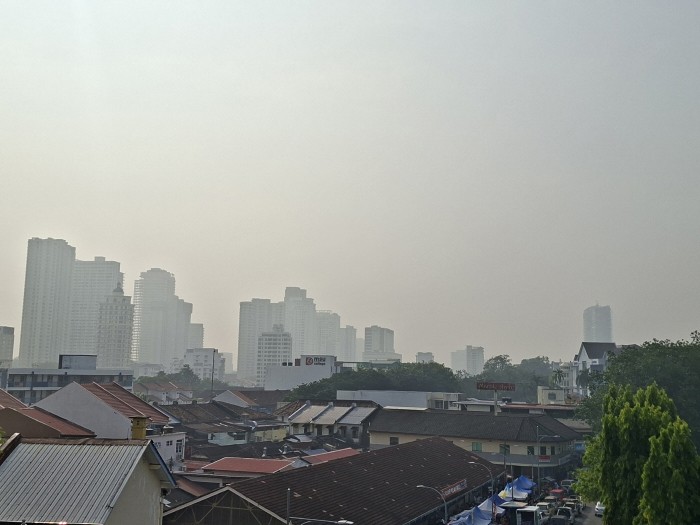 |
| The skies over downtown Penang, Malaysia, are blanketed in haze. / Kuala Lumpur Correspondent Hong Sung-a |
Air pollution across Malaysia has reached alarming levels as haze triggered by recent forest fires in Indonesia spreads nationwide.
With damages mounting, including a sharp spike in respiratory patients, the Malaysian government has stepped up efforts to seek measures in coordination with Indonesia to prevent recurring haze outbreaks.
According to the Malaysian daily The Star on the 17th, haze thickened further across Peninsular Malaysia the previous day, with 35 monitoring stations under the Air Pollutant Index Management System (APIMS) logging unhealthy levels as of 6:00 p.m., with Air Pollutant Index (API) readings soaring as high as 180.
Malaysia categorizes its API into five levels: 50 and below is "good," 51 to 100 is "moderate," 101 to 200 is "unhealthy," 201 to 300 is "very unhealthy," and 301 and above is "hazardous."
The worst-hit area was Johan Setia in Selangor (API 180), followed by Cheras (170) and Batu Muda (168) in Kuala Lumpur, Nilai in Negeri Sembilan (168), and Putrajaya (167).
Elevated pollution levels were also recorded across several other areas, including Seri Manjung and Shah Alam (166), Minden and Balik Pulau in Penang along with Tasek in Ipoh (164), Seremban (163), Petaling Jaya (161), and Kuala Terengganu (161).
In the East Malaysian state of Sarawak, a haze emergency was declared for the first time in seven years after the API in Serian spiked to 519 on the 4th, prompting the closure of 647 schools in the region.
From the 3rd to the 7th of this month, Sarawak authorities mobilized Royal Malaysian Air Force C-130 transport aircraft to conduct cloud seeding operations, spraying 7,200 liters of sodium chloride solution at altitudes of 5,000 to 7,000 feet.
While the API around Serian subsequently dropped back down to the 180 range, experts view the measure as merely a temporary stopgap rather than a fundamental solution.
The current haze is analyzed to stem from large-scale forest fires on the neighboring Indonesian islands of Sumatra and Kalimantan, carried into Malaysia by prevailing southwesterly winds.
These blazes are rated the most severe in 11 years since 2015. A severe dry season coinciding with a super El Niño triggered an explosion of wildfires, with up to 13,000 hotspots detected across Indonesia last month.
Haze damage typically occurs during the dry spell from June through October, with pollution peaking primarily in August and September. This year saw damage begin to surface last month as air quality deteriorated across Malaysia.
Respiratory cases are also climbing rapidly. According to the Malaysian Ministry of Health, reported asthma cases jumped from 219 between the 16th and 22nd of last month to 1,811 between the 23rd and 29th. Acute respiratory conditions such as bronchitis and upper respiratory infections have also surged substantially.
Public health specialist Dr. Zainal Ariffin Omar advised that "fine particles in the haze irritate the respiratory tract, leaving people far more vulnerable to viral and bacterial infections," emphasizing that "people must take extra precautions, including wearing masks when heading outdoors."
Professor Datuk Dr. Azizan Abu Samah of the Department of Meteorology at Universiti Malaya projected that "clear skies will likely return only in October, when the wind direction shifts."
The Malaysian Meteorological Department similarly anticipated that the haze impact will gradually ease as the southwest monsoon—which carries smoke from Indonesia to Malaysia through September—undergoes an inter-monsoon transition in October before shifting into the northeast monsoon by November, changing wind patterns.
Malaysian Deputy Prime Minister Ahmad Zahid Hamidi stressed that "prevention is far more crucial than treatment," underscoring that "diplomatic cooperation with Indonesia and the establishment of a long-term early warning system are urgently needed to stop recurring haze."
Hong Sung-a
Most Read
-
1
Celltrion’s Omlyclo gains ground in major European..

-
2
Trump demands rates fall below 1% as Fed hikes for..

-
3
Hyundai Motor Group breaks ground on integrated st..

-
4
U.S. strikes 3 Iranian oil tankers, Iran vows reta..

-
5
Trump makes $1 trillion bet ahead of midterm elect..

-
6
Iran resumes ballistic missile production, assembl..

-
7
Samsung Electronics, Mistral AI to jointly develop..

PEOPLE







-
Address : In-Young Bldg., 34, Uisadang-daero 1-gil, Yeongdeungpo-gu, Seoul
Copyright by ASIATODAY CO., LTD. All rights resereved