



World's top beef consumer Argentina sees per capita consumption drop to all-time low
Sep 18, 2026, 11:04 am


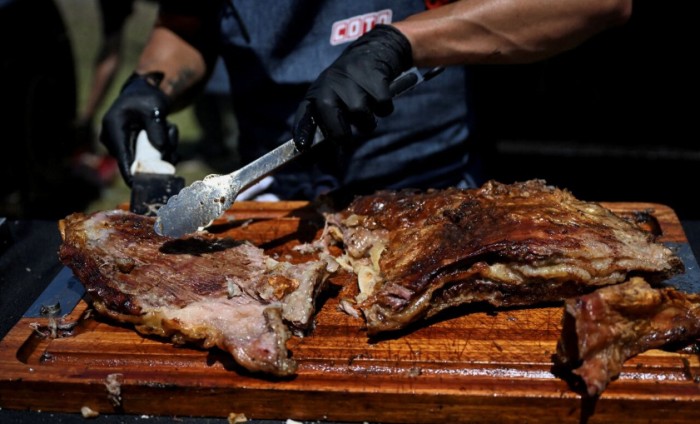 |
| A barbecue master cuts beef ribs at a barbecue festival held in San Isidro, Buenos Aires, Argentina, in November last year. / AFP, Yonhap |
Annual beef consumption has plunged in Argentina, the world's leading beef consumer per capita. The sharp drop is seen as a sign that consumers are feeling the pinch of soaring beef prices at the dinner table.
According to outlets including La Primera on the 16th (local time), the Chamber of Industry and Commerce of Meats and By-products of the Argentine Republic (CICCRA) reported that per capita beef consumption over the past 12 months stood at 46 kilograms as of last month.
This marks a 9.5% decline from 50.9 kilograms recorded in the same month last year, hitting the lowest level since the association began tracking the data in 2005. Compared to the 2005–2010 period, when annual per capita beef consumption exceeded 60 kilograms, the figure has tumbled by more than 20%.
Analysts say the downturn stems from steep price hikes caused by falling output. Between January and August this year, Argentina produced approximately 1.944 million metric tons of beef, down 6.8% from the same period last year.
The decline in production traces directly to fewer slaughter volumes. Over the first eight months of this year, cattle slaughter reached 8.13 million head, a 9.9% drop year on year.
Argentina, long renowned as a livestock powerhouse, has seen its herd shrink amid erratic weather patterns—including heavy rainfall that followed a historic drought in 2023—and is now grappling with the fallout of declining beef yields.
As output fell, retail prices shot up. In August this year, retail prices for popular cuts favored by Argentine consumers, such as ribs, surged by an average of 51.2% compared to the same period last year.
Frozen burger patties saw an even steeper increase of 56.6%. This outstripped the 32.2% headline inflation rate recorded over the same stretch by the National Institute of Statistics and Censuses (INDEC).
Soaring consumer prices were further fueled by expanding exports that catered to overseas demand. From January to August this year, Argentina exported 567,400 metric tons of beef, up 6.5% year on year.
Exports accounted for 29.2% of total production in August, up from 25.6% a year earlier, while the share destined for domestic consumption slipped from 74.5% to 70.8%.
In value terms, China was the largest importer of Argentine beef at $157.5 million, followed by the U.S. at $92.8 million and Israel at $89.7 million.
According to a report released last year by the Rosario Board of Trade compiling data from the World Health Organization (WHO) and other sources, Argentina topped global rankings with an annual beef consumption of 48 kilograms per capita. It was followed by Uruguay at 42 kilograms, Brazil at 39 kilograms, the U.S. at 38 kilograms, and Chile at 27 kilograms.
Local media outlets noted that in Argentina, a traditional stronghold of beef consumption, chicken consumption is on the rise as beef intake drops, highlighting how soaring prices are altering the national palate.
Son Young-sik
Most Read
-
1
Celltrion’s Omlyclo gains ground in major European..

-
2
Trump demands rates fall below 1% as Fed hikes for..

-
3
Hyundai Motor Group breaks ground on integrated st..

-
4
U.S. strikes 3 Iranian oil tankers, Iran vows reta..

-
5
Trump makes $1 trillion bet ahead of midterm elect..

-
6
Iran resumes ballistic missile production, assembl..

-
7
Samsung Electronics, Mistral AI to jointly develop..

PEOPLE







-
Address : In-Young Bldg., 34, Uisadang-daero 1-gil, Yeongdeungpo-gu, Seoul
Copyright by ASIATODAY CO., LTD. All rights resereved