



Hong Kong unveils first-ever five-year plan
Sep 17, 2026, 10:36 am


Hong Kong has unveiled its first-ever five-year economic and social development plan in alignment with mainland China's medium- and long-term national growth blueprint. The move can be interpreted as a step beyond China's "one country, two systems" framework, signaling an active embrace of the "One China" principle.
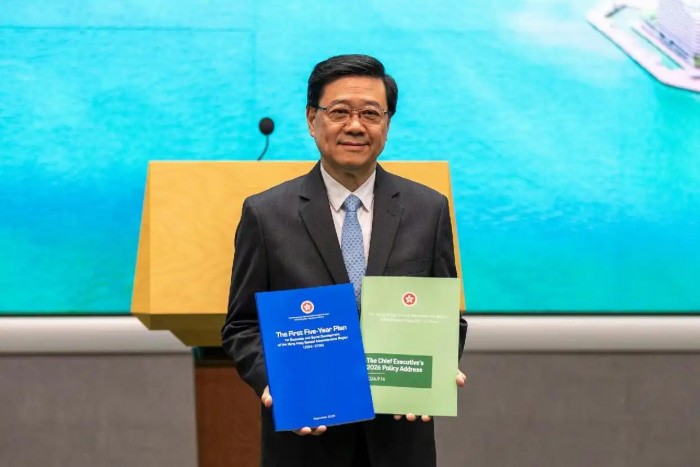 |
| Hong Kong Chief Executive John Lee unveils the city's first-ever five-year plan on the 16th, a move that can be seen as an official declaration that Hong Kong's economy will become increasingly subordinate to mainland China. / Xinhua News Agency |
According to a report on the 16th by China's state-run Xinhua News Agency, Hong Kong Chief Executive John Lee unveiled the "First Five-Year Plan for Economic and Social Development of the Hong Kong Special Administrative Region (2026–2030)" at the Legislative Council that day. In step with China rolling out its 15th Five-Year Plan (2026–2030) starting this year, Hong Kong has also set out its own medium- to long-term development roadmap for the same period.
The Hong Kong government explained that the initiative is intended to actively align with China's 15th Five-Year Plan and participate more deeply in national development. Consequently, Hong Kong is expected to establish an institutional framework, mirroring the mainland, that sets separate five-year medium- to long-term development goals and key policy directions.
After presenting the plan, Lee stated, "The period of the 15th Five-Year Plan presents a strategic window of opportunity for Hong Kong to achieve high-quality economic and social development," adding that "Hong Kong must seize this momentum to better integrate into and contribute to the broader picture of national development."
He further noted, "The five-year plan was drawn up to formulate medium- to long-term development strategies tailored to Hong Kong's actual conditions, clearly outlining the direction, tasks, targets, and major policies and initiatives."
According to Beijing sources well-versed in Greater China economic affairs on the 16th, the plan specifically lays out goals under the principle of fully implementing "one country, two systems," including forging new breakthroughs in economic growth, enhancing international competitiveness and influence, accelerating the development of the Northern Metropolis, and deepening alignment with national development strategies. To this end, strengthening the so-called "four centers"—international finance, shipping, trade, and innovation and technology—along with cultivating a hub for world-class talent, was also designated as a priority task.
Furthermore, the blueprint outlines plans to accelerate economic and industrial integration across Guangdong, Hong Kong, and Macao while expanding cooperation with neighboring mainland cities, including Shenzhen in Guangdong Province. In effect, it would not be far from the mark to conclude that Hong Kong's economy will become virtually subordinate to mainland China going forward.
Hong Soon-do
Most Read
-
1
U.S. Treasury Secretary Bessent publicly warns ove..

-
2
Celltrion’s Omlyclo gains ground in major European..

-
3
Hyundai Motor Group breaks ground on integrated st..

-
4
U.S. strikes 3 Iranian oil tankers, Iran vows reta..

-
5
S. Korea seeks redemption from World Cup setback w..

-
6
Trump makes $1 trillion bet ahead of midterm elect..

-
7
Iran resumes ballistic missile production, assembl..

PEOPLE







-
Address : In-Young Bldg., 34, Uisadang-daero 1-gil, Yeongdeungpo-gu, Seoul
Copyright by ASIATODAY CO., LTD. All rights resereved