



Could election in Philippines’ Muslim autonomous region end decades of bloodshed?
Sep 15, 2026, 02:22 pm


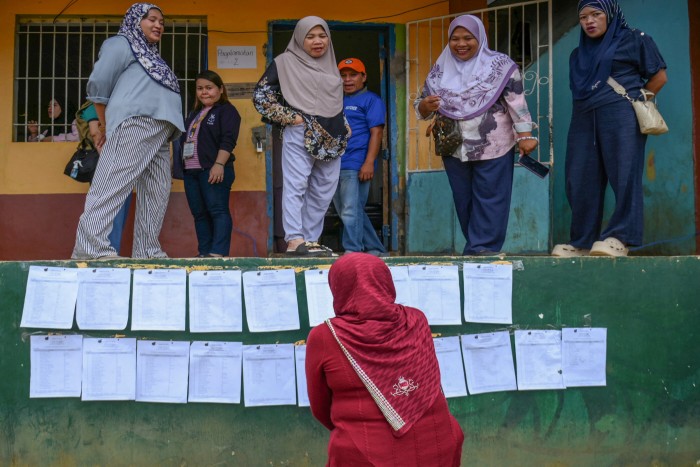 |
| A voter looks for a precinct number posted on a wall at a polling station in a school in Saguiaran on the southern Philippine island of Mindanao on Sept. 14 local time, as the region held its first-ever autonomous parliamentary election. / AFP-Yonhap |
Voting was held on Sept. 14 local time in the first-ever parliamentary election in the Bangsamoro Autonomous Region in Muslim Mindanao, or BARMM, in the southern Philippines. Tensions were high after a deadly shootout near a polling station the day before left three people dead, but under heavy security by police and military forces, the region took a historic first step toward ending half a century of armed conflict and transitioning to a permanent autonomous government.
According to local media and Reuters, an argument between rival political factions near a polling station in Cotabato City, Maguindanao del Norte, escalated into a gunfight on Sept. 13, a day before voting, leaving three people dead and 15 injured. The Philippine Commission on Elections, or Comelec, immediately placed Cotabato City under special control and took emergency measures including reprinting all ballots following allegations that some had been marked in advance. Around 20,000 police and military personnel were deployed for the vote, while polling stations experiencing delays were allowed to remain open until 9 p.m. Comelec said the voting process was generally peaceful despite sporadic clashes and confusion.
The election was held to end seven years of rule by the Bangsamoro Transition Authority, or BTA, and elect the first 80 members of the permanent autonomous parliament. The chamber consists of 40 party-list seats, 32 district seats and eight sectoral seats representing groups including women, youth and Indigenous peoples. About 2.3 million voters were eligible to participate.
Bangsamoro is the only region in the presidential system of the Philippines to operate under a parliamentary form of government. The newly elected parliament will choose a chief minister, the region’s head of government, by majority vote during its first official session.
The election marks the culmination of decades of bloody conflict and efforts to establish peace. In the predominantly Catholic Philippines, the Muslim-majority southern Mindanao region saw decades of separatist armed struggle over issues including resource distribution, land ownership and political autonomy, leaving more than 120,000 people dead and displacing more than 2 million.
The threat of extremism also peaked in 2017, when militants linked to the Islamic State seized the city of Marawi and held it for five months.
In response, the Philippine government and the Moro Islamic Liberation Front, or MILF, the country’s largest rebel group, signed a comprehensive peace agreement in 2014. The MILF abandoned its demand for full independence in exchange for broad autonomy.
The agreement was institutionalized through the passage of the Bangsamoro Organic Law, or BOL, in 2018. A transitional autonomous government was subsequently established following a 2019 plebiscite, ultimately leading to the region’s first regular election.
Philippine President Ferdinand Marcos Jr. described the election in a video address as “a historic milestone toward lasting peace and democratic self-rule in Bangsamoro, and a defining moment for the entire nation.”
Al Haj Murad Ebrahim, former interim chief minister and chairman of the MILF, who cast his ballot in the election, said, “Our people have long yearned for the day when they could choose their leaders with their own hands.”
The election, however, does not guarantee a complete and lasting peace settlement. The MILF last year temporarily suspended the final decommissioning of 14,000 of its fighters, arguing that the Philippine government had failed to fully deliver economic assistance and welfare commitments stipulated in the peace agreement.
Political divisions have also deepened within the MILF, with factions aligned with Murad and interim Chief Minister Abdulraof Macacua competing through two separate political parties.
Michael Henry Yusingco, a senior research fellow at the Ateneo Policy Center, said deeply rooted clan-based dynastic politics, recurring election violence and patronage-driven factional loyalties would pose the greatest challenges to the newly established parliamentary democracy.
Official election results are expected to begin taking shape as early as Sept. 15.
Jeong Ri-na
Most Read
-
1
U.S. Treasury Secretary Bessent publicly warns ove..

-
2
Celltrion’s Omlyclo gains ground in major European..

-
3
Hyundai Motor Group breaks ground on integrated st..

-
4
Russia faces warning signs over prolonged war econ..

-
5
Anti-Western solidarity strengthens amid Trump's e..

-
6
U.S. strikes 3 Iranian oil tankers, Iran vows reta..

-
7
S. Korea seeks redemption from World Cup setback w..

PEOPLE






-
Address : In-Young Bldg., 34, Uisadang-daero 1-gil, Yeongdeungpo-gu, Seoul
Copyright by ASIATODAY CO., LTD. All rights resereved