



Iran, UAE join BRICS declaration calling for restraint in Middle East conflict
Sep 14, 2026, 03:38 pm


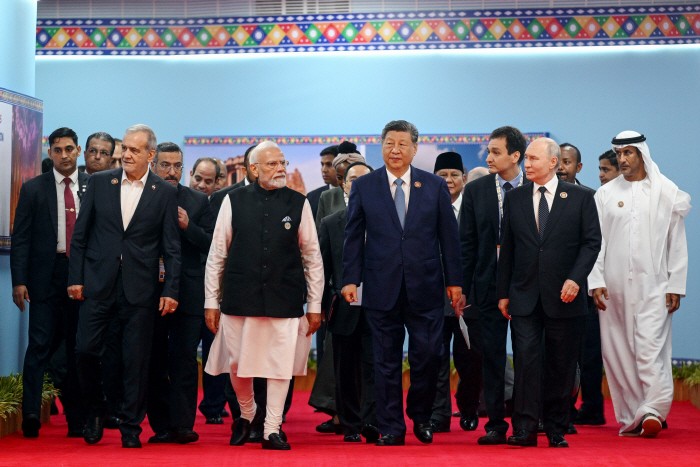 |
| From left in the front row, Iranian President Masoud Pezeshkian, Indian Prime Minister Narendra Modi, Chinese President Xi Jinping, Russian President Vladimir Putin, Indonesian President Prabowo Subianto, South African President Cyril Ramaphosa, Abu Dhabi Crown Prince Khaled bin Mohamed bin Zayed Al Nahyan and Ethiopian Prime Minister Abiy Ahmed Ali visit the “Innovative India” exhibition marking the 20th anniversary of BRICS in New Delhi, India, on Sept. 12 local time. / AP-Yonhap |
Iran and the United Arab Emirates signed a joint BRICS declaration on Sept. 12 local time calling on parties to exercise restraint over conflicts in the Middle East, Reuters reported.
On the first day of the two-day summit in New Delhi, Iranian President Masoud Pezeshkian held a separate meeting with Abu Dhabi Crown Prince Khaled bin Mohamed bin Zayed Al Nahyan. It marked the highest-level contact between the two countries since the Iran war broke out in February.
Iran has repeatedly carried out attacks targeting the UAE during the conflict. In late August, it targeted Al Minhad Air Base, where U.S. troops and helicopters are stationed.
The Abu Dhabi Media Office said on X, formerly Twitter, that the two sides discussed regional and international issues, de-escalation and ways to cooperate in promoting regional peace and stability, but did not disclose whether any specific agreement was reached.
The Iranian Embassy in India also released photos of the meeting but provided no details on the agenda.
The BRICS joint declaration adopted during the summit said the group was “deeply concerned about the continued escalation of tensions in the Middle East and West Asia” and called on all sides “to refrain from actions that could worsen the situation and to exercise maximum restraint.”
The declaration also stressed the importance of protecting civilians, respecting the sovereignty and territorial integrity of all countries, and maintaining global supply chains and maritime security.
Experts have focused on the fact that Iran and the UAE, which have been at odds amid the fallout from the war, were able to agree on wording acceptable to both sides in the joint declaration.
Sanjay Sudhir, a former Indian ambassador to the UAE, said the U.S. and Israel remain the key players in determining whether the war ends, but the summit helped preserve diplomatic channels among countries in the region.
Meanwhile, Indian Prime Minister Narendra Modi, whose country chairs BRICS, said in his opening remarks that the bloc had entered a more mature stage and emphasized reducing trade barriers and strengthening economic cooperation among member states.
Lee Jeong-eun
Most Read
-
1
U.S. Treasury Secretary Bessent publicly warns ove..

-
2
Celltrion’s Omlyclo gains ground in major European..

-
3
Hyundai Motor Group breaks ground on integrated st..

-
4
Russia faces warning signs over prolonged war econ..

-
5
Anti-Western solidarity strengthens amid Trump's e..

-
6
U.S. strikes 3 Iranian oil tankers, Iran vows reta..

-
7
S. Korea seeks redemption from World Cup setback w..

PEOPLE







-
Address : In-Young Bldg., 34, Uisadang-daero 1-gil, Yeongdeungpo-gu, Seoul
Copyright by ASIATODAY CO., LTD. All rights resereved