



French students post record-low scores in OECD PISA assessment
Sep 09, 2026, 05:21 pm


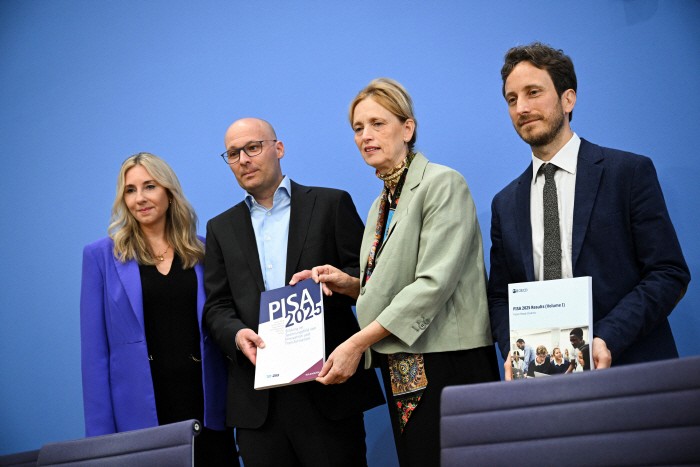 |
| Anna Stolz, Minister of Education and Cultural Affairs of Bavaria, Germany (from left); Samuel Greiff, head of the PISA National Center at the Technical University of Munich; Francesco Avvisati, OECD analyst; and Karin Prien, German Federal Minister of Education, Family Affairs, Senior Citizens, Women and Youth, pose for a photo at a press conference announcing the results of the OECD's Programme for International Student Assessment (PISA) 2025 in Berlin, Germany. / Reuters, Yonhap |
French students have recorded historic low scores in the Programme for International Student Assessment (PISA) released by the Organisation for Economic Co-operation and Development (OECD).
Citing the assessment results on the 8th (local time), local broadcaster BFM reported that the academic decline among French students has worsened across reading, mathematics, and science, cutting across all social classes and genders.
Scores in reading and mathematics dropped by 40 points each over the past decade. Eric Charbonnier, an analyst at the OECD Directorate for Education and Skills, expressed concern, stating that students' performance has dropped drastically over the past 10 years, and that the 40-point decline in reading and mathematics is equivalent to two years of schooling.
Students from affluent backgrounds were no exception to the downturn. Charbonnier explained that over the past decade, reading scores among wealthy students plunged by 50 points, while mathematics scores dropped by 28 points.
French students' mathematics achievement had already ranked 22nd among the 38 OECD member countries in 2023, drawing criticism over an unprecedented decline. Three years on, however, scores have shown no improvement, underscoring a persistent lack of progress in student achievement.
Charbonnier pointed out that the steep drop in reading scores inevitably spills over into other subjects, noting that deficiencies in literacy frequently prevent students from properly understanding mathematical word problems, leading to errors.
Another highlighted concern is parental disengagement. The proportion of students reporting that their families support them at home has fallen markedly across nearly all surveyed nations, including France.
According to the study, only 34 percent of parents regularly ask their children about school matters, while only 60 percent check in on their school life at least once or twice a week.
Charbonnier emphasized that parental involvement has dropped sharply since 2018, a trend shared across all socioeconomic strata, adding that academic support at home has a clear and positive impact on children's academic performance.
Conducted by the OECD, the PISA survey is the world's largest assessment of educational outcomes and international benchmarking study evaluating 15-year-old students across 91 countries. France has participated in the assessment since 2010, with more than 760,000 students worldwide taking part in last year's survey, including 6,501 French students.
Lim Yu-jeong
Most Read
-
1
U.S. Treasury Secretary Bessent publicly warns ove..

-
2
China overhauls National Defense Mobilization Law..

-
3
U.S. strikes Iran after a month, hits IRGC rocket..

-
4
Hyundai Motor Group breaks ground on integrated st..

-
5
Russia faces warning signs over prolonged war econ..

-
6
CIA director visits Russia, warns Moscow not to at..

-
7
Anti-Western solidarity strengthens amid Trump's e..

PEOPLE






HEADLINE NEWS
- U.S. strikes Iranian tanker again, retaliating for attack on American warships
- Canada enacts retaliatory tariffs up to 50% on U.S., deepening trade confli..
- 'Super El Niño' looms over Latin America, threatening food security and put..
- S. Korea and France sign 16 agreements and MOUs on defense, advanced tech

-
Address : In-Young Bldg., 34, Uisadang-daero 1-gil, Yeongdeungpo-gu, Seoul
Copyright by ASIATODAY CO., LTD. All rights resereved