



Kazakhstan pursues international satellite project
Sep 09, 2026, 10:18 am


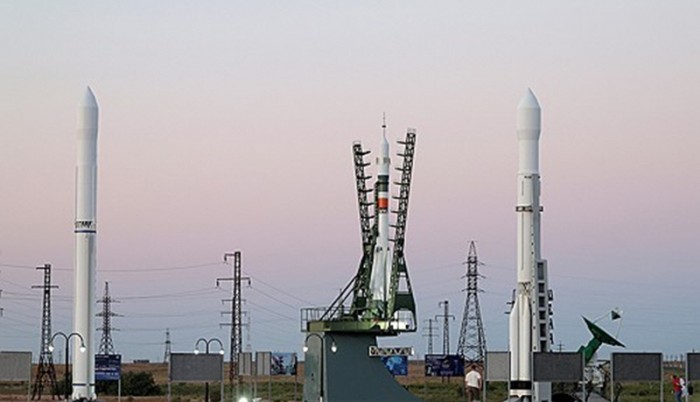 |
| People walk past a rocket model in Baikonur, Kazakhstan, on July 11. / EPA, Yonhap |
Kazakhstan is pursuing an international satellite project for Earth observation in partnership with Mongolia, the Republic of the Congo, and Nigeria.
According to a report by local news agency Kazinform, Kazakh Deputy Prime Minister Zhaslan Madiyev announced at the opening of the international space forum "Space Days Kazakhstan 2026" in Astana on the 7th that the country plans to establish an international constellation of nine Earth observation satellites by 2030. He added that Kazakhstan remains open to cooperation with new partners and sees the potential to expand the constellation to up to 14 satellites.
Under this project, Kazakhstan will provide six satellites, while Mongolia, the Republic of the Congo, and Nigeria will contribute one satellite each. Utilizing Earth remote sensing satellites, the constellation will monitor changes across agriculture, the environment, and natural resources.
Kazakhstan is already pursuing the co-production of domestically manufactured Earth observation satellites with Mongolia and the Republic of the Congo, while pursuing additional cooperation with Nigeria.
Kazakhstan's ability to drive this international collaboration in Central Asia, where advanced aerospace experience has historically been limited, is underpinned by its extensive history of space development anchored at the Baikonur Cosmodrome, founded by the Soviet Union in the 1950s.
Baikonur, the world's first operational space launch facility, served as the launch site for humanity's first artificial satellite, Sputnik 1, in 1957, as well as Yuri Gagarin's historic first crewed spaceflight in 1961.
As the Soviet Union's major crewed and uncrewed space missions continued to launch from Baikonur, the surrounding region accumulated extensive infrastructure and specialized personnel across launch vehicle and spacecraft operations, tracking, and communications.
Following the dissolution of the Soviet Union, Kazakhstan signed a lease agreement with Russia in 1994 to govern the continued operation of the Baikonur Cosmodrome. Through subsequent extensions, the lease period is slated to run through 2050.
While Russia has continued to utilize Baikonur as an active launch complex, Kazakhstan has steadily built up its own sovereign space development capabilities since independence.
In October 1991, Kazakh cosmonaut Tokhtar Aubakirov journeyed into space from Baikonur aboard the Soyuz TM-13 mission. He was followed by Talgat Musabayev, who completed three spaceflights in 1994, 1998, and 2001, while Aidyn Aimbetov took part in a mission to the International Space Station in 2015.
The legacy of fielding national cosmonauts paved the way for an institutional domestic space industry. Entering the 2000s, Kazakhstan expanded into satellite communications and Earth observation under the leadership of its national space agency.
In 2006, the nation's first telecommunications satellite, KazSat-1, was launched from Baikonur, followed by KazSat-2 in 2011 and KazSat-3 in 2014. In the Earth observation sector, Kazakhstan established a sovereign territory-monitoring system by deploying and operating KazEOSat-1 and KazEOSat-2.
The country has also secured domestic infrastructure to assemble and test satellites. At a spacecraft assembly and testing complex in Astana, engineers carry out satellite assembly alongside electrical, mechanical, thermal, and vacuum testing, strengthening domestic satellite manufacturing capabilities.
In satellite communications, development is underway on KazSat-3R, the successor to KazSat-3. With KazSat-3 expected to reach the end of its operational life by 2029, the follow-on spacecraft is designed to maintain uninterrupted operation of the national satellite communications network.
Kazakh telecommunications providers and government bodies utilize the KazSat network for broadcasting, data transmission, and internet services.
Kazakhstan's Earth observation satellite operations are also reaching into international partnerships. Since 2024, the nation has pursued overseas exports of domestically built satellites and secured formal agreements with Mongolia and the Republic of the Congo regarding joint satellite manufacturing.
Both partner nations are seeking to harness Kazakhstan's Earth observation technology to track developments across agriculture, environmental changes, and natural resource management.
Baikonur also holds historical ties to South Korea's space program. On April 8, 2008, Dr. Yi So-yeon, South Korea's first astronaut, launched to the International Space Station aboard a Russian Soyuz spacecraft from Baikonur.
In 2021, the Korea Aerospace Research Institute launched the Next-Generation Medium Satellite-1 from Baikonur aboard a Russian Soyuz-2.1a rocket.
Kim Min-gyu
Most Read
-
1
U.S. Treasury Secretary Bessent publicly warns ove..

-
2
China overhauls National Defense Mobilization Law..

-
3
U.S. strikes Iran after a month, hits IRGC rocket..

-
4
Hyundai Motor Group breaks ground on integrated st..

-
5
Russia faces warning signs over prolonged war econ..

-
6
CIA director visits Russia, warns Moscow not to at..

-
7
Anti-Western solidarity strengthens amid Trump's e..

PEOPLE






HEADLINE NEWS
- U.S. strikes Iranian tanker again, retaliating for attack on American warships
- Canada enacts retaliatory tariffs up to 50% on U.S., deepening trade confli..
- 'Super El Niño' looms over Latin America, threatening food security and put..
- S. Korea and France sign 16 agreements and MOUs on defense, advanced tech

-
Address : In-Young Bldg., 34, Uisadang-daero 1-gil, Yeongdeungpo-gu, Seoul
Copyright by ASIATODAY CO., LTD. All rights resereved