



South Korean students rank world's best in digital problem-solving, but reading scores drop
Sep 09, 2026, 09:30 am


 |
| /Ministry Education |
A shark and a turtle swim across a computer screen. Referring to a biologist's report and graphs in the left pane, a student must calculate at what feeding rate of sharks both species can coexist over a 10-year span, entering the result into the modeling pane on the right. This is a newly introduced question in the Programme for International Student Assessment (PISA) 2025. In the latest evaluation released by the Organisation for Economic Co-operation and Development (OECD), South Korean students achieved world-leading scores across most domains, including this novel assessment format.
The OECD announced the results of PISA 2025 on the 8th (French local time).
Approximately 760,000 15-year-old students from 91 countries participated in PISA 2025. In South Korea, 6,859 students across 196 schools took the test.
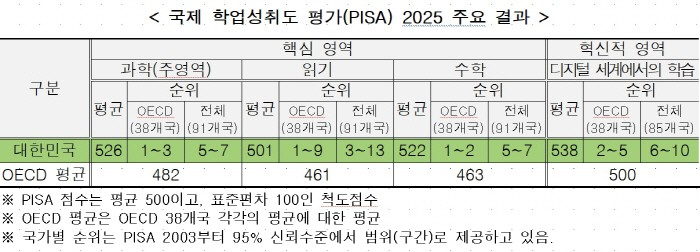
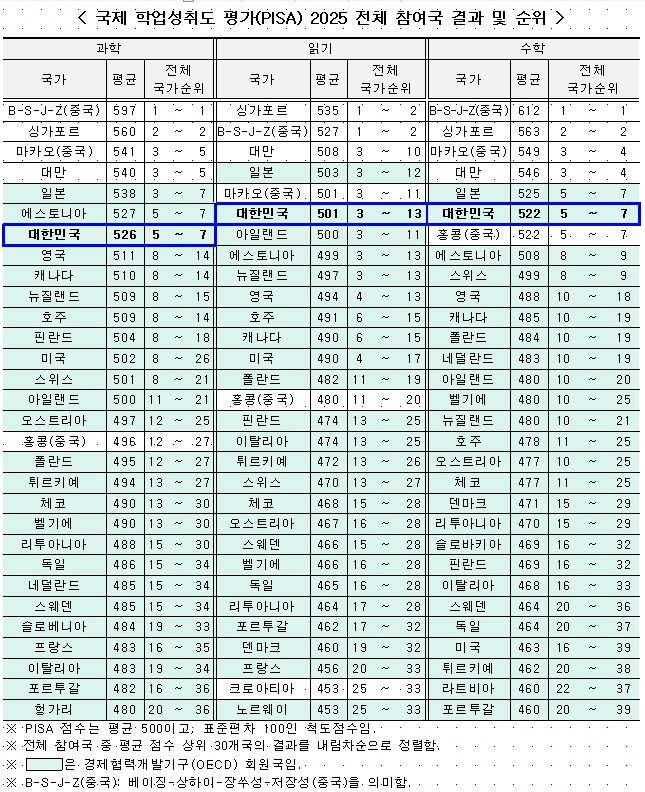
South Korea’s averages by subject stood at 526 in science, 501 in reading, and 522 in mathematics, all well above the OECD averages of 482 in science, 461 in reading, and 463 in mathematics. Among the 38 OECD member nations, South Korea ranked between 1st and 3rd in science, 1st and 9th in reading, and 1st and 2nd in mathematics. Across all 91 participating nations, it maintained top-tier positions, ranking 5th to 7th in science, 3rd to 13th in reading, and 5th to 7th in mathematics. Compared to the 2022 survey, however, average scores for science, reading, and mathematics fell across both OECD member nations and South Korea.
Rankings are presented in ranges rather than single ranks because PISA relies on sample-based surveys rather than full-scale censuses. An official from the Korea Institute for Curriculum and Evaluation (KICE) explained, "After measuring scores from sampled schools, we run 10,000 simulations at a 95% confidence level to estimate the national score. Through this process, the highest and lowest ranks that a country could occupy are calculated together." For instance, with only a one-point gap between South Korea's science average (526) and Estonia's (527), a nationwide estimation could flip their relative positions, which is why narrow differences within the margin of error are directly reflected as ranges.
South Korea excels in science, math, digital skills; educational equity and inclusion rate high
In computational problem-solving measured under "Learning in the Digital World (LDW)"—an innovative domain introduced for the first time in this cycle—South Korean students averaged 538 points, significantly surpassing the OECD average of 500. This placed South Korea between 2nd and 5th among OECD members and between 6th and 10th across all 85 participating countries in the module. LDW evaluates the ability to construct knowledge, identify and rectify errors, and solve problems using computational tools, comprising two subscales: modeling (identifying and predicting relationships among variables through simulations) and programming (composing code to solve real-world problems). As innovative domains are introduced anew each cycle, this module was administered only once, with the next cycle slated to measure capabilities in artificial intelligence (AI).
Educational equity indicators also proved high. The proportion reflecting the impact of parents' socioeconomic and cultural backgrounds on a student's science achievement was 7.7% in South Korea, notably lower than the OECD average of 11.6%, with this ratio declining across all domains compared to 2022. Conversely, inclusion—measured by the proportion of students achieving at or above baseline proficiency in science (80.1%)—and fairness—the degree to which students achieve evenly regardless of socioeconomic status (7.7%)—both outperformed OECD averages of 65% and 12%, respectively.
Reading scores decline OECD-wide amid digital media influence; reading and discussion programs expanded
Meanwhile, reading scores dropped from 515 in 2022 to 501 in 2025, and the proportion of high-achieving students (Level 5 or above) fell from 13.3% to 10.3%. The Ministry of Education assessed that this trend is not confined to South Korea.
A Ministry of Education official stated, "Reading scores fell in tandem across the globe, not just in South Korea. We presume this stems from a confluence of factors, including the pervasive digital media environment as well as this generation's motivation and attitudes toward reading." The official qualified, however, that it is difficult to attribute the decline to any single cause. The ministry explained that KICE plans to conduct follow-up analyses linking the results to contextual variables collected during the survey.
To reinforce literacy and mathematical competencies, the Ministry of Education announced plans to invigorate curriculum-linked reading education and expand programs fostering classroom cultures focused on inquiry and discussion. Specifically, the ministry will scale up its "Book-Reading School Culture" project from 1,000 schools this year to 3,000 next year, designate priority grades for reading education (grades 3-4, grade 7, and grade 10), and expand "Inquiring Schools" pilot programs from 104 schools this year to 308 next year. In addition, the ministry will ensure 100% nationwide deployment of intelligent science labs by 2027 and newly launch the STEM Step-In Project next year to strengthen fundamental competencies in science and mathematics.
Meanwhile, the PISA testing cycle will transition from three years to four years starting in 2029. An education ministry official remarked, "The next innovative domain will measure competencies in AI, which will offer a valuable opportunity to examine correlations with the current digital learning outcomes."
 |
/Ministry of Education Park Ji-sook |
Most Read
-
1
Celltrion nears additional contract with major U.S..

-
2
Putin proposes trilateral U.S.-China-Russia summit..

-
3
U.S. weighs dropping MOAB, world's most powerful n..

-
4
"Aren't those foreigners on welfare?": M..

-
5
Attention centers on APEC for possible Trump-Xi-Pu..

-
6
U.S., Israel plan to resume strikes on Iran after..

-
7
Saudi Arabia, Iran hold first diplomatic talks to..

PEOPLE






-
Address : In-Young Bldg., 34, Uisadang-daero 1-gil, Yeongdeungpo-gu, Seoul
Copyright by ASIATODAY CO., LTD. All rights resereved