



Substandard universities to be barred from hosting international students
Sep 08, 2026, 02:19 pm


 |
| International students try out pungmulnori (traditional Korean percussion music) at a second-semester club fair held at Ajou University in Suwon, Gyeonggi Province, on the 2nd. / Yonhap |
With the number of international students in South Korea surpassing 300,000, the Ministry of Education plans to shift the focus of its international student policy from quantitative expansion to improving educational quality and nurturing top talent.
The Ministry of Education announced on the 8th its "Innovation Strategy for Cultivating International Student Talent," which centers on tightening verification of academic credentials and oversight of study-abroad agencies, elevating universities' educational capabilities, and barring substandard universities from hosting international students.
According to basic education statistics released on the 27th of last month, the number of international students in Korea reached 307,464 in 2026, achieving the 300,000-student goal set under the "Study Korea 300K Project" formulated in July 2023 one year ahead of its 2027 target.
The international student population has maintained an annual growth rate in the 20% range, expanding from 182,000 in 2023 to 209,000 in 2024 (up 15%), 253,000 in 2025 (up 21%), and 307,000 in 2026 (up 21%).
To enhance transparency in recruitment and admissions, the Ministry of Education will draft and distribute standard agreement guidelines between universities and study-abroad agencies in the second half of this year.
The move comes amid growing reliance on recruitment agencies among prospective students, which has led to student damage from false or exaggerated advertising as well as fraudulent admissions using counterfeit degrees. In a National Research Foundation of Korea survey of 8,300 international students, 17.8% cited agency recommendations as a primary factor in choosing their university.
Visa Restrictions for Unaccredited and Financially Troubled Universities under Strict Management
The standard agreement will include student protection measures, such as providing accurate curriculum information and clear tuition refund policies. While it will initially take effect as an administrative recommendation, the ministry plans to make it mandatory through subsequent legal revisions.
An official from the Ministry of Education stated, "It is practically difficult for the government to directly sanction overseas agencies at present. We plan to clarify responsibilities between universities and agencies first, and then phase in broader oversight."
The ministry will also distribute guidelines for verifying foreign degrees to weed out forged credentials during transfer and freshman admissions, while expanding localized language information and one-stop application and screening fee payment services on the Study in Korea portal.
The International Education Quality Assurance System (IEQAS), which evaluates universities' capacity to educate and manage international students and links results to visa screening, will undergo structural reform. While institutions can currently choose certain evaluation indicators to earn accreditation, metrics essential to international student education and management will be converted into mandatory indicators. The official explained, "Student standards regarding dropout rates and certified language proficiency have been optional indicators until now, but they are critical for maintaining student quality." Specific indicator frameworks will be finalized in the second half of this year under the Basic Plan for the 5th Cycle of IEQAS.
Certified language proficiency benchmarks will also be raised incrementally. The share of incoming freshmen holding Test of Proficiency in Korean (TOPIK) Level 3 or higher and enrolled students holding Level 4 or higher—currently set at 40% or more as of 2026—will be raised to 60% by 2030. Evaluations of academic and student-life support programs will also be sharpened to prioritize substance and quality rather than operational tracking records.
Recruitment of international students by universities lacking baseline educational conditions will face much stricter curbs. Institutions that fail institutional accreditation evaluations or are designated as financially troubled private universities for two consecutive years will be classified directly into the lowest tier of the IEQAS framework, barring them from recruiting new international students. This represents an unprecedented institutional linkage.
Lee Nan-young, director general of the International Education Planning Bureau, explained the rationale for the two-year requirement, noting, "Financially troubled universities are in a different situation from unaccredited institutions; some retain educational capabilities and manage to overcome temporary financial crises." To allow an advance notice window, this linkage will take effect starting with the 5th cycle in 2029.
According to accreditation evaluation trends, the proportion of accredited universities has steadily increased from 8.6% in 2012 to 52.9% in 2025. However, the share of unaccredited institutions remains at 47.1% (38.7% general universities and 8.4% universities subject to tightened visa screening), indicating that nearly half of institutions still require improvement. On-site monitoring of substandard academic administration and human rights violations will also be reinforced.
To help international students prepare for careers after graduation, the ministry will expand university-community exchange initiatives and strengthen 24-hour native-language AI chatbot counseling linked with professional advisers.
To secure human resources in advanced industries and regional sectors, the selection quota for natural sciences and engineering under the Global Korea Scholarship (GKS) will rise from 40.9% in 2025 to 45% by 2027, with expanded support enabling outstanding master's scholars to continue into doctoral programs. Starting in 2027, an accreditation system for outstanding academic departments for global talent will be introduced to identify departments featuring curricula linked with regional industries and strong records of student regional employment and settlement, with selection prioritized outside the capital region.
Minister of Education Choi Kyo-jin said, "Surpassing 300,000 international students demonstrates that South Korea is recognized as a competitive destination by global talent. Going forward, we will concentrate on attracting and cultivating high-caliber individuals, supporting international students so they can thrive in our society and across the world based on their studies and experiences in Korea, and further elevating the standing of K-Education."
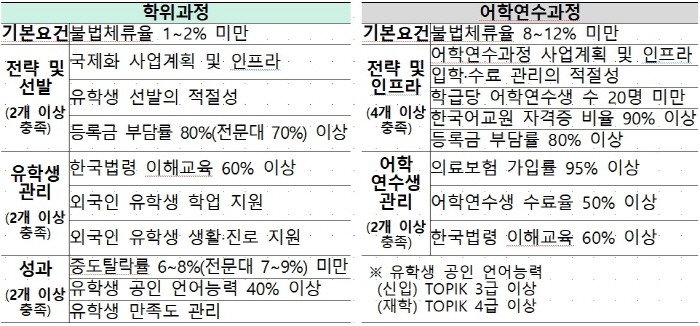 |
| Key Highlights of the Innovation Strategy for Cultivating International Student Talent / Ministry of Education |
Park Ji-sook
Most Read
-
1
Celltrion nears additional contract with major U.S..

-
2
Putin proposes trilateral U.S.-China-Russia summit..

-
3
U.S. weighs dropping MOAB, world's most powerful n..

-
4
"Aren't those foreigners on welfare?": M..

-
5
Attention centers on APEC for possible Trump-Xi-Pu..

-
6
Saudi Arabia, Iran hold first diplomatic talks to..

-
7
U.S., Israel plan to resume strikes on Iran after..

PEOPLE







-
Address : In-Young Bldg., 34, Uisadang-daero 1-gil, Yeongdeungpo-gu, Seoul
Copyright by ASIATODAY CO., LTD. All rights resereved