



KMA transfers Korean numerical weather prediction technology to five African nations
Sep 08, 2026, 09:23 am


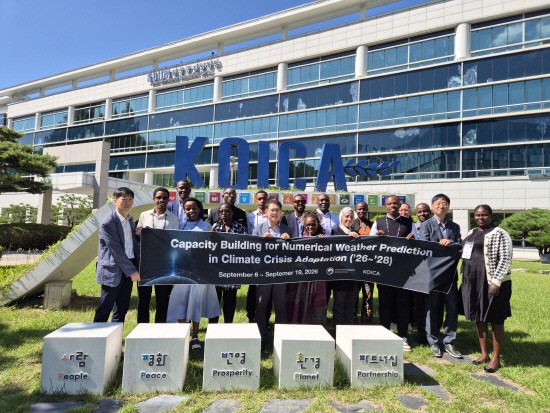 |
| Participants in the "Capacity Building Program on Numerical Weather Prediction Model Application for Climate Crisis Response" attend an opening ceremony at the Korea International Cooperation Agency Training Center in Seongnam, Gyeonggi Province, on the 7th. / Korea Meteorological Administration |
The Korea Meteorological Administration is set to transfer advanced technologies, including the Korean Integrated Model (KIM) and artificial intelligence models, to five African nations. The initiative forms part of the global early warning system project led by the World Meteorological Organization (WMO).
The KMA is running the first-year invitational training program, titled "Capacity Building Program on Numerical Weather Prediction Model Application for Climate Crisis Response," for two weeks from the 7th to the 18th at the Korea International Cooperation Agency Training Center. The session brings together 15 weather forecasting and numerical modeling specialists from Kenya, Liberia, Rwanda, Tunisia, and Uganda.
The program was prepared to support the "Early Warnings for All (EW4All)" initiative spearheaded by the WMO. South Korea is the ninth country in the world to develop an independent numerical weather prediction model and serves as a designated WMO Regional Training Center. Through this role, the agency aims to transfer advanced expertise to developing countries to enhance their capabilities in utilizing numerical prediction models.
Numerical weather prediction is a technology that calculates future weather by utilizing observational data along with physical and mathematical equations governing the atmosphere, serving as a vital tool for predicting severe weather such as torrential downpours, droughts, and heatwaves.
The 47-hour curriculum covers fundamental numerical prediction concepts, KIM, observational data utilization and data assimilation, ensemble and very-short-range numerical forecasting models, AI model applications, operational numerical prediction system management, and forecast performance verification.
Beyond classroom lectures, participants will share the operational status of their respective national observation networks and forecasting systems, taking part in hands-on exercises to build regional numerical forecasting setups tailored to their domestic conditions. They are also scheduled to tour the National Meteorological Supercomputer Center and the National Meteorological Satellite Center to observe South Korea's advanced facilities and operating infrastructure for weather forecasting production.
Starting with this year's program, the KMA plans to run numerical model training courses for developing countries across a three-year period through 2028.
KMA Administrator Lee Mi-sun noted, "In an era of climate crisis, enhancing collective response capabilities across the globe is just as critical as advancing a single country's meteorological technology," adding, "We will actively share South Korea's advanced numerical forecasting model technologies and expertise with the international community."
Kim Hong-chan
Most Read
-
1
Celltrion nears additional contract with major U.S..

-
2
Putin proposes trilateral U.S.-China-Russia summit..

-
3
U.S. weighs dropping MOAB, world's most powerful n..

-
4
"Aren't those foreigners on welfare?": M..

-
5
Attention centers on APEC for possible Trump-Xi-Pu..

-
6
Saudi Arabia, Iran hold first diplomatic talks to..

-
7
U.S., Israel plan to resume strikes on Iran after..

PEOPLE







-
Address : In-Young Bldg., 34, Uisadang-daero 1-gil, Yeongdeungpo-gu, Seoul
Copyright by ASIATODAY CO., LTD. All rights resereved