



Foreign media closely watch S. Korea weighing troop deployment to Strait of Hormuz
Sep 07, 2026, 05:26 pm


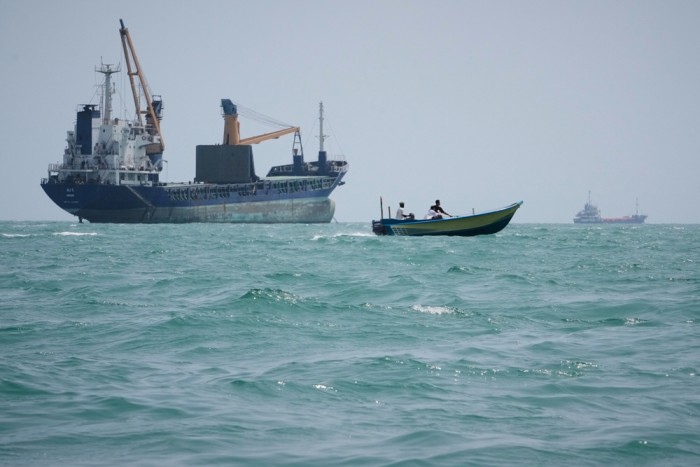 |
| Sailors in a motorboat pass near cargo vessels anchored in the Strait of Hormuz off Bandar Abbas, Iran, on the 6th (local time). / AP, Yonhap |
As South Korea weighs military contributions to the Strait of Hormuz at the request of the U.S., foreign media outlets are closely assessing the diplomatic and security trade-offs of a potential troop deployment.
While benefits are expected in strengthening the South Korea-U.S. alliance and securing energy supplies, concerns are emerging that actual deployment could strain South Korea's military readiness on the Korean Peninsula and expose it to risks of direct confrontation with Iran.
According to reporting compiled by Asia Today on the 7th, military assets under review for deployment to the Strait of Hormuz include maritime patrol aircraft, combat support ships, and mine detection and clearance units.
Deploying the P-8 Poseidon maritime patrol aircraft in particular would mark its first overseas operational mission since its induction, while dispatching naval combat support vessels for rear logistics is also reportedly on the table.
Reuters analyzed that South Korea could reap diplomatic and trade benefits by signaling to Washington its willingness to share responsibilities as an ally.
Ban Kil-joo, a professor at the Center for International Security Studies at the Korea National Diplomatic Academy, told Reuters that deployment would help South Korea manage alliance risks and solidify its position as an exemplary U.S. ally at a time when Washington demands greater contributions from its partners.
Professor Ban added that the deployment options under consideration represent medium-intensity contributions, allowing South Korea to demonstrate support for international efforts in the Strait of Hormuz without directly participating in combat operations.
The Guardian highlighted South Korea's mounting pressure from Washington to deploy forces, citing Seoul's heavy dependence on Middle Eastern energy and several pressing issues within the bilateral alliance.
Last year, 61% of South Korea's crude oil imports transited the Strait of Hormuz, alongside 54% of its naphtha imports.
With key issues entangled between Seoul and Washington—including the implementation of South Korea's pledged 350 billion-dollar investment in the U.S. and intelligence-sharing on North Korea—the troop deployment issue is emerging as another variable in bilateral ties.
Conversely, deployment entails military burdens and risks of clashing with Iran. Al Jazeera noted that South Korea faces mounting deployment pressure from its primary ally, the U.S.
Notably, U.S. President Donald Trump downscaled the joint military exercise Ulchi Freedom Shield last month, citing South Korea's lack of participation in U.S. military operations against Iran among other factors.
At the time, President Trump cited exercise costs and the need to avoid sending hostile signals to North Korea as justification.
South Korea has previously deployed military forces to the Strait of Hormuz at Washington's request.
Following U.S. calls to protect oil tankers in late 2019, Seoul expanded the operational remit of the Cheonghae Unit—which had been operating in the waters off Somalia—to encompass the Strait of Hormuz the following year.
A senior Iranian official recently warned via Al Mayadeen, a Lebanese media outlet affiliated with Hezbollah, that Iran would consider any South Korean action against it in the Strait of Hormuz as direct military aggression against Iran and participation in war.
Kim Hyun-min
Most Read
-
1
Celltrion nears additional contract with major U.S..

-
2
Putin proposes trilateral U.S.-China-Russia summit..

-
3
U.S. weighs dropping MOAB, world's most powerful n..

-
4
"Aren't those foreigners on welfare?": M..

-
5
Attention centers on APEC for possible Trump-Xi-Pu..

-
6
Saudi Arabia, Iran hold first diplomatic talks to..

-
7
Saudi airport in Riyadh struck again, leaving at l..

PEOPLE







-
Address : In-Young Bldg., 34, Uisadang-daero 1-gil, Yeongdeungpo-gu, Seoul
Copyright by ASIATODAY CO., LTD. All rights resereved