



Next year's national heritage budget set at 1.6645 trillion won to foster 'K-Heritage'
Sep 07, 2026, 09:26 am


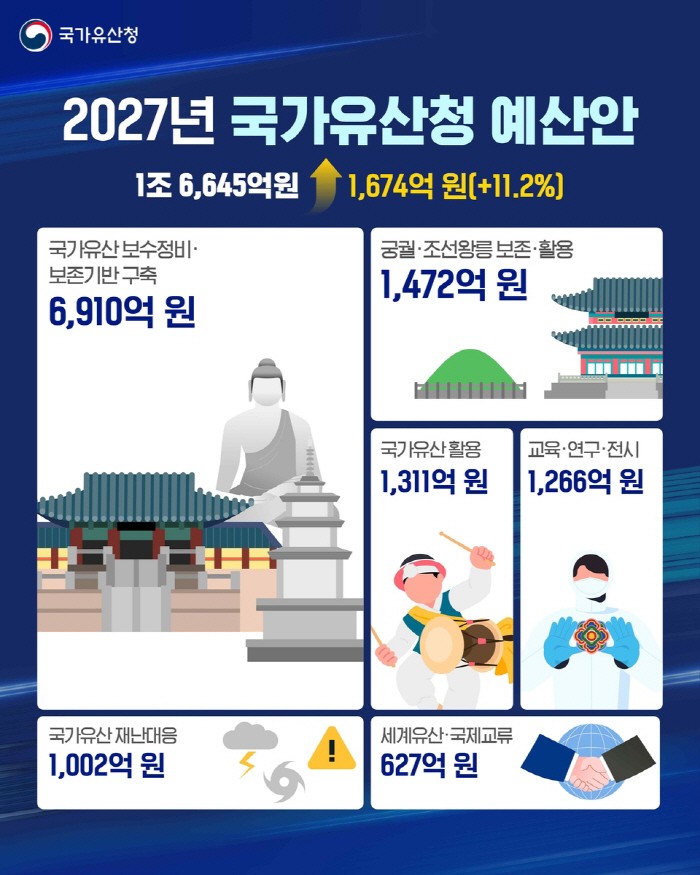 |
| 2027 budget proposal for the Korea Heritage Service. / Korea Heritage Service |
The Korea Heritage Service has allocated 1.6645 trillion won for next year's national heritage budget, an 11.2% increase from this year. Beyond merely preserving and managing national heritage, fiscal resources will focus on expanding infrastructure for experiencing and staying overnight near local heritage sites, while spearheading the globalization of "K-Heritage" centered around royal palaces.
The Korea Heritage Service announced on the 4th that the government's 2027 draft budget and fund operation plan passed the Cabinet meeting on the 1st. Next year's budget represents an increase of 167.4 billion won from this year's 1.4971 trillion won. Aligning with the government's fiscal efficiency drive, the agency conducted expenditure restructuring worth 193 billion won, including support for national heritage landscape improvements, while planning to reinvest the saved funds into safety, vulnerable sectors, regional revitalization, and elevating the nation's brand value.
By sector, maintenance and establishment of preservation infrastructure received the largest share at 691 billion won. This was followed by 147.2 billion won for the preservation and utilization of palaces and royal tombs of the Joseon Dynasty, 131.2 billion won for heritage utilization, 126.6 billion won for education, research, and exhibitions, 100.2 billion won for disaster response, and 62.7 billion won for World Heritage and international exchanges.
A notable initiative is a project linking national heritage with regional tourism to create stay-based travel content. As a newly launched project with an allocation of 6.1 billion won next year, "National Heritage Stay" will develop lodging infrastructure across 10 traditional historic houses designated as national heritage, while establishing integrated branding and service standards. By developing programs linked to surrounding heritage sites, the initiative aims to expand heritage tourism from mere sightseeing to immersive overnight experiences.
The "National Heritage Rest Project," which utilizes heritage sites endowed with historical ruins and natural surroundings as public relaxation spaces, will also be newly launched. A total of 1.5 billion won will be invested across five locations: Hyeonchungsa Shrine in Asan, Chilbaeg-uichong in Geumsan, Manin-uichong in Namwon, Gwangneung Royal Tomb in Namyangju, and Uireung Royal Tomb in Seoul. Alongside this, projects utilizing local heritage as tourism and cultural assets—such as heritage-based attraction regeneration, revitalizing K-folk villages, and promoting historic cultural zones—will be expanded.
Investment in national heritage safety management is also set to increase. A total of 520.1 billion won will be allocated for heritage repairs and maintenance, alongside 170.9 billion won for preservation infrastructure, 35.3 billion won for disaster safety management, and 13.9 billion won for emergency repairs. To reinforce continuous preservation and management systems, 22.1 billion won will go toward heritage care projects and 26.5 billion won toward disaster prevention systems at royal palaces and tombs.
Sectors that previously received comparatively less policy support, such as natural and intangible heritage, will also see expansion. New spending includes 3.3 billion won for the construction of the National Natural Heritage Center, 16 billion won for a branch of the National Intangible Heritage Center, 16.6 billion won for the Children's Intangible Heritage Center, and 16.2 billion won for intangible heritage activation projects.
Initiatives to raise overseas awareness of K-Heritage will also be strengthened. Allocations include 10.1 billion won for establishing the International Centre for the Interpretation and Presentation of World Heritage Sites under the auspices of UNESCO, 9.1 billion won for cultural heritage Official Development Assistance (ODA), and 1 billion won for the Busan World Heritage International Forum. New international exchange projects, including underwater heritage cooperation with Vietnam and exhibitions commemorating outcomes from the South Korea-Mongolia summit, will also be pursued.
In particular, royal palaces, which have drawn surging interest from foreign tourists, will be developed into global tourism assets. The Korea Heritage Service aims to surpass 7 million foreign visitors to royal palaces and Joseon royal tombs by 2027, upgrading viewing infrastructure and expanding visitor content. It will commit 10 billion won to the Royal Culture Festival, 6.3 billion won to the Guard Changing Ceremony, and 5.1 billion won to nighttime palace exploration programs, while expanding community-linked heritage programs.
Efforts will also go toward building tourism brands centered on national heritage. A total of 1.7 billion won will support the K-Pungryu tourism brand utilizing scenic historic trails, 1 billion won will revitalize K-folk villages, and 1.5 billion won will fund regional exhibitions on royal court culture. Gyeongbokgung Palace will see 11 billion won invested to establish a flagship souvenir and merchandise hall for national heritage.
Support for livelihoods and youth employment was also included. State funding for small-scale excavation surveys will expand from 517 cases this year to 660 cases next year, with the related budget rising to 22.3 billion won. A 1.6 billion won investment in national heritage industrial internships will provide six-month jobs for 100 individuals, while supporting 60 personnel dedicated to preserving and utilizing unorganized buried cultural artifacts.
Through next year's budget, the Korea Heritage Service plans to realize "national heritage protected together with the public, advancing toward the future and the world." An agency official stated, "Beyond mere conservation, we focused on using national heritage as a place of rest for citizens and an asset for regional growth, while extending the global brand value of our heritage as the root of K-Culture."
The 2027 Korea Heritage Service draft budget will be finalized after review and approval by the National Assembly.
Jeon Hye-won
Most Read
-
1
Celltrion nears additional contract with major U.S..

-
2
Putin proposes trilateral U.S.-China-Russia summit..

-
3
U.S. weighs dropping MOAB, world's most powerful n..

-
4
"Aren't those foreigners on welfare?": M..

-
5
Attention centers on APEC for possible Trump-Xi-Pu..

-
6
Saudi Arabia, Iran hold first diplomatic talks to..

-
7
Saudi airport in Riyadh struck again, leaving at l..

PEOPLE







-
Address : In-Young Bldg., 34, Uisadang-daero 1-gil, Yeongdeungpo-gu, Seoul
Copyright by ASIATODAY CO., LTD. All rights resereved