



Political circle locks horns over review of troop deployment to Strait of Hormuz
Sep 07, 2026, 09:06 am


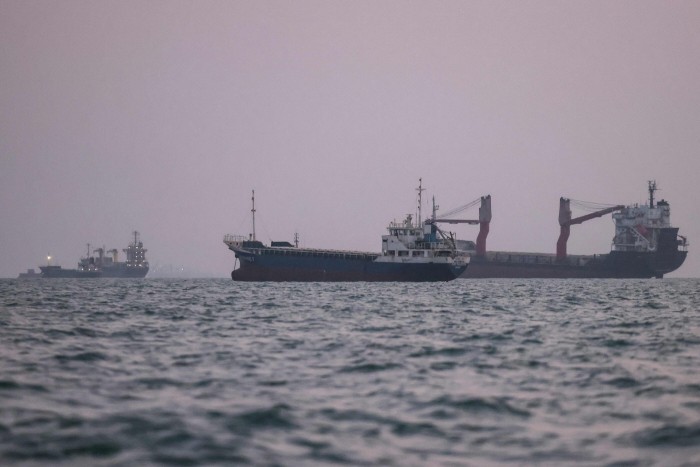 |
| Ships pass through the Strait of Hormuz off the coast of the southern port city of Bandar Abbas, Iran, on the 5th (local time). Meanwhile, a high-ranking Iranian security and political official warned that if South Korea engages in military activities against Iran in the Strait of Hormuz, it will be regarded as South Korea's military participation in an aggressive war waged by the U.S. and Israel against Iran. / AFP-Yonhap |
With the government reviewing troop deployment to the Strait of Hormuz, political skirmishes are also intensifying. The People Power Party stepped up its offensive, slamming the move as "testing-the-waters diplomacy" and a "belated reaction," claiming the government pulled out the deployment card late only after being pushed by U.S. pressure. In contrast, the Democratic Party of Korea stepped back from its past hardline opposition, advocating caution while emphasizing the gathering of opinions within the National Assembly. With public voices of opposition also emerging from parts of the broader ruling bloc, the ruling party appears to be having difficulty settling on a unified stance.
According to political circles on the 6th, leadership of the Democratic Party maintains the position that it will monitor National Assembly discussions, given that specific deployment guidelines have not yet been presented by the government. Chief Spokesperson Park Sung-joon said, "Opinions from the standing committee must be thoroughly gathered," adding, "It would be best to first review the views emerging from the National Defense Committee." Floor Spokesperson Lee Ju-hee also stated, "It seems this needs to be discussed in the National Defense Committee."
The Democratic Party has historically displayed a cautious attitude toward military intervention in overseas conflicts. Even during the 2003 vote on the consent motion for troop deployment to Iraq, opinions were split within the party. Furthermore, when the Yoon Suk Yeol administration pursued dispatching an observer delegation to Ukraine last year, the party strongly opposed it, defining it as "de facto troop deployment."
However, this time, voices opposing the government's review of troop deployment itself are emerging one after another from the Democratic Party and progressive parties aligned with the broader ruling bloc. Representative Lee Ki-heon of the Democratic Party stated, "Under no pretext can our military's deployment to the Strait of Hormuz be tolerated," adding, "If a motion requesting consent for deployment comes to the National Assembly, I will not consent."
The Rebuilding Korea Party also voiced opposition, stating, "Even the Yoon Suk Yeol administration did not openly dispatch troops to the war in Ukraine." The Progressive Party likewise remarked, "What President Lee Jae-myung should be doing now is stopping the war, not participating in the war in Hormuz."
Within the Democratic Party, anti-deployment sentiment was the mainstream just a few months ago. In March, former Supreme Council member Hwang Myung-sun criticized the idea, saying, "Those in favor should volunteer first as the advance team alongside their own children," and Representative Boo Seung-chan noted that "most Democratic Party lawmakers oppose troop deployment."
The People Power Party intensified its offensive, arguing that the government's response came far too late. Leader Jang Dong-hyeok criticized the administration, remarking, "More than six months have passed since the U.S. requested cooperation. Even if troops are sent now, could we even expect a word of thanks?" He added, "Diplomacy that begins to move only after receiving a warning from an ally is not strategy, but a day late and a dollar short."
Representative Ahn Cheol-soo of the National Assembly's Foreign Affairs and Unification Committee said in response to the ruling bloc's voices against deployment, "It is obvious that they will package 'anti-deployment' as personal conviction and act like 'armchair pacifists.'" He added, "The president should first clamp down on the security self-sabotage orchestrated by these armchair pacifists."
Cho Yong-sul, spokesperson for the People Power Party, urged in a commentary that day, "The Lee Jae-myung administration's tactic of testing the waters regarding deployment has turned into 'diplomacy that pleases no one' by doing nothing but reading the room of the U.S., Iran, and hardline supporters," calling on the administration to "engage in principled diplomacy based on national interest and conviction."
Lee Chae-ri
Most Read
-
1
Celltrion nears additional contract with major U.S..

-
2
Putin proposes trilateral U.S.-China-Russia summit..

-
3
U.S. weighs dropping MOAB, world's most powerful n..

-
4
"Aren't those foreigners on welfare?": M..

-
5
Attention centers on APEC for possible Trump-Xi-Pu..

-
6
U.S., Israel plan to resume strikes on Iran after..

-
7
Saudi Arabia, Iran hold first diplomatic talks to..

PEOPLE







-
Address : In-Young Bldg., 34, Uisadang-daero 1-gil, Yeongdeungpo-gu, Seoul
Copyright by ASIATODAY CO., LTD. All rights resereved