



Spanish prime minister denies Moroccan involvement in Ceuta border crossing crisis
Sep 04, 2026, 05:15 pm


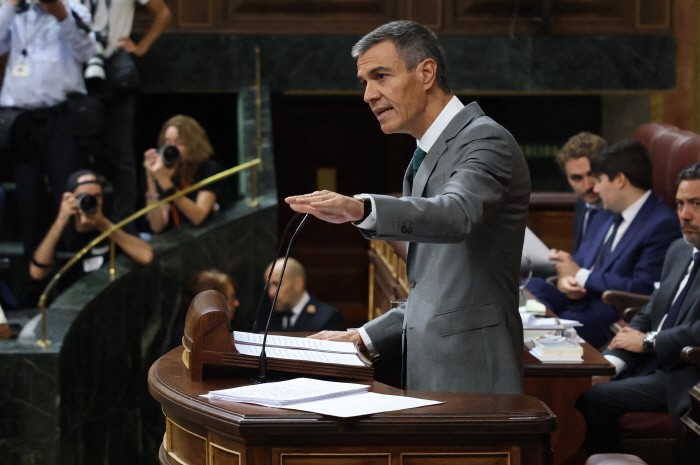 |
| Spanish Prime Minister Pedro Sánchez speaks before the Congress of Deputies in Madrid on the 3rd (local time) regarding the government's response to the situation in the Spanish North African enclave of Ceuta, following a massive influx of migrants in July. / AFP-Yonhap |
Spanish Prime Minister Pedro Sánchez stated that there is no evidence that the Moroccan government was systematically involved in the massive border-crossing incident that occurred in the Spanish North African enclave of Ceuta in July. This stance contradicts findings from a Spanish police investigation that raised the possibility of Moroccan authorities' connivance and planning, sparking controversy.
According to Reuters, Prime Minister Sánchez appeared before the Spanish parliament on the 3rd (local time) and refuted findings in a Spanish police report that the mass entry of more than 70,000 Moroccans into Ceuta in July had been planned in advance to neutralize border controls.
Prime Minister Sánchez stated, "Neither diplomatic authorities, the European Commission, nor any other international organization has presented concrete evidence to the Spanish government that Morocco planned and carried out this incident."
However, he acknowledged that Moroccan police left the border crossing unattended for about 10 hours on July 30, when the influx of migrants reached its peak. Prime Minister Sánchez explained that it remains unclear whether such measures stemmed from a lack of control or intentional neglect.
While emphasizing that the Moroccan government cooperated in repatriating migrants following the incident, he added that he summoned the Moroccan ambassador to protest recent remarks by Moroccan ministers reasserting sovereignty over Ceuta and Melilla.
Meanwhile, the Spanish police report presented a conflicting analysis. According to a report on the Ceuta incident compiled last month, Moroccan security forces deployed fewer personnel near the border than usual at the time and took no action to disperse the crowds.
The report also included statements from migrants who said they crossed the border guided by Moroccan security forces, along with accounts that some uniformed police officers guided travel routes and unidentified individuals managed the flow of passage.
Evaluating the Moroccan police's response as "tantamount to total connivance," the report pointed out that it would be difficult for civilian networks alone to orchestrate an incident of this scale, Reuters reported.
The Moroccan government flatly denies allegations of complicity. Moroccan Minister of Justice Abdellatif Ouahbi stated that authorities merely responded calmly rather than forcefully suppressing the crowds to prevent bloodshed.
The Moroccan side points to the involvement of smuggling rings, misunderstandings over a Spanish court ruling, and the spread of false information on social media as primary drivers of the mass border crossing.
Lee Jeong-eun
Most Read
-
1
Celltrion nears additional contract with major U.S..

-
2
Putin proposes trilateral U.S.-China-Russia summit..

-
3
U.S. weighs dropping MOAB, world's most powerful n..

-
4
"Aren't those foreigners on welfare?": M..

-
5
Attention centers on APEC for possible Trump-Xi-Pu..

-
6
Saudi Arabia, Iran hold first diplomatic talks to..

-
7
Saudi airport in Riyadh struck again, leaving at l..

PEOPLE







-
Address : In-Young Bldg., 34, Uisadang-daero 1-gil, Yeongdeungpo-gu, Seoul
Copyright by ASIATODAY CO., LTD. All rights resereved