



Vance says 'Iran conflict is not a war'
Sep 04, 2026, 01:14 pm


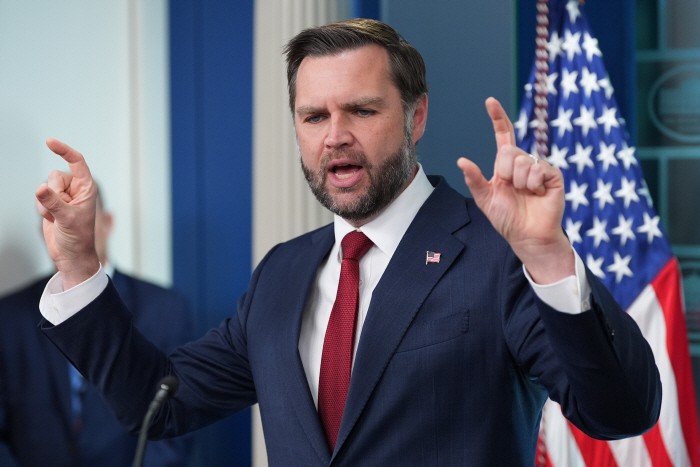 |
| U.S. Vice President J.D. Vance engages in a question-and-answer session with reporters in the James S. Brady Press Briefing Room at the White House in Washington, U.S., on the 3rd (local time). / AP, Yonhap |
U.S. Vice President J.D. Vance stated on the 3rd (local time) regarding the military clashes between the U.S. and Iran that he does not define them as a war. He avoided giving a direct answer regarding when the conflict might end.
At a White House briefing that day, Vice President Vance drew a line against the term "war," citing that major, large-scale combat operations have concluded despite recent localized skirmishes. "There is no full-scale combat currently taking place, only localized clashes," the Vice President explained, adding, "I would not call this a war."
He added that at this point, the primary U.S. objective is to prevent Iran from disrupting the transit of civilian tankers and commercial vessels.
When asked about a timeline for an end to the hostilities and the possibility of negotiations, he made it clear that a halt to Iranian provocations must come first. "I cannot say definitively when Iran will stop its attacks on vessels," Vice President Vance emphasized, adding, "There will be no negotiations as long as Iran continues to threaten commercial shipping."
The Vice President's remarks came immediately after the two nations exchanged airstrikes and retaliatory strikes again earlier this week following a brief lull. Diplomatic negotiations to resolve the conflict between the two countries currently remain suspended.
He underscored the U.S. military's efforts since the outbreak of the dispute to secure crude oil transport through the Strait of Hormuz, explaining that these efforts prevented the crisis from escalating into a global energy catastrophe.
With hostilities between the U.S. and Iran continuing into their seventh month, Reuters pointed out that these remarks reflect the current situation of the Donald Trump administration, which faces political burdens such as surging oil prices and declining approval ratings ahead of the November midterm elections.
Currently, the U.S. military maintains more than 50,000 troops in the Middle East and has deployed about 20 warships, focusing on maritime containment. In the process, military strains have persisted, with some deployments extended and forces drawn from Europe and the Indo-Pacific.
Although large-scale engagements have subsided, international oil prices continue their upward climb amid ongoing intermittent military exchanges and lingering uncertainty.
Lee Jeong-eun
Most Read
-
1
Celltrion nears additional contract with major U.S..

-
2
Putin proposes trilateral U.S.-China-Russia summit..

-
3
U.S. weighs dropping MOAB, world's most powerful n..

-
4
"Aren't those foreigners on welfare?": M..

-
5
Attention centers on APEC for possible Trump-Xi-Pu..

-
6
Saudi Arabia, Iran hold first diplomatic talks to..

-
7
Saudi airport in Riyadh struck again, leaving at l..

PEOPLE







-
Address : In-Young Bldg., 34, Uisadang-daero 1-gil, Yeongdeungpo-gu, Seoul
Copyright by ASIATODAY CO., LTD. All rights resereved