



Funerals without bodies held in flood-stricken Nepal
Sep 04, 2026, 10:11 am


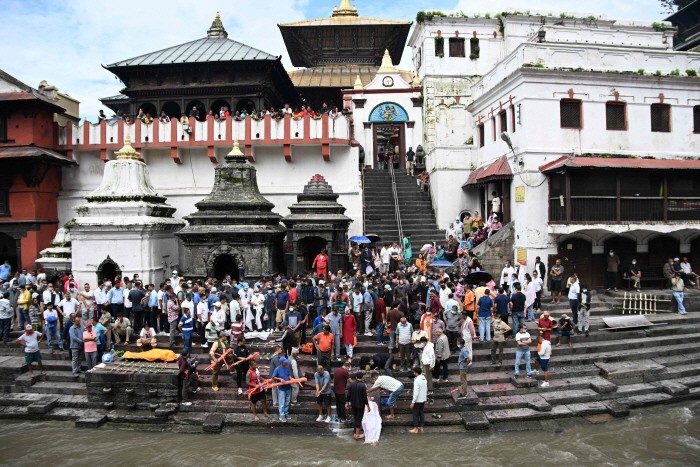 |
| Bereaved family members hold effigies made of Kusha, a sacred grass, to perform funeral rites according to Nepali Hindu customs at the Pashupatinath Temple in Kathmandu, Nepal, on the 2nd (local time). / AFP, Yonhap |
With the number of missing persons exceeding 4,800 following the devastating floods in Nepal, some families of the missing have begun holding funerals without bodies. Nepali media outlets, including Kantipur and Setopati, reported on the 2nd (local time) that even when bodies are recovered, bereaved families face severe difficulties as dedicated facilities for funeral and mourning rites are fully occupied, forcing them to pitch tents to conduct the ceremonies.
In Nepal, when missing individuals cannot be found, a ritual is performed to hold funerals using human-shaped effigies woven from Kusha, a sacred grass. By cremating these effigies to console the souls of the deceased, the tradition offers spiritual solace to families while the community shares in their mourning.
Nirajan Paudel, who lost his parents, relatives, and younger sister in the massive floods, cremated five dolls made of Kusha grass and began the Kriya mourning rites at Kathmandu's Pashupatinath Temple, Nepal's largest Hindu temple.
Rajan Raila, who also lost family members, cremated effigies made of Kusha grass at Pashupati Aryaghat, a Hindu funeral cremation site along the Bagmati River in Kathmandu, and then performed mourning rituals at a Kriyaputri.
In Nepal, a tradition dictates that the bereaved remain for 13 days after a funeral to continue mourning rites, a period known as Kriya. The site where these rites take place is the Kriyaputri, a dedicated facility where bereaved families stay for a set period following the funeral to carry out their mourning rituals.
Even when bodies are recovered, grieving families struggle to find available rooms because Kriyaputri facilities are completely overwhelmed.
The Rudramati Mahadev Temple temporarily opened its doors at the request of bereaved families even though the building was under renovation. However, with eight grieving families already occupying the space, it can no longer accept more.
At the Gupteshwor Mahadev Temple, where all eight rooms were fully booked, six additional temporary spaces were set up by pitching tents; however, with eight mourning families arriving, it quickly reached capacity again. The Kriyaputri facility in the Balaju area is likewise fully occupied.
Kantipur added that bereaved families who traveled to the capital city of Kathmandu to observe mourning rites after the funerals cannot secure rooms due to a shortage of facilities, and many are seen staying in tents to carry out their traditional ceremonies throughout the city.
Park Jin-sook
Most Read
-
1
Celltrion nears additional contract with major U.S..

-
2
Putin proposes trilateral U.S.-China-Russia summit..

-
3
U.S. weighs dropping MOAB, world's most powerful n..

-
4
"Aren't those foreigners on welfare?": M..

-
5
Attention centers on APEC for possible Trump-Xi-Pu..

-
6
Saudi Arabia, Iran hold first diplomatic talks to..

-
7
Saudi airport in Riyadh struck again, leaving at l..

PEOPLE






-
Address : In-Young Bldg., 34, Uisadang-daero 1-gil, Yeongdeungpo-gu, Seoul
Copyright by ASIATODAY CO., LTD. All rights resereved