



NATO and EU weigh response levels as Russian sabotage spreads across Europe
Sep 03, 2026, 01:05 pm


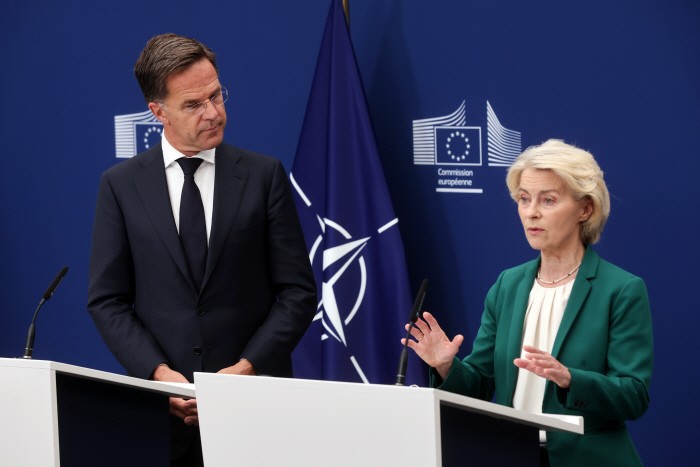 |
| European Commission President Ursula von der Leyen (right) and North Atlantic Treaty Organization (NATO) Secretary General Mark Rutte hold a press conference following their meeting in Brussels, Belgium, on the 2nd local time. / EPA Yonhap |
As Russia mounts successive low-intensity attacks targeting European nations, the international community is wrestling with how strongly to respond, facing the challenge of finding effective ways to deter Russian provocations while guarding against full-scale escalation.
After Germany attributed an attempted explosive drone strike on the Leipzig/Halle Airport in August to Russia, the heads of NATO and the European Union held an emergency meeting on the 2nd local time to discuss countermeasures, according to reports from the Associated Press and The Wall Street Journal.
European officials, including those in Germany, condemned Russia for crossing a line by targeting a busy German airport with explosive-laden drones, yet their response largely stopped at reiterating previous stances.
Pointing to the Leipzig/Halle Airport incident, NATO Secretary General Mark Rutte called out Russian accountability, stating that "malicious activities directly targeting Allied territory are increasing." The airport serves as a major international cargo hub facilitating assistance to Ukraine.
European Commission President Ursula von der Leyen, appearing alongside Secretary General Rutte at EU headquarters that day, stated that "Europe and NATO will not merely maintain pressure on Russia, but intensify it."
European leaders are deliberating to secure options capable of delivering meaningful impacts while avoiding direct, all-out military confrontation with Russia.
European member states of NATO, grounded in the principle of collective defense, have thus far drawn the line at defending their own borders and channeling military aid to Ukraine, holding back from direct, alliance-level interventions.
Instead of tangible military retaliation, Western nations have maintained a posture of applying indirect pressure through assistance to Ukraine. Military and financial aid from European countries is being utilized by Ukraine to strike logistics hubs and petroleum facilities inside Russia.
Skepticism over the deterrent effect of the current response has also surfaced within Germany.
Nico Lange, a senior fellow at the Munich Security Conference and former German defense ministry official, argued that "we must hit Putin where it hurts," asserting that "every time a Russian hybrid attack occurs, Germany should increase its support for Ukraine." He also called for robust additional measures, including tightening sanctions against Russia's shadow fleet and restricting the freedom of movement for Russian diplomats.
According to the Sahaidachny Security Center, a Ukrainian think tank, European authorities directly attributed a total of 20 incidents of sabotage and similar acts to Russia last month. The Wall Street Journal reported that this marks the highest monthly figure since Russia's full-scale invasion in 2022.
Lee Jeong-eun
Most Read
-
1
Celltrion nears additional contract with major U.S..

-
2
Putin proposes trilateral U.S.-China-Russia summit..

-
3
U.S. weighs dropping MOAB, world's most powerful n..

-
4
"Aren't those foreigners on welfare?": M..

-
5
Attention centers on APEC for possible Trump-Xi-Pu..

-
6
Saudi Arabia, Iran hold first diplomatic talks to..

-
7
Saudi airport in Riyadh struck again, leaving at l..

PEOPLE







-
Address : In-Young Bldg., 34, Uisadang-daero 1-gil, Yeongdeungpo-gu, Seoul
Copyright by ASIATODAY CO., LTD. All rights resereved