



Nepal government claims relief aid sent, but flood victims say they have received nothing yet
Sep 02, 2026, 10:01 am


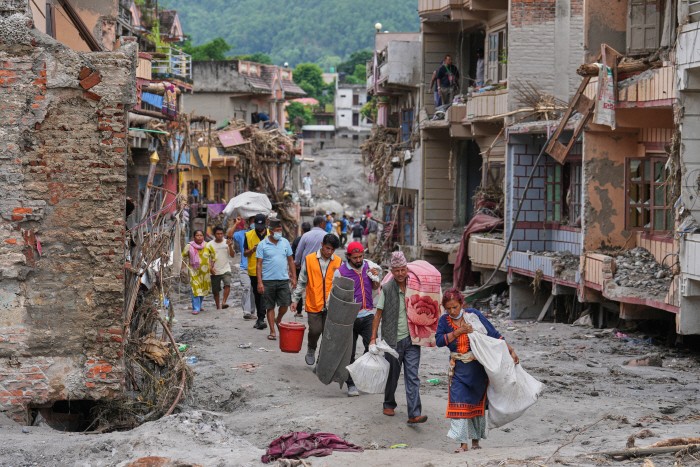 |
| Residents of Devighat in Nuwakot, Nepal, salvage usable household items from homes damaged by flash floods and debris flows on the 29th (local time). / AP, Yonhap News |
Although the Nepalese government and disaster response authorities are dispatching relief supplies to residents isolated by massive flooding, essential provisions such as food and medicine are reportedly failing to reach those in need adequately.
According to Nepalese local media outlet Onlinekhabar on the 31st (local time), Pemba Lamu Tamang, a resident of Gosaikunda in Rasuwa, stated that she had received no aid even five days after the flood struck.
She lamented enduring excruciating conditions with power cut off in her village, adding that household food reserves had nearly run out and she had fallen ill from hunger.
"With electricity cut off, the village is plunged into darkness," Tamang said. "All roads are blocked, making it feel like being trapped in a prison."
Other villagers face similar conditions, surviving solely on water as food supplies run dry. Kaisang Nurpu Tamang, chairman of Gosaikunda Rural Municipality, said, "Not a single piece of relief aid has arrived yet."
Buchung Tamang, chairman of neighboring Aama Chhodingmo Rural Municipality, stated, "A small amount of aid arrived initially, but supplies are now exhausted and residents are pleading for help," adding, "Communication with locals is difficult due to power outages, and the entire village feels blockaded."
Government authorities maintain that relief supplies are being delivered. The National Disaster Risk Reduction and Management Authority announced that day that aid had been dispatched using 37 trucks, 35 vehicles, and 8 helicopter flights. It also stated that five generators, along with food and medicine, were sent to Rasuwa.
However, local residents countered that the aid has not reached them. Grievances continue on the ground that relief supplies remain piled up at military barracks without making it to the villages.
Indeed, relief vehicles remain halted near the Nepalese Army barracks in Battar, Nuwakot, failing to deliver goods to affected areas. Aid delivery faces severe bottlenecks because collapsed roads and deteriorating weather conditions have crippled transportation routes.
Officials handling local administration in Rasuwa explained, "Roads leading to Rasuwa and Nuwakot are blocked by floods, making vehicle entry difficult," adding, "Helicopters are also unable to deliver sufficient relief supplies due to adverse weather and limited airlift capacity."
Meanwhile, Nepalese Prime Minister Balendra Shah stated that relief supplies have arrived from countries including India, China, the U.S., and Australia. India sent 57.5 tons of aid, while international bodies such as the World Bank and the Asian Development Bank have pledged financial support.
Park Jin-sook
Most Read
-
1
Celltrion nears additional contract with major U.S..

-
2
Putin proposes trilateral U.S.-China-Russia summit..

-
3
U.S. weighs dropping MOAB, world's most powerful n..

-
4
"Aren't those foreigners on welfare?": M..

-
5
Attention centers on APEC for possible Trump-Xi-Pu..

-
6
Saudi Arabia, Iran hold first diplomatic talks to..

-
7
Saudi airport in Riyadh struck again, leaving at l..

PEOPLE







-
Address : In-Young Bldg., 34, Uisadang-daero 1-gil, Yeongdeungpo-gu, Seoul
Copyright by ASIATODAY CO., LTD. All rights resereved