



Armed with 'AI hyper-connectivity,' Samsung SmartThings expands DX ecosystem territory
Sep 02, 2026, 09:50 am


 |
Samsung Electronics is accelerating efforts to strengthen SmartThings, the core platform connecting the so-called "Samsung ecosystem." While expanding its reach from household appliances such as smartphones, TVs, and home appliances to heating, ventilation, and air conditioning (HVAC) systems and entire buildings, the company is broadening its operational scope from business-to-consumer (B2C) to business-to-business (B2B). Beyond simply embedding artificial intelligence (AI) into individual products, the company's "hyper-connectivity" strategy—designed to connect devices and services for integrated management across entire spaces—is taking concrete shape.
According to industry sources on the 1st, Samsung Electronics is considering reorganizing its application programming interface (API) architecture to ensure stable SmartThings operations. An API serves as a gateway linking external services with SmartThings, enabling third-party applications and platforms to interface with SmartThings devices and services.
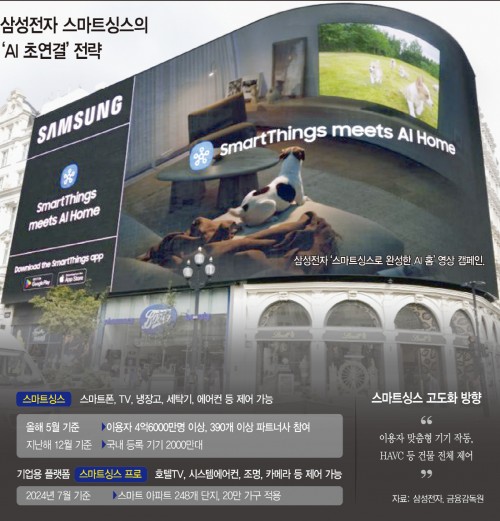
The operational footprint of SmartThings is expanding rapidly. Global registered users surpassed 460 million as of May. Through the Works With SmartThings (WWST) certification program, the platform supports more than 390 partners and over 4,700 types of devices.
The number of registered home appliances is also climbing. The figure reached 33 million units in November of last year, marking an increase of about 30% compared to January of the same year. In South Korea, the total count of registered devices including home appliances broke past 20 million units in December of last year. This reflects an increase of roughly 30% year-on-year, with an average of approximately 13,200 devices newly connected every day during that span.
Samsung Electronics explained that registered devices continue to climb this year as SmartThings integration expands across AI-enabled TVs and home appliances. In line with this growth, Samsung Electronics plans to introduce a paid tier for commercial APIs and a subscription priced at around 5 dollars per month for non-commercial individual developers as early as October. This change will not apply to general SmartThings app users.
Device connection models are also advancing. Moving past using smartphones to control standalone products like TVs and appliances, current development focuses on enabling devices to exchange data with one another to deliver tailored functions for users. The setup is evolving so that multiple devices operate cohesively centered around the user.
Application scopes are broadening to the corporate sector as well. Samsung Electronics unveiled its enterprise platform SmartThings Pro in 2024, enabling unified management of diverse equipment including hospitality TVs, system air conditioners, lighting, and cameras. As of July of that year, the number of domestic smart apartment complexes running SmartThings Pro exceeded 248 complexes, covering over 200,000 households.
HVAC systems, which Samsung Electronics has identified as a future growth engine, represent a leading example. Samsung Electronics integrated SmartThings-based "AI Energy Mode" into its "EHS All-in-One" heat pump heating and cooling system released in Europe this year. The company also plans to combine SmartThings Pro and its integrated building solution (b.IoT) with central air conditioning technologies from FläktGroup, which it acquired last year. This approach expands SmartThings from home device control to overall building operations and energy management.
This trajectory aligns directly with Samsung Electronics' strategy to reinforce the competitiveness of its Device eXperience (DX) division. Samsung Electronics maintains a comprehensive product lineup across smartphones, TVs, and home appliances. In the AI era, organic device integration to deliver a unified user experience is emerging as a critical competitive factor alongside individual product performance. The central question remains whether Samsung Electronics can translate its massive device ecosystem into tangible business performance.
Ahead of Galaxy Unpacked in July, Roh Tae-moon, President of Samsung Electronics, emphasized, "Through SmartThings, Samsung has connected countless devices, services, and partners into a unified experience," adding, "We do not stop at simply adding exceptional intelligence. We design the very way AI operates at the core of the user experience so that intelligence functions seamlessly within the user's context."
Choi In-gyu
#Samsung SmartThings #AI
Copyright by Asiatoday
Most Read
-
1
Celltrion nears additional contract with major U.S..

-
2
Putin proposes trilateral U.S.-China-Russia summit..

-
3
U.S. weighs dropping MOAB, world's most powerful n..

-
4
"Aren't those foreigners on welfare?": M..

-
5
Attention centers on APEC for possible Trump-Xi-Pu..

-
6
Saudi Arabia, Iran hold first diplomatic talks to..

-
7
Saudi airport in Riyadh struck again, leaving at l..

PEOPLE







-
Address : In-Young Bldg., 34, Uisadang-daero 1-gil, Yeongdeungpo-gu, Seoul
Copyright by ASIATODAY CO., LTD. All rights resereved