



Foreign ministry significantly increases budget for overseas disasters and cyber threat responses
Sep 02, 2026, 09:08 am


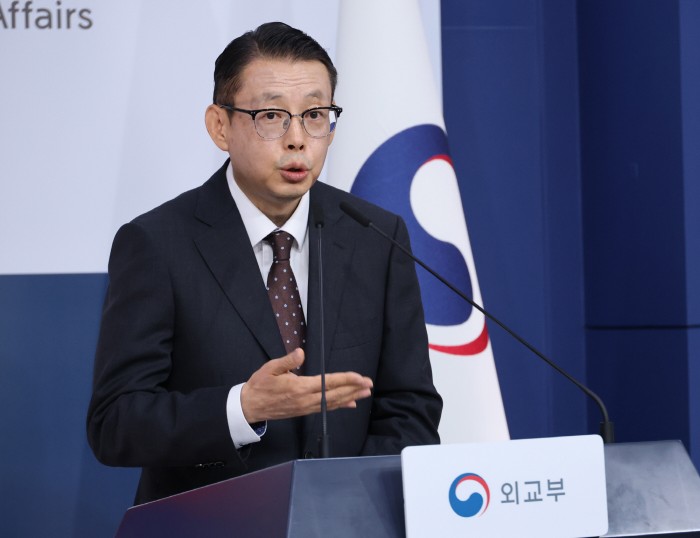 |
| Ministry of Foreign Affairs Spokesperson Park Doo-soon answers questions regarding the dispatch of an emergency relief team to the site of catastrophic flood damage in Nepal during a regular briefing held at the Ministry of Foreign Affairs in the Government Complex Seoul, Jongno-gu, Seoul, on the 1st. / Yonhap News |
The Ministry of Foreign Affairs' 2027 budget proposal, designed to bolster responses to overseas crises and cyber security threats, passed the Cabinet meeting. The ministry significantly increased budgets in related sectors to address the continuous occurrence of overseas crises, such as wars, civil conflicts, and earthquakes, as well as deepening cyber security risks.
The ministry's budget proposal for next year totals 2.7033 trillion won, a slight increase of 2.4% compared to this year (3.6152 trillion won).
As the war between the U.S. and Iran this year generated a need to ensure the safety of citizens residing in the Middle East, and overseas crises such as international disasters like the catastrophic Nepal floods have occurred repeatedly, the Ministry of Foreign Affairs plans to establish overseas diplomatic missions as core hubs for protecting citizens. Accordingly, the budget for facility maintenance and management projects at overseas missions was raised from 6.1 billion won this year to 9.7 billion won next year, and a budget of 3.9 billion won was newly allocated next year for facility reinforcement and fire preparedness at overseas missions.
The foreign ministry also substantially expanded its budget to counter increasingly sophisticated cyber threats, such as the hacking incident at the Korea National Diplomatic Academy in which approximately 10,000 pieces of civil servant-related data were leaked. Consequently, the budget for information security and the construction and operation of diplomatic information systems surged from 11.6 billion won this year to 26.2 billion won next year, while the cyber security budget increased more than fourfold from 3.8 billion won this year to 15.5 billion won next year.
The Ministry of Foreign Affairs stated, "We will more securely protect core information assets and information systems in the diplomacy and security sectors, and establish a foundation for stable execution of diplomatic duties."
In addition, with South Korea set to assume the presidency of the '2028 G20 Summit,' the ministry newly allocated 2.3 billion won related to this, alongside 1.5 billion won for strengthening AI diplomacy to support the faithful implementation of government AI policies, including the 'San Francisco Artificial Intelligence (AI) Declaration.'
The Ministry of Unification announced that it significantly increased the budget for peace, unification, and democratic citizenship education for future generations through next year's budget proposal. The relevant budget rose sharply from 15.9 billion won this year to 25.3 billion won. The unification ministry stated, "Based on a paradigm shift from conventional security-centered education to education emphasizing peaceful coexistence, dialogue and cooperation, and democratic values, we plan to focus on strengthening education targeting future generations."
Additionally, the budget to expand public access to North Korean materials was increased. For the opening of the 'Northeast Asia Peace Information Center' and activities to make North Korean documents public, the Ministry of Unification expanded the relevant budget about tenfold, from the previous 1.6 billion won to 15.6 billion won.
Furthermore, reflecting the decline in North Korean defectors entering South Korea, 2.9 billion won was newly allocated to completely reorganize the Second Hanawon, and the budget for peace experience programs in border areas along the Demilitarized Zone (DMZ) was adjusted upward from 380 million won to 1.46 billion won. In particular, the budget for the economic cooperation infrastructure loan program, which enables large-scale fiscal investment upon the resumption of inter-Korean economic cooperation, was expanded significantly from 59.1 billion won to 199.4 billion won.
Mok Yong-jae
Most Read
-
1
Celltrion nears additional contract with major U.S..

-
2
Putin proposes trilateral U.S.-China-Russia summit..

-
3
U.S. weighs dropping MOAB, world's most powerful n..

-
4
"Aren't those foreigners on welfare?": M..

-
5
Attention centers on APEC for possible Trump-Xi-Pu..

-
6
U.S., Israel plan to resume strikes on Iran after..

-
7
Saudi Arabia, Iran hold first diplomatic talks to..

PEOPLE







-
Address : In-Young Bldg., 34, Uisadang-daero 1-gil, Yeongdeungpo-gu, Seoul
Copyright by ASIATODAY CO., LTD. All rights resereved