



S. Korea risks falling behind without physical AI as LLM race cools, experts warn
Sep 01, 2026, 02:10 pm


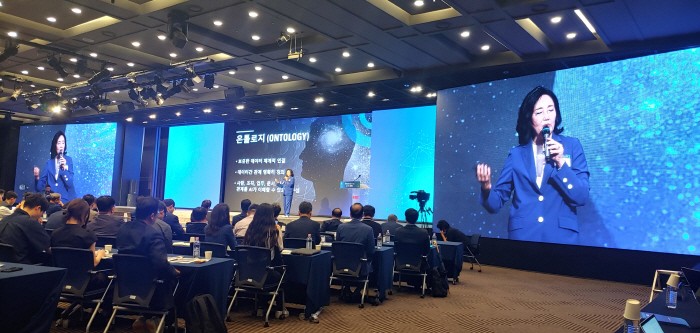 |
| Park Young-sun, chair of the Strategic Economy Advisory Committee under the Ministry of Economy and Finance, delivers a lecture at the Seminar on Strategic Economy and AI Transformation for SMEs, held at the Korea Federation of SMEs in Yeouido, Seoul, on the 1st. / Photo by Reporter Oh Se-eun |
The era of "AI agent commerce," where artificial intelligence independently makes decisions and autonomously executes payments, is taking hold in earnest. A warning has emerged that domestic small and medium-sized enterprises (SMEs) and small business owners must focus on "practical application" and "preempting standards" rather than developing ultra-large foundation models to avoid being sidelined in the global standards war. The golden window to respond to global Big Tech's monopoly on standards is only the next 18 months.
The Korea Federation of SMEs (KBIZ) hosted the Seminar on Strategic Economy and AI Transformation for SMEs at the KBIZ headquarters in Yeouido, Seoul, on the 1st.
Kim Ki-mun, chairman of KBIZ, said, "While the AI transformation of SMEs is essential for South Korea to leap into one of the world's top three AI powerhouses, the on-site burden is substantial due to shortages of capital and personnel," urging step-by-step customized support tailored to each company's AI readiness level and the construction of win-win AI models between large and small businesses. Chairman Kim emphasized, "As the disparity among companies is significant—ranging from manual documentation to advanced stages—systematic policy design is urgent," adding, "Just like the win-win smart factory initiative pursued with Samsung, POSCO, and others for nine years that achieved a 93% satisfaction rate, large and small companies must innovate together in the AI sector to make the Republic of Korea an irreplaceable industrial powerhouse."
Following this, Park Young-sun, chair of the Strategic Economy Advisory Committee under the Ministry of Economy and Finance, presented paradigm shifts in the AI industry and national-level response strategies. Chair Park assessed, "The focus of Silicon Valley in the U.S. has already moved beyond developing Large Language Models (LLMs) that broadly learn text and data to converse like humans; it has shifted toward the coexistence of AI agents with humans, and workflow innovation—the entire procedural framework from conception to execution and final completion—going beyond merely automating individual tasks." She added, "In the AI era, human-centered work processes are shifting to structures of parallel collaboration with AI agents. Thus, if 2025 was the prologue, 2026 is the entry phase, and 2027 will become the era of action-oriented AI agents."
In particular, Chair Park pointed out that the initiative is shifting from a hardware-centric "simple GPU" competition—where players competed over who secures more high-performance graphics processing units (GPUs) to accelerate massive data operations and boost computing power—to building "AI factories," where telecommunications and software combine to operate entire facilities through AI, and "Physical AI," which moves beyond virtual screen spaces to directly integrate with real-world physical entities like robots, autonomous vehicles, and manufacturing equipment to judge and take action.
Kim Yong-jin, a professor at Sogang University, pointed out, "In the AI agent commerce market, which is projected to grow to up to $5 trillion (approx. 6,700 trillion won) by 2030, a rapid transition will occur first in the business-to-business (B2B) sector where data and process standardization are relatively feasible." He added, "We must preempt data standardization (K-Ontology) and trust infrastructure before global Big Tech monopolizes connection standards and payment protocols." Professor Kim also presented public-private coordinated solutions as alternatives to overcome the limitations of individual SMEs, including building shared platforms centered on industry-specific cooperatives and win-win cooperation models based on anchor enterprises.
Oh Se-eun
Most Read
-
1
Celltrion nears additional contract with major U.S..

-
2
Putin proposes trilateral U.S.-China-Russia summit..

-
3
U.S. weighs dropping MOAB, world's most powerful n..

-
4
"Aren't those foreigners on welfare?": M..

-
5
Attention centers on APEC for possible Trump-Xi-Pu..

-
6
Saudi Arabia, Iran hold first diplomatic talks to..

-
7
Saudi airport in Riyadh struck again, leaving at l..

PEOPLE







-
Address : In-Young Bldg., 34, Uisadang-daero 1-gil, Yeongdeungpo-gu, Seoul
Copyright by ASIATODAY CO., LTD. All rights resereved