



Will military coup risks rise after military academy merger?
Aug 28, 2026, 09:19 am


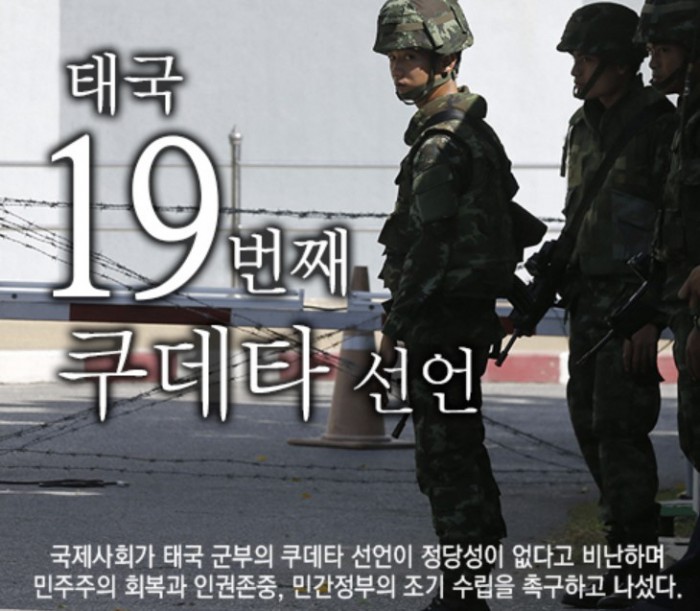 |
| Thai soldiers wearing helmets and combat uniforms while holding rifles maintain high alert in a guarded area equipped with barbed wire and barricades after Army Chief Prayuth Chan-ocha seized power and declared a coup in Thailand on May 22, 2014. / Yonhap |
Following President Lee Jae-myung's directive to swiftly merge the army, naval, and air force academies to prevent recurrences after noting that the Korea Military Academy stood at the center of three military coups, the Ministry of National Defense plans to finalize and announce a detailed master plan in October for the establishment of a unified Armed Forces Academy, following a public hearing on the 26th and subsequent opinion-gathering from media and experts.
While the defense ministry aims to dismantle the monopolistic structure of a specific service branch through the merger of the three service academies, concerns have emerged in some quarters that an external merger of the academies could inadvertently strengthen the cohesion of specific factions, thereby heightening the risk of a military coup.
However, at the public hearing on the establishment of the Armed Forces Academy held at the MND Convention in Yongsan on the 26th, Kim Hong-chul, deputy minister for national defense policy, dismissed such concerns. Presenting empirical data from Western security studies, Kim stated, "There is no statistically significant correlation between the institutional merger of military academies and the frequency of coups."
According to a 2019 study titled "A Professionalism Trap? Military Academies and Coup Risk" by a research team led by Professor Tobias Böhmelt cited by Kim that day, the external institutional restructuring of merging military academies neither directly reduces nor increases coup risk.
Regarding this, Professor K, a military expert who requested anonymity, emphasized in an interview with this newspaper on the 27th that if internal personnel structures and control mechanisms within the military remain unchanged, merging the academies will not reduce the risk of a coup, whereas coups do not occur even if academies remain separate as long as civilian control is robust.
Deputy Minister Kim likewise dispelled lingering concerns that coup risks would rise following an external academy merger by drawing on academic data. Professor K noted that decisive factors behind coups indicated by global data analysis are not the outward form of military academies, but rather the monopolistic power of specific internal military factions over key posts and operational troop command.
Citing findings from studies by Professor Anders Johansson's research team (2022) and Professor Jacob Ricks (2016), he noted that the crux lies in specific factions privatizing operational troop command, such as the positions of Army Chief of Staff and Capital Defense Commander.
The key variables they identified as triggering coups include factional monopolization of appointments, the oligopolization of military authority by officer networks, internal conflicts driven by personnel exclusions, privatization of operational troop command, and the erosion of civilian control. If the monopolization of key posts by specific factions is left unaddressed, the side effect of another faction privatizing military authority from within is bound to recur even if the academies are merged.
As the deputy minister of national defense policy emphasized, the core solution to fundamentally deter coups cannot be achieved merely through the external merger of schools regarding where officers are educated.
Reforming military personnel management into a transparent and fair system to prevent specific factions and graduating classes from monopolizing key posts, alongside establishing robust civilian control, represents the true essential task to nip coups in the bud. True defense reform can be realized only when fundamental personnel reforms dismantling internal factional dynamics accompany the push for an outward merger of the military academies.
Gu Pil-hyun
Most Read
-
1
Celltrion nears additional contract with major U.S..

-
2
Putin proposes trilateral U.S.-China-Russia summit..

-
3
U.S. weighs dropping MOAB, world's most powerful n..

-
4
"Aren't those foreigners on welfare?": M..

-
5
Attention centers on APEC for possible Trump-Xi-Pu..

-
6
U.S., Israel plan to resume strikes on Iran after..

-
7
Saudi Arabia, Iran hold first diplomatic talks to..

PEOPLE







-
Address : In-Young Bldg., 34, Uisadang-daero 1-gil, Yeongdeungpo-gu, Seoul
Copyright by ASIATODAY CO., LTD. All rights resereved