



First sea trial of suicide drone fails as it crashes into ocean right after launch
Aug 27, 2026, 09:12 am


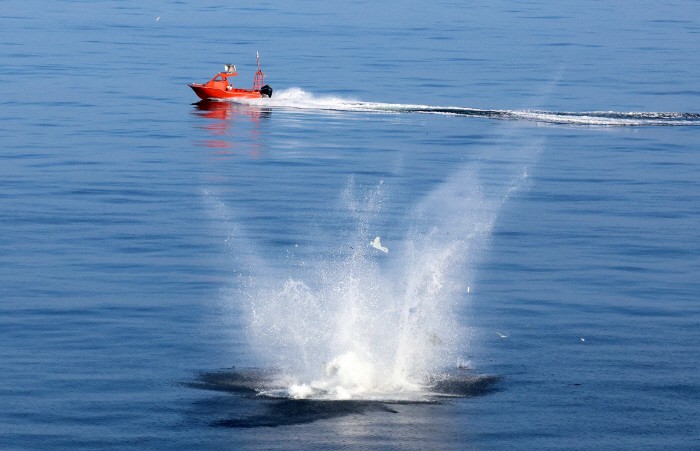 |
| A suicide drone (unmanned aerial vehicle) crashes into the sea right after takeoff during a Navy combat experiment conducted in waters south of Busan on the 25th to verify the maritime operability of suicide drones. The combat experiment, originally scheduled to involve the drone striking an unmanned surface vessel, failed to proceed as drones launched twice from the ROKS Marado crashed into the sea immediately after takeoff. The Navy explained that it will continue verifying maritime operability. / Yonhap |
The first sea trial of a suicide drone under development by the Agency for Defense Development (ADD) ended in failure after the drone plunged into the ocean immediately following a shipboard launch.
The Republic of Korea Navy announced on the 26th that in a combat experiment planned for the 25th to verify the maritime operability of suicide drones aboard the 14,000-ton amphibious assault ship ROKS Marado in the South Sea, the suicide drone crashed into the water right after launch, preventing the combat experiment from proceeding.
Originally, the Navy had planned to work with the ADD to test the suicide drone's operational suitability aboard naval vessels, its maritime flight capability, and its potential to strike moving targets from the ROKS Marado. The goal was to launch the drone from the flight deck of the ROKS Marado and have it fly autonomously to a designated maritime mission zone.
The unmanned aerial vehicle plunged into the sea immediately upon launch. After checking the causes behind the first failure, a second launch was conducted using a backup unit, but it also crashed into the ocean. Ultimately, the planned core verification procedures could not be carried out.
The suicide drone deployed in the trial has a wingspan of about 3 meters, can stay aloft for more than 10 hours, and is being developed to conduct reconnaissance, search, and strike missions simultaneously. The drone is equipped with electro-optical and infrared (EO/IR) cameras and an automatic target recognition feature. It can precisely identify and strike targets day and night as well as in severe weather, and it can transmit real-time reconnaissance video from long distances using low Earth orbit satellite data links.
While ground tests saw more than 30 successful runs, speculation suggests that minute shipboard vibrations may have caused physical parameter discrepancies. The Navy did not disclose specific crash causes or the condition of the airframe regarding the trial results. Given that similar symptoms appeared in both the first and second attempts, the development team plans to conduct an epidemiological investigation based on data collected through the ground control system to thoroughly analyze the root cause.
Lee Han-sol
Most Read
-
1
Celltrion nears additional contract with major U.S..

-
2
Putin proposes trilateral U.S.-China-Russia summit..

-
3
U.S. weighs dropping MOAB, world's most powerful n..

-
4
"Aren't those foreigners on welfare?": M..

-
5
Attention centers on APEC for possible Trump-Xi-Pu..

-
6
Saudi Arabia, Iran hold first diplomatic talks to..

-
7
U.S., Israel plan to resume strikes on Iran after..

PEOPLE







-
Address : In-Young Bldg., 34, Uisadang-daero 1-gil, Yeongdeungpo-gu, Seoul
Copyright by ASIATODAY CO., LTD. All rights resereved