



Even Xi Jinping's favorite dumpling restaurant struggles amid wave of small business closures in China
Aug 25, 2026, 05:08 pm


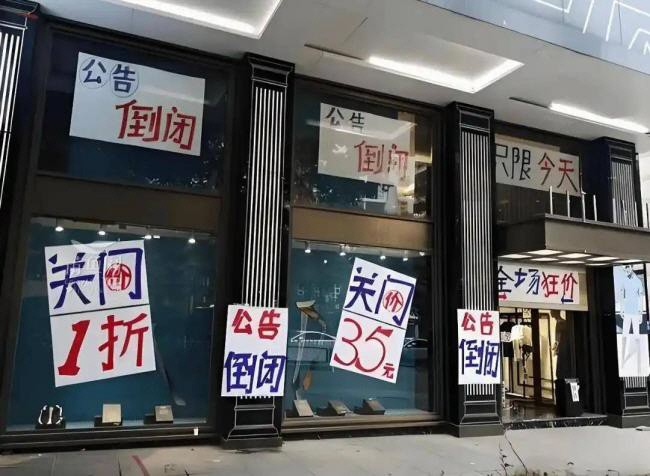 |
| A street scene in Sanlitun, Chaoyang District, the economic hub of the Chinese capital, Beijing. Signs are posted stating that due to business closures, inventory has to be sold at 10% of cost. It seems more than enough to show how dire the situation is for Chinese self-employed business owners. / The Beijing News |
Chinese self-employed business owners, estimated to number at least 150 million, are facing severe distress as they are swept up alongside the broader economic wave of bankruptcies that has become almost routine in recent years. If this situation persists, it will likely place a heavy burden on the overall economy, which is already in a critical state.
The severity of the situation is perhaps best illustrated by the ongoing wave of closures across the Qingfeng Steamed Dumpling Shop chain, which gained immense fame after General Secretary and President Xi Jinping stood in line with ordinary citizens to order a meal in late 2013. Until a few years ago, roughly 170 outlets—including privately invested locations—were operating across mainland China, but more than 30 are now estimated to have shut down.
Even the branch on Yuetan North Road in Xicheng District, Beijing, which reigned as a hotspot for over a decade thanks to the massive appeal of the seat where President Xi sat and ate, failed to escape the misfortune of closing recently. Today, only a bleak sign reading "No Agency Fee, For Rent" hangs on its faded, stained glass window. It offers every impression of having been entirely abandoned.
The problem is that the situation is highly likely to worsen rather than improve. This is clearly evidenced by the fact that out of about ten outlets operating in Shenyang, Liaoning Province—a city renowned as one of China's culinary capitals—only a single store remains. Considering the words of Chen Lan, a restaurateur operating between Beijing and Shenyang who remarked that "it is only a matter of time before the last one closes," rumors that the chain faces insolvency appear far from baseless. For franchise investors who bought in purely on Qingfeng's fame, it is nothing short of a bolt from the blue.
One must also note that liquor and tobacco retailing, which has historically drawn the largest number of self-employed operators nationwide, is suffering an unprecedented slump. Last year alone, an estimated 870 stores closed each day, totaling 320,000 businesses over the year. Given estimates that each store supported the livelihoods of two to three people, at least 640,000 and up to 960,000 individuals lost their jobs last year.
Considering the lightning pace at which other retailers, such as grocery stores and hair salons, are disappearing through closures, it is hardly an exaggeration to say that Chinese small business owners are enduring an arduous march. This downturn poses a substantial burden on the macroeconomy, even as booms in the AI and semiconductor sectors create an optical illusion masking widespread underlying issues. It can be safely asserted that this is precisely why the Chinese leadership's economic growth target of 4.5 to 5% for this year appears far from easy to achieve.
Hong Soon-do
Most Read
-
1
Celltrion nears additional contract with major U.S..

-
2
Putin proposes trilateral U.S.-China-Russia summit..

-
3
U.S. weighs dropping MOAB, world's most powerful n..

-
4
"Aren't those foreigners on welfare?": M..

-
5
Attention centers on APEC for possible Trump-Xi-Pu..

-
6
Saudi Arabia, Iran hold first diplomatic talks to..

-
7
China tightens grip on boosting domestic demand an..

PEOPLE






-
Address : In-Young Bldg., 34, Uisadang-daero 1-gil, Yeongdeungpo-gu, Seoul
Copyright by ASIATODAY CO., LTD. All rights resereved