



Indonesia vows to become palm oil price setter, challenging Malaysia's stronghold
Aug 25, 2026, 10:22 am


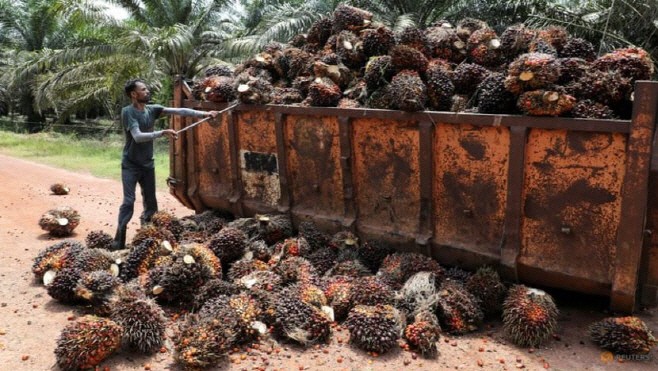 |
| A worker harvests oil palm fruit, the raw material for palm oil, at a plantation in Malaysia. / Reuters, Yonhap News |
Indonesia, the world's largest producer and exporter of palm oil, has set out to establish its own commodity exchange with the goal of securing leadership in international raw material prices. While the plan aims to directly take hold of price-setting power based on overwhelming resource output, the market is raising questions about its effectiveness due to a lack of transparency and liquidity.
According to local media including Antara and the South China Morning Post (SCMP) on the 24th (local time), Indonesian President Prabowo Subianto stated in a recent annual budget speech to parliament, "Indonesia must not remain merely a raw material producer, but must become a price setter for international commodity prices."
Accordingly, the Indonesian government plans to establish the Strategic Mineral and Commodity Exchange (BMKS) to set reference prices for crude palm oil (CPO), nickel, tin, coal, and coffee, with an official launch scheduled for January 1 next year. The Financial Services Authority (OJK) will oversee the exchange and has begun organizational restructuring, including recently appointing Henry Rialdi as deputy director in charge of the exchange.
The biggest test for this project is undoubtedly palm oil. Indonesia produced 51.66 million tonnes of palm oil last year, accounting for more than half of global export volume. In contrast, output from Malaysia, the second-largest producer, stood at only 20.28 million tonnes. Nevertheless, price benchmarks for both global futures trading and physical palm oil contracts worldwide remain dominated by the CPO futures contract (FCPO) on Bursa Malaysia Derivatives.
Experts view Indonesia's objective in establishing the exchange as a dual strategy aimed at "expanding price control" and "strengthening the tax base." Siwage Dharma Negara, a senior fellow at the ISEAS-Yusof Ishak Institute in Singapore, analyzed, "The intention is to leverage supply dominance to exert influence on international market prices while simultaneously strengthening state oversight over export prices, volumes, and tax payment records."
However, whether supply dominance will translate directly into pricing power for the exchange remains uncertain. Senior Fellow Siwage warned, "Without reductions in transaction costs, transparent governance, and reliable data, it will be difficult to shake the stronghold of the FCPO," adding, "Excessive government intervention in pricing could undermine the credibility of the exchange instead."
In fact, Indonesia launched a physical CPO market through a commodity and derivatives exchange in 2023, but due to sluggish trading, it failed to replace the price discovery and hedging functions of the existing FCPO. David Ng, a trader at financial and commodity trading firm Iceberg X, pointed out, "The core competitiveness of the FCPO lies in its abundant liquidity, with participation ranging from plantation companies to global speculative capital generating more than 80,000 transactions per day on average."
Some also analyze that this move focuses more on securing domestic tax revenue rather than competing for international price leadership. Bhima Yudhistira Adhinegara, executive director of the Center of Economic and Law Studies (CELIOS) in Jakarta, projected, "The real goal is to capture income tax revenue from export companies by enhancing transaction transparency," adding, "Given that existing contract practices with major importing countries such as China and India are firmly entrenched, overseas buyers are unlikely to switch to Indonesian benchmark prices."
Jeong Ri-na
Most Read
-
1
Celltrion nears additional contract with major U.S..

-
2
Putin proposes trilateral U.S.-China-Russia summit..

-
3
U.S. weighs dropping MOAB, world's most powerful n..

-
4
"Aren't those foreigners on welfare?": M..

-
5
Attention centers on APEC for possible Trump-Xi-Pu..

-
6
Saudi Arabia, Iran hold first diplomatic talks to..

-
7
China tightens grip on boosting domestic demand an..

PEOPLE







-
Address : In-Young Bldg., 34, Uisadang-daero 1-gil, Yeongdeungpo-gu, Seoul
Copyright by ASIATODAY CO., LTD. All rights resereved