



Semiconductor boom pushes up Taiwan's valuation, but overall mood remains cool
Aug 24, 2026, 03:27 pm


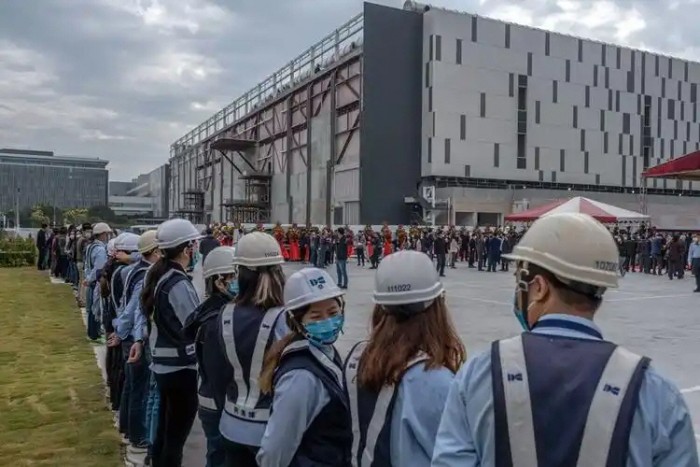 |
| Workers at a TSMC plant in Tainan, Taiwan. They are known to receive average salaries and performance bonuses far beyond what ordinary Taiwanese workers could imagine. / United Daily News (Taiwan) |
Taiwan's global standing has soared to an almost unimaginable degree, driven by the boom in the AI-fueled semiconductor industry that has become the defining force in global manufacturing. It's a moment rarely, if ever, seen before in Taiwan's history. Yet, oddly enough, the broader mood across Taiwan remains cool rather than jubilant, despite what would seem like a once-in-a-lifetime opportunity worth celebrating.
According to Beijing sources familiar with industry developments on both sides of the Taiwan Strait on the 24th, the "butterfly effect" AI has unleashed within Taiwan is genuinely staggering. This is clear enough when considering that semiconductor-related industries and companies like TSMC (Taiwan Semiconductor Manufacturing Company) are posting record-breaking results.
It's hardly surprising that even back-end companies handling semiconductor packaging and testing are enjoying an unprecedented boom of their own. There's good reason the top five back-end firms, including ASE Group, plan to invest a staggering 460 billion New Taiwan dollars (about 20.24 trillion won) in capacity expansion this year. It's also no coincidence that the global semiconductor industry has begun regarding Taiwan as an "Attack Titan" of sorts.
Given this reality, it's only natural that employees at companies like TSMC enjoy benefits beyond ordinary imagination. Around New Taipei City, near Taipei, where TSMC's headquarters is located, TSMC employees are known as a new class of salaried aristocracy, guaranteed high wages and performance bonuses. Cui Zhongxi, a Taiwanese businessman based in Beijing, described the reality plainly: "In Taipei and New Taipei, whether you work at TSMC or not determines your social status among office workers — and it applies to your family, too." That's hardly momentary hyperbole.
Given all this, it would be strange if Taiwan's government tax revenue weren't exploding as well. This year, tax revenue growth is projected to run slightly above the latest revised GDP growth forecast of 11.05%. Against this backdrop, it's hardly surprising that Taiwan's total defense budget for 2027, recently drawn up by the government, is set at 1.1225 trillion New Taiwan dollars — surpassing the 1 trillion New Taiwan dollar mark for the first time ever.
At this point, it would seem only natural for all of Taiwan to be shouting for joy. But reality tells a different story — the mood is decidedly cool, and there's good reason for it. First, workers employed in semiconductor-related industries account for just 3% of the total workforce, making it easy to conclude that only a tiny minority of workers are actually riding the semiconductor boom. What's more, the average annual salary for the remaining 97% comes to just 570,000 New Taiwan dollars — far below the 2.58 million New Taiwan dollars earned in the semiconductor sector.
And even that figure understates the divide: about 70% of Taiwan's workforce reportedly earns considerably less than that. Even for those lucky enough to earn 570,000 New Taiwan dollars, that's still roughly 40,000-50,000 won less than South Korea's monthly minimum wage of 2.15 million won. In short, for these workers, Taiwan's soaring global standing driven by the semiconductor boom might as well be happening in another country.
The picture becomes even starker when factoring in that most industries outside the semiconductor sector are performing quite poorly. It's little wonder that Taiwanese workers and companies left out of the boom, feeling a real sense of relative deprivation from Taiwan's soaring reputation driven by semiconductors, are looking on with a cold eye.
Hong Soon-do
Most Read
-
1
Trump shares map on social media labeling Strait o..

-
2
Kia Sportage outperforms Mazda CX-5 in German auto..

-
3
Houthis launch successive attacks on Saudi airport..

-
4
U.S. deploys carrier, 10,000 more troops to Middle..

-
5
Trump rejects Iran's offer to open Strait of Hormu..

-
6
N. Korea conducts first swarm attack drill with dr..

-
7
U.S.-China summit falls short on substance as Trum..

PEOPLE





HEADLINE NEWS
- Seoul dismisses Ukraine's claim of 'S. Korean support for Russia' as "inaccurate and inappropriate"
- S. Korea, Japan race to develop nuclear-powered submarines
- Henri Kagan, Kenso Soai win Nobel Prize in Chemistry for uncovering how mol..
- Vance says Alaska LNG cooperation will move forward with Seoul's current or..

-
Address : In-Young Bldg., 34, Uisadang-daero 1-gil, Yeongdeungpo-gu, Seoul
Copyright by ASIATODAY CO., LTD. All rights resereved