



Argentina's fertility rate halves in a decade
Aug 24, 2026, 02:09 pm


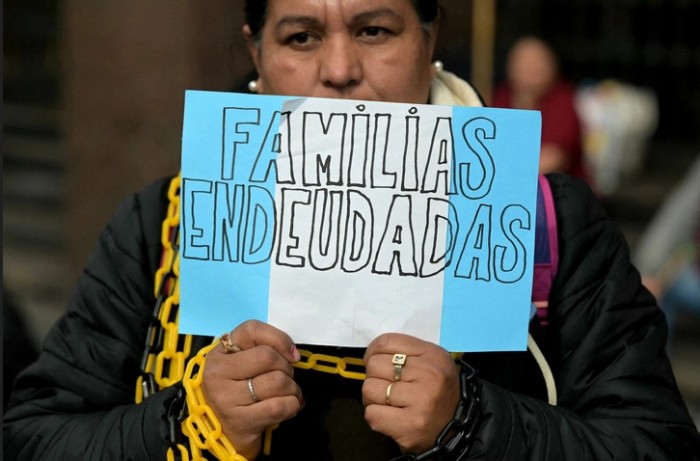 |
| A woman holds a sign reading "Households are in debt" during a protest against high interest rates in Buenos Aires, Argentina on the 20th (local time). / AFP-Yonhap |
Argentina's birth rate has fallen to a historic low over the past decade, and the UN attributes the decline to economic instability.
According to EFE on the 23rd (local time), the UN Population Fund (UNFPA) said in a recently released report that Argentina's total fertility rate — the average number of children a woman is expected to have during her childbearing years (ages 15-49) — fell to 1.2 children per woman in 2024. A fertility rate of about 2.1 children is generally considered the level needed to maintain a stable population over the long term.
According to a birth statistics report released in February by Argentina's Ministry of Health, compiling birth certificate issuance records, 413,135 babies were born in Argentina in 2024 — nearly half the 777,012 born in 2014.
On a daily average basis, this amounts to 2,128 births per day in 2014, compared to 1,131 in 2024. The crude birth rate, which measures births per 1,000 people, fell from 18 in 2014 to 11.8 in 2024.
In a survey conducted by UNFPA together with polling firm Voices in January and February of this year, covering 1,515 women aged 18-70 nationwide in Argentina, about 57% of respondents aged 18-45 who had already had children or planned to said they were unable to have as many children as they wanted due to social and economic constraints.
The most commonly cited reason for limiting or giving up on having children was "being unable to provide economic stability for a child," cited by about 79% of respondents, followed by "being unable to provide adequate housing" (78%) and "lacking time to devote to childcare" (74%).
Mariana Isasi, head of UNFPA's Argentina office, explained, "The survey results show a gap between people's plans for having children and the realistic conditions needed to make that happen."
President Javier Milei sparked controversy on the 20th at an Americas Council event in Buenos Aires, claiming that the enthusiasm for killing children in the womb is costing Argentina in terms of economic growth and social security, attributing the country's declining birth rate primarily to abortion.
"The same applies in terms of human capital," he said, stressing that "Argentina is not reaching a population and birth rate sufficient for replacement."
EFE pointed out that with unemployment rising in Argentina amid intense austerity measures and growing numbers of people taking on more than one job due to expanding job insecurity, the claim that the declining birth rate is primarily due to abortion carries little persuasive weight.
According to recent statistics released by Argentina's National Institute of Statistics and Census (INDEC), the country's unemployment rate stood at 7.8% in the first quarter of this year — up 2.1 percentage points from 5.7% in the fourth quarter of 2023, before Milei's government took office.
Son Young-sik
Most Read
-
1
Trump shares map on social media labeling Strait o..

-
2
Kia Sportage outperforms Mazda CX-5 in German auto..

-
3
Houthis launch successive attacks on Saudi airport..

-
4
U.S. deploys carrier, 10,000 more troops to Middle..

-
5
Trump rejects Iran's offer to open Strait of Hormu..

-
6
N. Korea conducts first swarm attack drill with dr..

-
7
U.S.-China summit falls short on substance as Trum..

PEOPLE






HEADLINE NEWS
- Seoul dismisses Ukraine's claim of 'S. Korean support for Russia' as "inaccurate and inappropriate"
- S. Korea, Japan race to develop nuclear-powered submarines
- Henri Kagan, Kenso Soai win Nobel Prize in Chemistry for uncovering how mol..
- Vance says Alaska LNG cooperation will move forward with Seoul's current or..

-
Address : In-Young Bldg., 34, Uisadang-daero 1-gil, Yeongdeungpo-gu, Seoul
Copyright by ASIATODAY CO., LTD. All rights resereved