



Financial authorities watch rising rates in major economies
Aug 24, 2026, 10:06 am


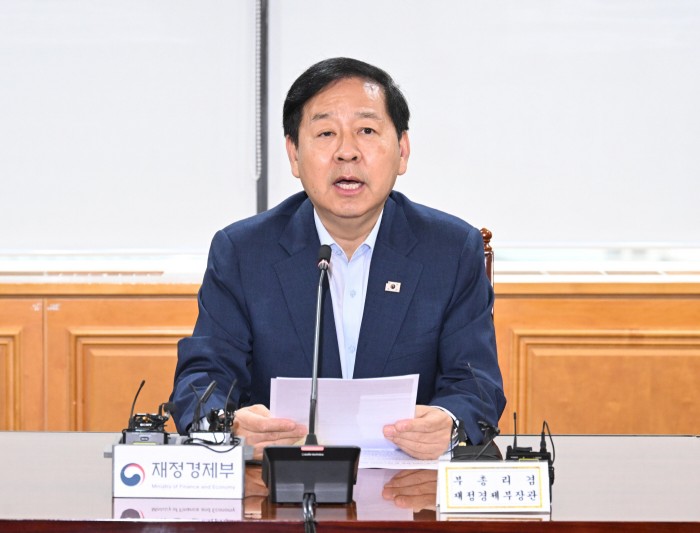 |
| Deputy Prime Minister and Minister of Economy and Finance Koo Yun-cheol delivers opening remarks at a market conditions review meeting held at the Korea Federation of Banks in Jung-gu, Seoul on the 21st. / Ministry of Economy and Finance |
As rising long-term interest rates in major economies like the U.S. drive up borrowing costs, the government is preparing measures to ease the burden. Given that rising rates could weigh heavily on vulnerable borrowers, the government plans to explore approaches including active debt restructuring and financial support.
According to the Ministry of Economy and Finance on the 21st, Deputy Prime Minister and Minister Koo Yun-cheol chaired a joint "Market Conditions Review Meeting" with relevant agencies at the Korea Federation of Banks building, reviewing financial and foreign exchange market trends and discussing response measures. FSC Chairman Lee Eok-won, Financial Supervisory Service Governor Lee Chan-jin, and Bank of Korea Deputy Governor Park Jong-woo attended the meeting.
The meeting reviewed rising long-term interest rates in major economies like the U.S. and Japan and their impact on Korea. Long-term government bond yields in these countries have continued to rise, driven by a combination of ongoing uncertainty from the Middle East war, expanded fiscal spending across countries, and increased corporate bond issuance by global AI companies.
In the U.S., the 30-year Treasury yield rose from 4.61% at the end of February to 5.19% as of the 19th, while Japan's rose from 3.34% to 4.09% over the same period. The U.K.'s 30-year yield also climbed from 5.03% at the end of February to 5.79%.
In response, the government plans to swiftly prepare and announce support measures aimed at easing the debt burden on small business owners and reducing the financial strain on lower-income and vulnerable borrowers, to ensure rising rates don't become an excessive burden for them.
Deputy PM Koo said, "We will support struggling small business owners and individuals in getting back on their feet through active debt restructuring and other measures," adding, "We will also expand financial support for small and medium-sized enterprises and lower-income and vulnerable borrowers."
The meeting also reviewed domestic risk factors. Korea's total household debt in the second quarter posted its largest increase in four years and nine months, surpassing 2 trillion won for the first time ever [likely a translation of a large won figure]. While the government noted that the ratio of household debt to GDP is declining even as the debt total rises, it decided to continue managing the issue closely given that the ratio remains high compared to major economies.
Meanwhile, the government attributed the won-dollar exchange rate's fall into the 1,300-won range this month — its first time there in 11 months, after reaching the high 1,500s in the first half of the year — to record-level current account surpluses and easing foreign investor stock rebalancing. Even as the rate continues declining, the government said it will remain vigilant in responding to volatility, given that both upward and downward pressures — including Middle East geopolitical tensions and monetary policy in major economies — remain in play simultaneously.
Deputy PM Koo said, "Given the significant uncertainty in the external environment, a more vigilant response than ever is needed," adding, "We will operate an integrated management framework covering the financial and foreign exchange markets as well as the government bond and real estate markets, preemptively monitoring risk factors across each sector and responding promptly when necessary."
Seo Byung-ju
Most Read
-
1
Celltrion nears additional contract with major U.S..

-
2
Putin proposes trilateral U.S.-China-Russia summit..

-
3
U.S. weighs dropping MOAB, world's most powerful n..

-
4
"Aren't those foreigners on welfare?": M..

-
5
Attention centers on APEC for possible Trump-Xi-Pu..

-
6
Saudi Arabia, Iran hold first diplomatic talks to..

-
7
China tightens grip on boosting domestic demand an..

PEOPLE







-
Address : In-Young Bldg., 34, Uisadang-daero 1-gil, Yeongdeungpo-gu, Seoul
Copyright by ASIATODAY CO., LTD. All rights resereved