



Korean retail investors pour over W100bn into Samsung Electronics-SK Hynix ETF in a week
Aug 23, 2026, 09:53 am


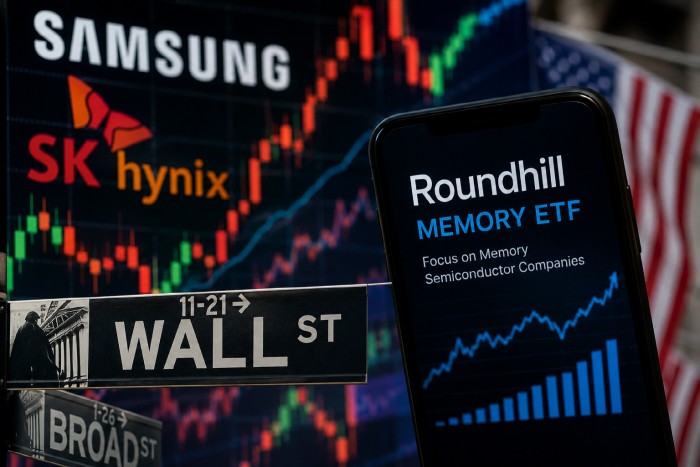 |
| Image representing the U.S.-listed "Roundhill Memory ETF," which invests in memory chip companies including Samsung Electronics and SK Hynix. / This image was generated by AI. |
Domestic retail investors trading in U.S. stocks — commonly known as "seohak ants" — bought more than 100 billion won worth of U.S.-listed exchange-traded funds (ETFs) holding memory chipmakers like Samsung Electronics and SK Hynix over the past week alone. Meanwhile, in the domestic market, large sums of money flowed into ETFs tracking major U.S. indices.
According to the Korea Securities Depository's SEIBro securities information portal on the 22nd, "seohak ants" net purchased $85.61 million (about 118.5 billion won) of the "Roundhill Memory ETF" from the 14th to the 20th (based on inquiry date). This was the second-largest amount among all overseas stocks Korean retail investors bought over the period, behind only Alphabet ($89.12 million).
The Roundhill Memory ETF is a U.S.-listed actively managed ETF that focuses on memory chipmakers such as Samsung Electronics, SK Hynix, and Micron.
The inflow appears to reflect a recent recovery in memory chip stocks across both domestic and international markets. From the 10th to the 21st, SK Hynix shares rose 21.66% and Samsung Electronics rose 21.86% — more than double the Kospi's gain of 10.45% over the same period. U.S. memory chipmakers Micron and SanDisk also rose 11.0% and 32.0%, respectively, from the 10th to the 20th.
In the domestic ETF market, products tracking major U.S. indices proved popular. According to Koscom's ETF Check, the domestically listed ETF with the largest net inflow from the 14th to the 20th was "TIGER U.S. S&P500," which drew 170.9 billion won, followed by "KODEX U.S. Nasdaq100" at 132.3 billion won.
Third and fourth place went to "KODEX Kospi" (120.5 billion won) and "KODEX 200 Futures Inverse 2X" (110.2 billion won). KODEX Kospi tracks the Kospi index at 1x, while KODEX 200 Futures Inverse 2X inversely tracks the daily return of Kospi 200 futures at 2x. In other words, similar amounts of money flowed into two products betting in opposite directions — reflecting how, amid heightened market volatility, investors betting on both a Kospi rise and a Kospi fall appear to have increased simultaneously.
Funds waiting on the sidelines that could flow into the market are also growing. Investor deposits totaled 105.3542 trillion won as of the 20th. According to the Korea Financial Investment Association, investor deposits, which had fallen to 97.9289 trillion won on the 11th, climbed back above 100 trillion won by the 14th and have since hovered around 105 trillion won.
The balance of margin loans — a gauge of "debt-fueled investing" — has also been rising. It stood at 31.8939 trillion won as of the 20th, up 3.1% from 13th, a week earlier. The margin loan balance, which stood at 27.4038 trillion won on the 4th, recovered above 30 trillion won by the 10th and has continued climbing since.
Jang Ji-young
Most Read
-
1
Celltrion nears additional contract with major U.S..

-
2
Putin proposes trilateral U.S.-China-Russia summit..

-
3
U.S. weighs dropping MOAB, world's most powerful n..

-
4
"Aren't those foreigners on welfare?": M..

-
5
Attention centers on APEC for possible Trump-Xi-Pu..

-
6
Saudi Arabia, Iran hold first diplomatic talks to..

-
7
China tightens grip on boosting domestic demand an..

PEOPLE







-
Address : In-Young Bldg., 34, Uisadang-daero 1-gil, Yeongdeungpo-gu, Seoul
Copyright by ASIATODAY CO., LTD. All rights resereved