



Trump declares "maximum-strength sanctions" on Iran
Aug 20, 2026, 04:46 pm


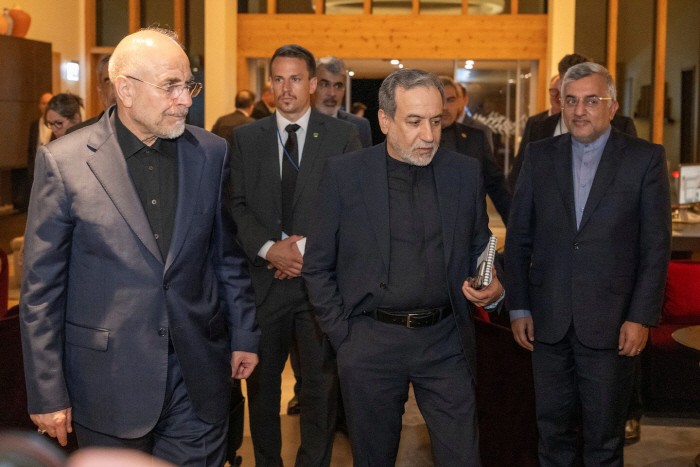 |
| Iranian Foreign Minister Abbas Araghchi (center) stands with Parliament Speaker Mohammad Bagher Ghalibaf (left) on the 20th (local time). / Reuters-Yonhap |
As President Donald Trump vowed to strengthen economic sanctions against Iran on an unprecedented scale, analysis has emerged suggesting Iran is seeking new breakthroughs by expanding financial and military cooperation with Russia and China.
Fox News reported on the 19th (local time), citing regional security experts, that Iran is strengthening ties with Russia and China to counter not just military pressure from the U.S. and Israel but political and economic pressure as well.
Behnam Ben Taleblu, senior director of the Iran Program at the Foundation for Defense of Democracies (FDD), explained that Iran is seeking to entangle itself more deeply with Russia and China in response to U.S. economic pressure, describing this as a move to maximize ties with countries that have themselves previously experienced U.S. sanctions.
Iran has recently sought active integration into non-Western cooperative bodies, including BRICS — the economic bloc comprising Brazil, Russia, India, China, and South Africa — and the Shanghai Cooperation Organisation (SCO), led by Russia and China.
Iranian Central Bank Governor Abdolnaser Hemmati said at a BRICS finance ministers and central bank governors meeting held in India on the 12th that Iran will soon join the BRICS-backed New Development Bank (NDB).
Military support has also continued. NBC News reported on the 17th that Russia is supplying Iran with ammunition, drone components, and TNT (high-performance explosives) via transport routes across the Caspian Sea.
Taleblu assessed that even a limited level of technical and military support significantly helps Iran survive and adapt in the face of the U.S.-led regional order.
He also identified Iran as a key link connecting what he called the "Axis of Aggressors" and the "Axis of Resistance." The Axis of Aggressors refers to a coalition of authoritarian states including Russia, China, and North Korea, while the Axis of Resistance refers to the network of Iran-backed regional militant groups, including Hamas, Hezbollah, the Houthi rebels, and Shiite militias in Iraq.
Taleblu explained that Iran serves as a bridge connecting the two axes, becoming a conduit through which funding, technology, and capabilities flow toward the Axis of Resistance, adding that Iran is working to evade U.S. political and economic pressure not only through its role in BRICS but also through other international bodies.
He added that even if Iran's economic goals within BRICS are not fully realized, the political and military support it receives from Russia and China carries significant weight, stressing that it's important for policymakers in Washington to recognize just how closely interconnected these national threats have become.
Park Jin-sook
Most Read
-
1
Trump shares map on social media labeling Strait o..

-
2
Kia Sportage outperforms Mazda CX-5 in German auto..

-
3
Houthis launch successive attacks on Saudi airport..

-
4
U.S. deploys carrier, 10,000 more troops to Middle..

-
5
Trump rejects Iran's offer to open Strait of Hormu..

-
6
N. Korea conducts first swarm attack drill with dr..

-
7
U.S.-China summit falls short on substance as Trum..

PEOPLE






HEADLINE NEWS
- Seoul dismisses Ukraine's claim of 'S. Korean support for Russia' as "inaccurate and inappropriate"
- S. Korea, Japan race to develop nuclear-powered submarines
- Henri Kagan, Kenso Soai win Nobel Prize in Chemistry for uncovering how mol..
- Vance says Alaska LNG cooperation will move forward with Seoul's current or..

-
Address : In-Young Bldg., 34, Uisadang-daero 1-gil, Yeongdeungpo-gu, Seoul
Copyright by ASIATODAY CO., LTD. All rights resereved