



Thailand takes new approach to southern insurgency
Aug 20, 2026, 02:29 pm


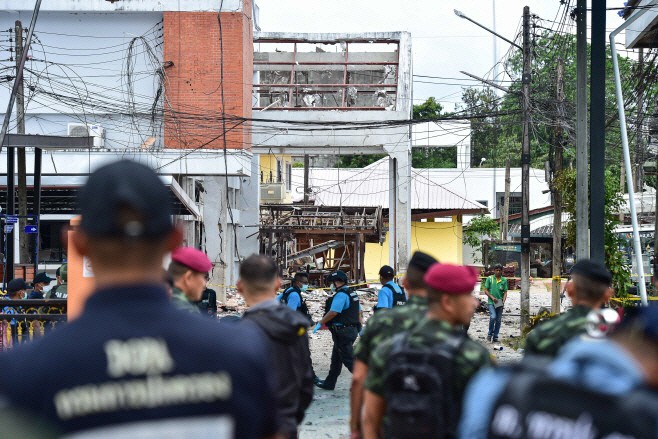 |
| Military and police investigate the scene of an attack in Narathiwat Province, southern Thailand, that killed 2 and injured 12 in March of last year. / AFP-Yonhap |
Thailand's chief negotiator for the southern conflict said the government would abandon its previous transactional approach to the more than two-decade-long separatist insurgency, shifting instead toward discussing what form of governance would actually suit the region. Both sides have been in talks aiming for a preliminary agreement as early as September.
According to Reuters on the 20th (local time), Tanut Suwannananda, director-general of Thailand's National Intelligence Agency (NIA) and chief negotiator for southern peace talks, said, "It's not a matter of principle whether we make a deal or not," adding, "We shouldn't fall into the trap of asking what we should give if they lay down their guns."
He said Thailand needs to revisit what form of governance would truly suit the southern border region, signaling a more flexible stance than before on decentralization and autonomy mechanisms. He also outlined a vision for turning insurgent group Barisan Revolusi Nasional (BRN) into "a potential partner rather than an enemy." Tanut said the government is also considering amnesty, sentence reductions, and pardons for insurgent suspects with outstanding warrants or those currently detained.
He said he envisions a structure, developed through public hearings, in which BRN representatives or figures trusted by BRN would work alongside Thai officials and experts to explore governance options such as decentralization. He also took a conciliatory stance, calling for existing security measures like village lockdowns, searches, and checkpoints to be reviewed, noting they could deepen local resentment, and urged continued dialogue.
Thailand is a Buddhist-majority country, but in its three southern provinces of Pattani, Yala, and Narathiwat — once part of the old Malay Sultanate of Pattani — BRN has waged a guerrilla campaign seeking independence. The separatist conflict in this Muslim-majority southern region has claimed more than 7,800 lives since 2004.
Peace talks began in 2013 with Malaysia mediating, but have faced repeated setbacks due to changes in Thailand's government and internal divisions on both sides. Reuters noted that Tanut's proposals on amnesty, sentence reductions, and pardons have been discussed before but never translated into concrete measures.
The Thai government's new approach has also gotten off to a shaky start. Scheduled talks were postponed after an attack in Narathiwat last month killed five security personnel and injured six civilians. Authorities said discussions had been going well and asked BRN for an explanation of the attack, but no official date has been set for resuming formal talks.
Rungrawee Chalermsripinyorat, a lecturer at Prince of Songkla University who studies the southern conflict, said that while those at the negotiating table remain engaged, many others within the organization have already lost trust, attributing the recent surge in violence to eroding confidence in the peace process within BRN. She added that the government needs to be prepared to make genuine political concessions during negotiations.
Jeong Ri-na
Most Read
-
1
Trump shares map on social media labeling Strait o..

-
2
Kia Sportage outperforms Mazda CX-5 in German auto..

-
3
Houthis launch successive attacks on Saudi airport..

-
4
U.S. deploys carrier, 10,000 more troops to Middle..

-
5
Trump rejects Iran's offer to open Strait of Hormu..

-
6
N. Korea conducts first swarm attack drill with dr..

-
7
U.S.-China summit falls short on substance as Trum..

PEOPLE






HEADLINE NEWS
- Seoul dismisses Ukraine's claim of 'S. Korean support for Russia' as "inaccurate and inappropriate"
- S. Korea, Japan race to develop nuclear-powered submarines
- Henri Kagan, Kenso Soai win Nobel Prize in Chemistry for uncovering how mol..
- Vance says Alaska LNG cooperation will move forward with Seoul's current or..

-
Address : In-Young Bldg., 34, Uisadang-daero 1-gil, Yeongdeungpo-gu, Seoul
Copyright by ASIATODAY CO., LTD. All rights resereved