



Poverty drives child marriage crisis across Latin America
Aug 20, 2026, 01:11 pm


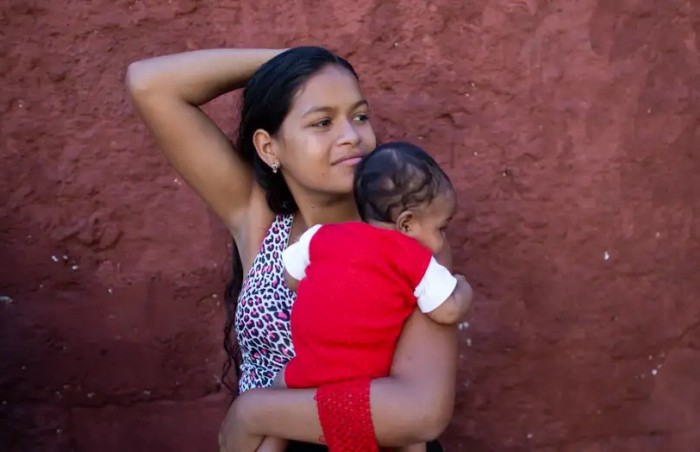 |
| A teenage girl holds a baby in Caracas, Venezuela. / AP-Yonhap |
Child marriage remains widespread across Latin America and the Caribbean, drawing renewed attention as a social problem.
According to BBC's Spanish-language service, Ecuadorian prosecutors said on the 18th (local time) that they recently arrested a 50-year-old man in Espejo, a locality along the Tigre River in the Amazonian province of Pastaza, for participating in human trafficking in order to marry a minor.
The man is accused of receiving a 10-year-old girl trafficked from Peru into Ecuador with the intent of entering into a so-called "forced marriage" — a marriage carried out against the victim's will.
Investigators identified the case while tracking two other minor trafficking incidents, ultimately rescuing the 10-year-old girl after a two-month investigation.
The case has drawn fresh attention to the severity of child marriage across Latin America and the Caribbean. A 2019 UNICEF survey of women aged 20-24 in the region found that roughly one in four had married or entered a cohabiting relationship before age 18.
The BBC noted that while sub-Saharan Africa has a higher rate of child marriage — affecting about four in ten girls — that figure has been declining amid bans and other regulatory measures, whereas Latin America and the Caribbean is the only region in the world showing no meaningful progress on the issue, raising concern among observers.
Poverty and Indigenous cultural traditions are cited as the main drivers behind the problem. Alma Bursiaga González, a spokesperson for the Latin America and Caribbean office of international NGO Girls Not Brides, said that poverty makes it difficult for girls to access education or economic opportunity, and that many are also exposed to violence — leading them to accept child marriage in search of economic stability and safety.
Child marriage has traditionally been common in Indigenous communities across Latin America and the Caribbean. The practice is said to have taken root during the Spanish colonial era, when marriage was institutionally permitted for boys from age 14 and girls from age 12. The 10-year-old girl rescued in Ecuador also belonged to an Indigenous community in Peru.
Authorities only began recognizing the severity of the issue in earnest in the 2010s. Nicaragua banned marriage under 18 in principle in 2014, and El Salvador enacted a similar ban in 2017.
Mexico fully banned marriage or cohabitation for those under 18 in 2019, followed by Peru in 2023 and Colombia and Bolivia, which enacted bans in 2025.
Even so, child marriage appears to remain widespread. Girls Not Brides said nearly 9,000 cases of child marriage were recorded in Mexico last year alone.
According to a 2025 UNICEF report, the three countries with the highest child marriage rates in Latin America and the Caribbean were the Dominican Republic, Nicaragua, and Honduras.
In the Dominican Republic, more than 35% of women aged 20 and older had married or entered a cohabiting relationship before turning 18.
The BBC noted that child marriage causes a range of harmful outcomes, including teen pregnancy, dropping out of school, and exposure to domestic violence, and stressed the need to address the underlying driver: poverty.
Son Young-sik
Most Read
-
1
Trump shares map on social media labeling Strait o..

-
2
Kia Sportage outperforms Mazda CX-5 in German auto..

-
3
Houthis launch successive attacks on Saudi airport..

-
4
U.S. deploys carrier, 10,000 more troops to Middle..

-
5
Trump rejects Iran's offer to open Strait of Hormu..

-
6
N. Korea conducts first swarm attack drill with dr..

-
7
U.S.-China summit falls short on substance as Trum..

PEOPLE






HEADLINE NEWS
- Seoul dismisses Ukraine's claim of 'S. Korean support for Russia' as "inaccurate and inappropriate"
- S. Korea, Japan race to develop nuclear-powered submarines
- Henri Kagan, Kenso Soai win Nobel Prize in Chemistry for uncovering how mol..
- Vance says Alaska LNG cooperation will move forward with Seoul's current or..

-
Address : In-Young Bldg., 34, Uisadang-daero 1-gil, Yeongdeungpo-gu, Seoul
Copyright by ASIATODAY CO., LTD. All rights resereved