



Iran's control over Strait of Hormuz significantly weakened, report says
Aug 20, 2026, 11:02 am


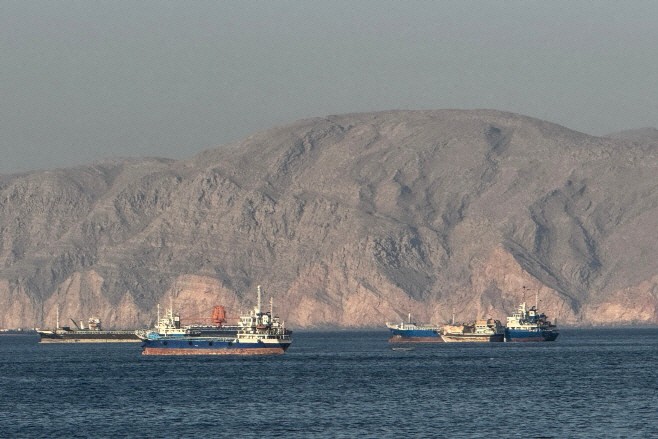 |
| Ships anchor in the Strait of Hormuz off the port city of Khasab on the Musandam Peninsula in northern Oman on August 17 (local time). / AFP, Yonhap |
As conflict surrounding control over the Strait of Hormuz emerges as a central flashpoint in the war between the U.S.-Israel alliance and Iran, recent developments in the strait point to expanding U.S. influence and a weakening of Iranian control, CNN reported on August 18 (local time).
According to ship-tracking firm Kpler, more than 80 percent of vessels passing through the Strait of Hormuz over the past two weeks used the United Nations-approved Omani route.
The Omani route is a passage that Iran has vehemently opposed. While Iran previously attacked ships attempting to use northern Omani waters in asserting its control over the Strait of Hormuz, most vessels recently chose the Omani route relying on protection from the U.S. Navy.
Homayoun Falakshahi, head of crude oil analysis at Kpler, remarked, "It appears that Iran has, at least partially, lost control over the strait."
This stands in stark contrast to just a month ago. At that time, very few ships used the Omani passage, but with most vessels recently opting for the Omani route, traffic has plunged along the route running north of the Strait of Hormuz and along Oman's coastline—which Iran promoted as its "approved passage."
Consequently, Iran is no longer able to collect the transit tolls it previously imposed, and Kpler explained that tolls are not actually being collected despite the memorandum of understanding (MOU) between the U.S. and Iran expiring this week.
Kuwait, Saudi Arabia, and the United Arab Emirates (UAE) are shifting their crude oil transportation methods. Andy Lipow, president of Lipow Oil Associates, explained that they are using Very Large Crude Carriers (VLCCs) to exit the Persian Gulf through the Strait of Hormuz and then transferring crude to client vessels outside high-risk areas in the Gulf of Oman, with some ships operating for weeks with their Automatic Identification Systems (AIS) turned off to evade Iranian attacks.
The U.S. has deployed massive military assets to the strait to monitor all vessels and claimed that far more crude oil is passing through the region than previously estimated. U.S. Secretary of Energy Chris Wright stated, "Crude oil transport through the strait alongside detour shipments reached roughly 15 million barrels per day last week," adding that this figure "approaches the pre-war average of 20 million barrels."
Regarding this, CNN assessed that it remains difficult to view the U.S. as having established complete control over the strait. This is because Iranian attacks on vessels persist, and crude transport volumes have yet to recover to pre-war levels.
Nevertheless, CNN analyzed that if the volume of oil claimed by the U.S. is indeed being transported through the strait, Iran's control and deterrence over the waterway can be seen as significantly diminished compared to one or two months ago.
Andy Lipow, president of Lipow Oil Associates, noted, "While incoming information and related reports must be viewed with caution, it is valid to say that Iran has partially lost control over the Strait of Hormuz."
Park Jin-sook
Most Read
-
1
Trump shares map on social media labeling Strait o..

-
2
Kia Sportage outperforms Mazda CX-5 in German auto..

-
3
Houthis launch successive attacks on Saudi airport..

-
4
U.S. deploys carrier, 10,000 more troops to Middle..

-
5
Trump rejects Iran's offer to open Strait of Hormu..

-
6
N. Korea conducts first swarm attack drill with dr..

-
7
U.S.-China summit falls short on substance as Trum..

PEOPLE






HEADLINE NEWS
- Seoul dismisses Ukraine's claim of 'S. Korean support for Russia' as "inaccurate and inappropriate"
- S. Korea, Japan race to develop nuclear-powered submarines
- Henri Kagan, Kenso Soai win Nobel Prize in Chemistry for uncovering how mol..
- Vance says Alaska LNG cooperation will move forward with Seoul's current or..

-
Address : In-Young Bldg., 34, Uisadang-daero 1-gil, Yeongdeungpo-gu, Seoul
Copyright by ASIATODAY CO., LTD. All rights resereved