



Experts say Trump's threat to "bomb Oman" is unlikely to happen
Aug 19, 2026, 03:35 pm


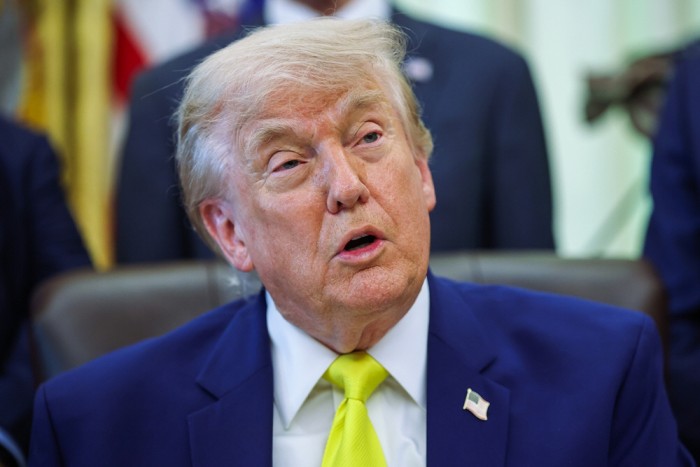 |
| U.S. President Donald Trump speaks about renovation work on the Lincoln Memorial Reflecting Pool and coal industry promotion policy at the Oval Office in Washington, D.C. on the 4th (local time). / EPA-Yonhap |
An expert has assessed that President Trump's warning to bomb Oman if the country obstructs U.S. operations in the Strait of Hormuz is unlikely to actually materialize.
According to CNN on the 18th (local time), the network cited an interview with Yasmine El-Gamal, a former Middle East adviser at the U.S. Department of Defense, who appeared on the program "Connect the World" to explain the context behind Trump's remark and past precedent.
El-Gamal said, "The U.S.-Iran war has been going on for six months now, with no end in sight," adding, "It's understandable that President Trump is feeling frustrated."
In an interview with Fox News the day before, Trump said, "If Oman interferes, I'll bomb them." He also called on Iran to "raise the white flag of surrender," sharply criticizing Oman's efforts to work with Iran to jointly manage the Strait of Hormuz.
El-Gamal cited Trump's past threat to "wipe out" Iranian civilization alongside his warning to Oman, noting that "President Trump tends to make these kinds of exaggerated statements when he's frustrated."
In early April, Trump warned on his social media platform Truth Social that he would bomb Iran's civilian infrastructure, including bridges and power plants, if Iran did not comply with U.S. demands, using inflammatory language such as vowing to "send Iran back to the Stone Age" and warning it would "live through hell."
This is also not the first time Trump has issued a threat against Oman. In May, he said the country "will have to be blown up" if it fails to cooperate with U.S. demands.
CNN assessed that Trump has repeatedly issued specific demands and deadlines while warning of military action against Iran and Oman, but that these threats have consistently not led to actual attacks — suggesting he is using the threats more as leverage to pressure negotiations than as genuine plans for military action.
Park Jin-sook
Most Read
-
1
Trump shares map on social media labeling Strait o..

-
2
Kia Sportage outperforms Mazda CX-5 in German auto..

-
3
Houthis launch successive attacks on Saudi airport..

-
4
U.S. deploys carrier, 10,000 more troops to Middle..

-
5
Trump rejects Iran's offer to open Strait of Hormu..

-
6
N. Korea conducts first swarm attack drill with dr..

-
7
U.S.-China summit falls short on substance as Trum..

PEOPLE






HEADLINE NEWS
- Seoul dismisses Ukraine's claim of 'S. Korean support for Russia' as "inaccurate and inappropriate"
- S. Korea, Japan race to develop nuclear-powered submarines
- Henri Kagan, Kenso Soai win Nobel Prize in Chemistry for uncovering how mol..
- Vance says Alaska LNG cooperation will move forward with Seoul's current or..

-
Address : In-Young Bldg., 34, Uisadang-daero 1-gil, Yeongdeungpo-gu, Seoul
Copyright by ASIATODAY CO., LTD. All rights resereved