



U.S. administration sanctions ICC's Japanese president and other senior officials
Aug 19, 2026, 01:08 pm


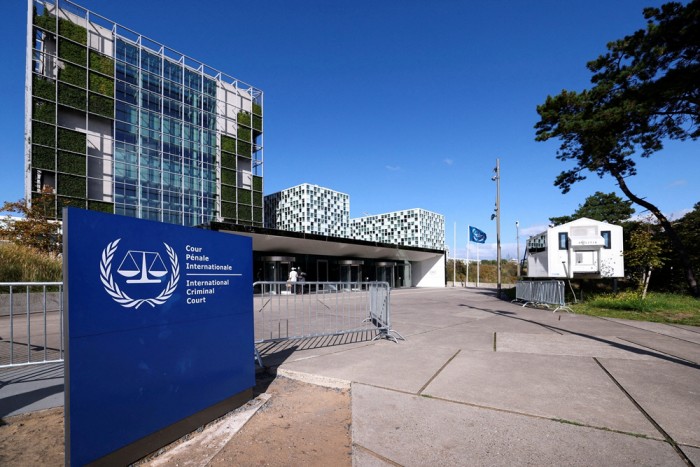 |
| The International Criminal Court (ICC) in The Hague, Netherlands. / Reuters-Yonhap |
The U.S. State Department imposed sanctions on the 18th (local time) on the president of the International Criminal Court (ICC) and other senior officials, as part of an effort to pressure the court, which Washington considers politicized.
According to Reuters and other outlets, Secretary of State Marco Rubio announced in a statement that day that sanctions had been imposed on ICC President Akane Tomoko, a Japanese national, and lead trial lawyer Abdoulaye Seye, a Senegalese national.
The move follows an executive order President Trump issued last year authorizing sanctions against the ICC.
Rubio said the two officials "have been directly engaged in the ICC's efforts to investigate, arrest, detain, or prosecute officials of governments that have not consented to the court's jurisdiction."
The U.S. Treasury Department's Office of Foreign Assets Control (OFAC) also added President Akane and lawyer Seye to its Specially Designated Nationals (SDN) sanctions list that same day.
Under the sanctions, the individuals' assets held in the U.S. could be frozen, and they could be cut off from the U.S. financial system. Since nearly every bank engaged in international relations maintains close ties with the U.S., this could significantly constrain their financial transactions.
The ICC immediately issued a statement pushing back, arguing the measures undermine the rule of law and warning that "the international legal order is put at risk when judicial officials carrying out their mandate are threatened."
Lawyer Seye serves as lead counsel for the prosecution team that sought an arrest warrant for Israeli Prime Minister Benjamin Netanyahu and is a nominated candidate for ICC judge.
Dutch Foreign Minister Tom Berendsen, whose country hosts the ICC, said on social media that his government opposes the U.S. sanctions and plans to invite President Akane to discuss support measures.
Berendsen stressed, "International courts and tribunals must be able to carry out their mandate freely."
The ICC is a permanent international court established in The Hague, Netherlands in 2002 under the Rome Statute signed in 1957. It has jurisdiction over serious international crimes and punishes individuals who violate international humanitarian law.
The U.S. government has argued that since it is not a party to the Rome Statute, the ICC has no authority to try American citizens.
Last year, the U.S. also sanctioned multiple ICC officials, including judges and prosecutors, citing the court's issuance of arrest warrants for Netanyahu and former Israeli Defense Minister Yoav Gallant, as well as its past investigation into U.S. forces stationed in Afghanistan.
Kim Hyun-min
Most Read
-
1
Trump shares map on social media labeling Strait o..

-
2
Kia Sportage outperforms Mazda CX-5 in German auto..

-
3
Houthis launch successive attacks on Saudi airport..

-
4
U.S. deploys carrier, 10,000 more troops to Middle..

-
5
Trump rejects Iran's offer to open Strait of Hormu..

-
6
N. Korea conducts first swarm attack drill with dr..

-
7
U.S.-China summit falls short on substance as Trum..

PEOPLE






HEADLINE NEWS
- Seoul dismisses Ukraine's claim of 'S. Korean support for Russia' as "inaccurate and inappropriate"
- S. Korea, Japan race to develop nuclear-powered submarines
- Henri Kagan, Kenso Soai win Nobel Prize in Chemistry for uncovering how mol..
- Vance says Alaska LNG cooperation will move forward with Seoul's current or..

-
Address : In-Young Bldg., 34, Uisadang-daero 1-gil, Yeongdeungpo-gu, Seoul
Copyright by ASIATODAY CO., LTD. All rights resereved