



Putin visits Kuril Islands, which Japan claims as its own
Aug 18, 2026, 01:47 pm


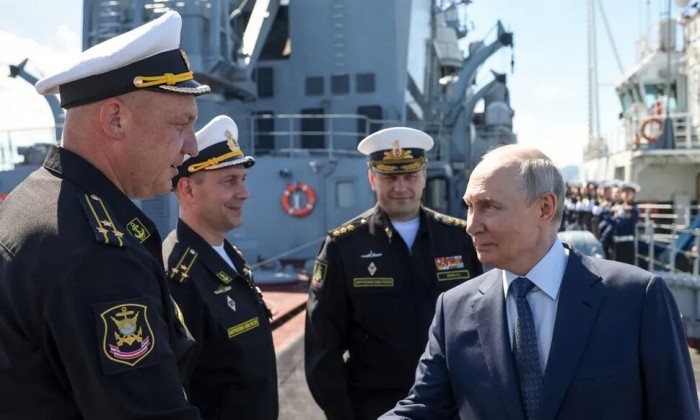 | ||
Russian President Vladimir Putin visits the Kuril Islands on the 13th (local time), shaking hands with a naval officer aboard the Pacific Fleet missile cruiser "Varyag." This marks Putin's first visit to the Kuril Islands — a territory disputed between Russia and Japan — during his 22 years in power. / Sakhalin, Reuters-Yonhap
Japan-Russia relations have sharply cooled again after Russian President Vladimir Putin made a surprise visit to the disputed Kuril Islands off Hokkaido, which Japan has long sought to have returned. Analysts note that with Japan's relations with China having already fallen to their worst level in decades, this direct clash with Russia further underscores the growing importance of stable Korea-Japan relations within Japan's overall diplomatic posture.
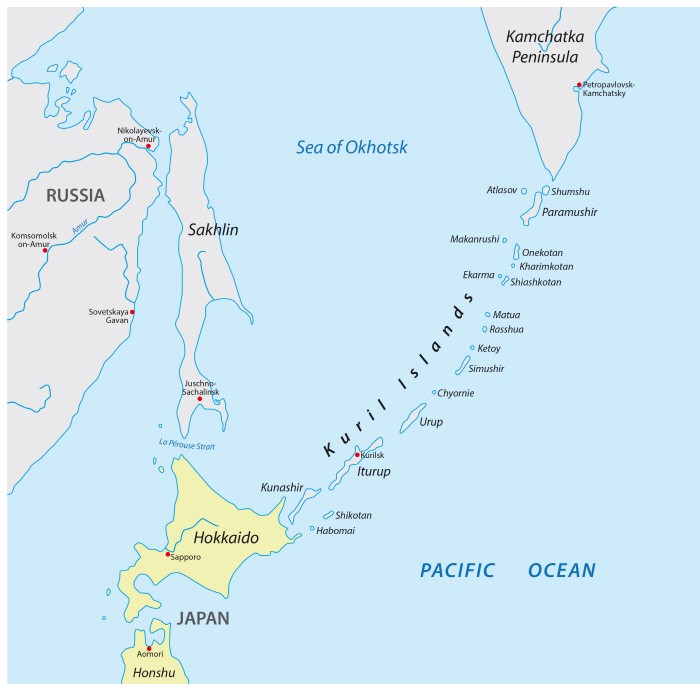
According to the Sankei Shimbun and other outlets on the 18th, Russian Foreign Minister Sergey Lavrov, responding to Japan's protest over Putin's visit to Etorofu, plans to summon Japanese Ambassador to Russia Muto Akira to convey Russia's position. Putin visited Etorofu, an island northeast of Hokkaido, on the 13th — the largest of the four islands (Etorofu, Kunashiri, Shikotan, and the Habomai group) that Japan calls its "Northern Territories" and has sought to have returned. This marked Putin's first personal visit to the disputed territory since taking power.
Japan's government immediately protested. Prime Minister Takaichi Sanae strongly objected, calling the visit an absolutely unacceptable act that hurts the feelings of the Japanese people, and Japan's Foreign Ministry summoned Russian Ambassador to Japan Nikolai Nozdrev to lodge a protest. Russia pushed back, saying Japan has no right to interfere with a president's visit to his own country's territory. The four islands were occupied by the Soviet Union in 1945, near the end of World War II, and remain under Russian control to this day. Japan has long claimed the islands as its own inherent territory and demanded their return — a dispute that has kept the two countries from signing a formal peace treaty even more than 80 years after the war ended.
This latest clash is especially notable because it comes just as Japan had been working to reopen a difficult dialogue channel with Russia. Japanese government officials visited Moscow in May to discuss issues including the assets of Japanese companies still remaining in Russia. Last month, Foreign Minister Motegi Toshimitsu and Foreign Minister Lavrov made direct contact for the first time since Russia's invasion of Ukraine — an effort to prevent relations from deteriorating further while still maintaining sanctions against Russia.
In Tokyo's diplomatic circles, analysts see Putin's visit as testing Japan's efforts to keep dialogue open while also serving as a way to pressure Japan on future economic cooperation and sanctions issues. If Japan raises the intensity of its response, relations with Russia could deteriorate uncontrollably, leaving Tokyo with limited diplomatic options. What further complicates matters for Japan is its relationship with China, which has rapidly deteriorated since Prime Minister Takaichi's remarks on a potential Taiwan contingency. China has tightened export controls on rare earths and other strategic materials to Japan, and recently detained employees of a Japanese company on allegations related to rare earth product exports. Adding to Japan's burden, on the same day as Putin's visit to Etorofu, the Chinese and Russian ambassadors to Japan issued a joint statement opposing efforts to revise the outcomes of World War II and opposing remilitarization in the Asia-Pacific region. Because of this, the fallout from the Russia-Japan clash is likely to extend to Korea-Japan relations as well. For Japan, facing simultaneous deterioration in relations with neighboring countries — China, Russia, and now potentially Korea as well — would be difficult to manage. Stable Korea-Japan relations have thus become important not merely as a bilateral issue, but as a pillar supporting Japan's broader diplomatic space in Northeast Asia. This could give Korea more room diplomatically. As Japan's external relations grow more difficult, Tokyo is likely to place greater importance on stably managing ties with Korea. Analysts say this gives Korea greater room to expand its national interests through practical cooperation — in areas like the economy, supply chains, security, and people-to-people exchange — while still maintaining its existing principles on historical issues. As tensions between China/Russia and Japan intensify in Northeast Asia, stably managing Korea-Japan relations could itself become a card that broadens Korea's diplomatic options. Choi Young-jae |
Most Read
-
1
Trump shares map on social media labeling Strait o..

-
2
Kia Sportage outperforms Mazda CX-5 in German auto..

-
3
Houthis launch successive attacks on Saudi airport..

-
4
U.S. deploys carrier, 10,000 more troops to Middle..

-
5
Trump rejects Iran's offer to open Strait of Hormu..

-
6
N. Korea conducts first swarm attack drill with dr..

-
7
U.S.-China summit falls short on substance as Trum..

PEOPLE






HEADLINE NEWS
- Seoul dismisses Ukraine's claim of 'S. Korean support for Russia' as "inaccurate and inappropriate"
- S. Korea, Japan race to develop nuclear-powered submarines
- Henri Kagan, Kenso Soai win Nobel Prize in Chemistry for uncovering how mol..
- Vance says Alaska LNG cooperation will move forward with Seoul's current or..

-
Address : In-Young Bldg., 34, Uisadang-daero 1-gil, Yeongdeungpo-gu, Seoul
Copyright by ASIATODAY CO., LTD. All rights resereved