



Asian allies voice growing security concerns as U.S. focuses on Iran war
Aug 18, 2026, 10:28 am


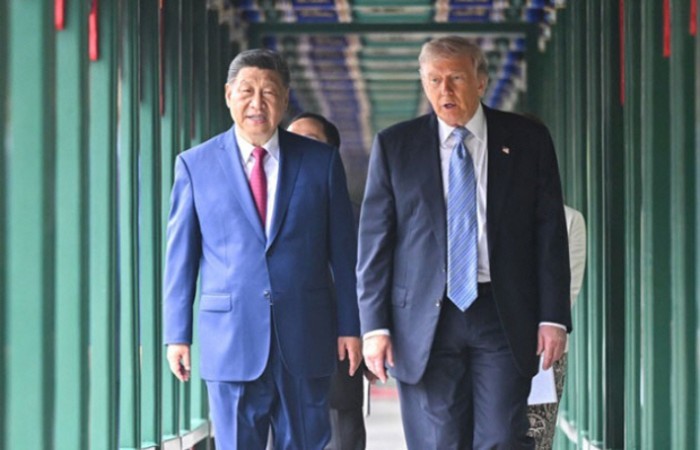 |
| Trump, Xi Jinping. / Yonhap |
While the U.S. focuses its resources on the war with Iran, China is accelerating its expansion in Asia, deepening security concerns among American allies, the New York Times reported on the 15th (local time).
Last month, near Scarborough Shoal in the South China Sea, China's coast guard struck Philippine personnel with batons and used water cannons — the largest armed confrontation between the two countries in years. China claimed the Philippines had provoked the incident, sparking a dispute over responsibility, while the U.S. ambassador to the Philippines affirmed Washington's support for Manila.
NYT assessed that there is no expectation China will scale back its expansionist behavior. As the war with Iran diverts U.S. attention and depletes American resources, Asian countries are growing increasingly skeptical about whether Washington remains willing to counter China's influence.
The depletion of key U.S. military assets, such as air defense interceptor missiles, was also flagged as a concern. Iranian missile and drone attacks have destroyed facilities at some U.S. bases in the Middle East and forced troop evacuations. NYT interpreted this as a preview of the role China's military — stronger than Iran's — could play in an Asian conflict.
China test-launched a submarine-launched ballistic missile (SLBM) capable of carrying a nuclear warhead in the Pacific on the 6th of last month. SLBMs are considered a core component of China's weapons arsenal.
During the same period, the Trump administration moved to close some consulates in Indonesia and Japan, among other locations, and raised the need for increased defense cost-sharing contributions from allies.
The warming trend in U.S.-China relations is also cited as a source of unease among American allies. Since China's retaliatory tariffs last year, Trump has treated Beijing as an equal great power, continuing to praise President Xi Jinping at their summit in Beijing this past May. NYT assessed that Trump's "G2" vision has unsettled the bipartisan approach of confronting China that the U.S. had pursued over the past decade or so.
Some Asian countries, while feeling sidelined, are choosing to maintain friendly relations with China regardless. NYT's analysis notes that China remains the largest trading partner for most of these countries, while the U.S. has failed to offer a viable economic alternative.
Mira Rapp-Hooper, a visiting fellow at the Brookings Institution who served on the National Security Council under the Biden administration, said Southeast Asian countries want the U.S. to serve as a counterweight to China, even as they don't want to get caught up in a U.S.-China confrontation. She added that the perception that the U.S. is losing its standing as a viable alternative has deepened concerns among many partner countries.
Lee Seo-yeon
Most Read
-
1
Trump shares map on social media labeling Strait o..

-
2
Kia Sportage outperforms Mazda CX-5 in German auto..

-
3
Houthis launch successive attacks on Saudi airport..

-
4
U.S. deploys carrier, 10,000 more troops to Middle..

-
5
Trump rejects Iran's offer to open Strait of Hormu..

-
6
N. Korea conducts first swarm attack drill with dr..

-
7
U.S.-China summit falls short on substance as Trum..

PEOPLE






HEADLINE NEWS
- Seoul dismisses Ukraine's claim of 'S. Korean support for Russia' as "inaccurate and inappropriate"
- S. Korea, Japan race to develop nuclear-powered submarines
- Henri Kagan, Kenso Soai win Nobel Prize in Chemistry for uncovering how mol..
- Vance says Alaska LNG cooperation will move forward with Seoul's current or..

-
Address : In-Young Bldg., 34, Uisadang-daero 1-gil, Yeongdeungpo-gu, Seoul
Copyright by ASIATODAY CO., LTD. All rights resereved