



Gov't to release W30tn more in loans, launch youth mortgage for non-apartment homes
Aug 14, 2026, 10:05 am


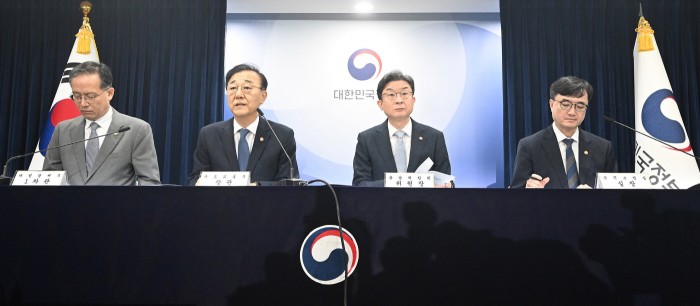 |
| Land, Infrastructure and Transport Minister Kim Yun-deok (second from left) gives a briefing on "Measures for Rapid Housing Supply to Stabilize the Rental and Sales Markets and Comprehensive Financial Measures to Stabilize the Real Estate Market" at a video conference room in the Government Complex Seoul, Jongno-gu, on the morning of the 13th. Also in attendance were Office for Government Policy Coordination Minister Lim Ki-geun, Financial Services Commission Chairman Lee Eok-won, and Vice Minister of Economy and Finance Lee Hyung-il. / Park Sung-il, Staff Photographer |
The government is doubling this year's target for household debt growth from 1.5% to 3%. As household loan volume controls had begun squeezing even genuine borrowing needs — like relocation and settlement loans for moving homes — the government is expanding lending capacity to ease the "loan cliff" for the second half of the year.
Still, core regulations such as the loan-to-value (LTV) and debt service ratio (DSR) will remain unchanged, continuing the government's approach of managing speculative demand.
The Financial Services Commission (FSC) announced on the 13th a "Comprehensive Financial Package to Stabilize the Real Estate Market," raising this year's household debt growth target to 3%.
This is expected to free up roughly 30 trillion won in additional lending capacity across the financial sector, which will be directed toward easing financing difficulties for genuine homebuyers, including relocation, interim, and settlement loans.
Financial support for housing supply will also expand from 26.3 trillion won to 47.8 trillion won plus additional funding. Public guarantees for normally functioning project financing (PF) sites will rise from 23 trillion won this year to 33 trillion won next year, with 30 trillion won planned for 2028 as well. For distressed PF sites, a new PF normalization support fund worth 3 trillion won plus additional funding will be set up through the Korea Asset Management Corporation (KAMCO), and joint bank-insurance syndicated loans will expand from 1 trillion won to 5 trillion won. Implementation of equity capital ratio regulations for residential PF projects will be pushed back from 2027 to 2029.
Targeted support for genuine buyers, including young people, will also be strengthened. Starting in January next year, the government plans to tentatively launch the "Youth Future Bogeumjari Loan," available to first-time homebuyers aged 39 or younger purchasing a non-apartment home priced at 400 million won or below with exclusive floor area of 85 square meters or below, along with a new product that also guarantees jeonse and monthly rent loans. For Bogeumjari loans, the government will also ease the so-called "marriage penalty," allowing newlywed couples to qualify if their combined annual income is 85 million won or below, or if either spouse's individual income is 70 million won or below.
Meanwhile, the basic framework for managing household debt demand will remain unchanged, with core lending regulations such as LTV, DSR, and home price-based mortgage caps staying as they are.
FSC Chairman Lee Eok-won said, "We will manage money flowing toward speculation more tightly, while providing stronger financial support for housing supply and genuine homebuyer needs."
Park Seo-ah
Most Read
-
1
Celltrion’s Omlyclo gains ground in major European..

-
2
Trump demands rates fall below 1% as Fed hikes for..

-
3
Hyundai Motor Group breaks ground on integrated st..

-
4
U.S. strikes 3 Iranian oil tankers, Iran vows reta..

-
5
Trump makes $1 trillion bet ahead of midterm elect..

-
6
Iran resumes ballistic missile production, assembl..

-
7
Samsung Electronics, Mistral AI to jointly develop..

PEOPLE







-
Address : In-Young Bldg., 34, Uisadang-daero 1-gil, Yeongdeungpo-gu, Seoul
Copyright by ASIATODAY CO., LTD. All rights resereved