



Malaysia looks to palm oil for data center cooling, nears commercialization of cooling fluid
Aug 13, 2026, 02:45 pm


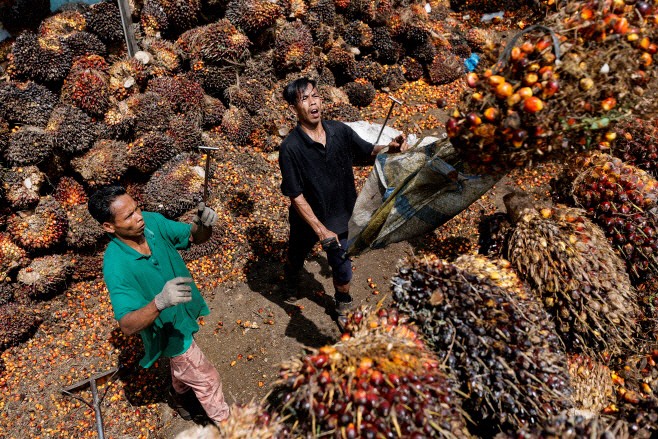 |
| Workers load palm fruit (oil palm) used for palm oil processing in Indonesia. / Reuters-Yonhap |
Malaysia, the world's second-largest palm oil producer, is nearing commercialization of a palm oil-based cooling fluid for data centers, as water-free cooling technology draws attention amid a data center boom pushing daily water consumption to nearly 29 million liters.
According to the South China Morning Post on the 13th (local time), researchers at the Malaysian Palm Oil Board (MPOB) have developed a palm oil-based cooling technology called "Sawit EcoTherm." Having been tested in real operating conditions, the technology is now in the final stages of licensing agreements with local manufacturers. According to Malaysia's National Water Services Commission, domestic data centers used up to 28.68 million liters of water per day as of January last year. MPOB data shows a 100-megawatt (MW) data center uses 1.7-4.2 million liters of water daily — a figure that could be eliminated entirely with Sawit EcoTherm.
Costs are also significantly lower than conventional methods. According to MPOB senior researcher Nur Kaeirin Mohd, for a 100MW data center, palm oil-based cooling fluid costs $2.44-6.10 per kg (about 3,450-8,630 won), far cheaper than synthetic or petroleum-based cooling fluids (about 17,260-27,620 won per kg). Since it eliminates the need for server fans and mechanical air conditioning, it can cut operating costs by 30-50% and energy consumption by up to 40%.
Behind the mounting water and power burden lies rapid growth in data center investment. According to the Malaysian Investment Development Authority (MIDA), 143 data center and cloud computing investment projects worth a combined $35.23 billion (about 50 trillion won) were approved between 2021 and mid-last year. Fadillah Yusof, Minister of Energy Transition and Water Transformation, told parliament in June last year that as of April, data centers were already using half of the approved power and water capacity. In a written response on the 24th of that same month, he explained that measures such as comprehensive technical assessments had been put in place to avoid affecting consumers and planned development projects.
However, experts caution that being palm oil-based doesn't automatically make the technology eco-friendly. Renard Siew, sustainability director at energy company Inhoco and a climate change expert, said the environmental impact must be assessed across the entire lifecycle — from raw material sourcing to processing, transport, use, and disposal — stressing that deforestation-free commitments, traceable and certified raw materials, and land-use safeguards must all be in place beforehand. There's concern that if demand for palm oil-based cooling fluid drives plantation expansion, environmental burdens could simply shift upstream in the supply chain.
Badrul Azhar, an associate professor at the Faculty of Forestry and Environment at Universiti Putra Malaysia, said this wouldn't necessarily lead to new plantation development. Since plantation land is limited even as demand rises across food, biofuel, and industrial uses, he said the more likely path is maximizing yield per hectare. Still, Badrul warned that intensification could lead to excessive use of fertilizers, herbicides, and pesticides, adding that the question isn't just whether forests were cleared for palm oil, but how palm oil is being produced on existing farmland.
Jeong Ri-na
Most Read
-
1
Trump shares map on social media labeling Strait o..

-
2
Kia Sportage outperforms Mazda CX-5 in German auto..

-
3
Houthis launch successive attacks on Saudi airport..

-
4
U.S. deploys carrier, 10,000 more troops to Middle..

-
5
Trump rejects Iran's offer to open Strait of Hormu..

-
6
N. Korea conducts first swarm attack drill with dr..

-
7
U.S.-China summit falls short on substance as Trum..

PEOPLE






HEADLINE NEWS
- Seoul dismisses Ukraine's claim of 'S. Korean support for Russia' as "inaccurate and inappropriate"
- S. Korea, Japan race to develop nuclear-powered submarines
- Henri Kagan, Kenso Soai win Nobel Prize in Chemistry for uncovering how mol..
- Vance says Alaska LNG cooperation will move forward with Seoul's current or..

-
Address : In-Young Bldg., 34, Uisadang-daero 1-gil, Yeongdeungpo-gu, Seoul
Copyright by ASIATODAY CO., LTD. All rights resereved