



Will Takaichi carry forward Ishiba's "reflection" in Japan's Aug. 15 message?
Aug 13, 2026, 01:51 pm


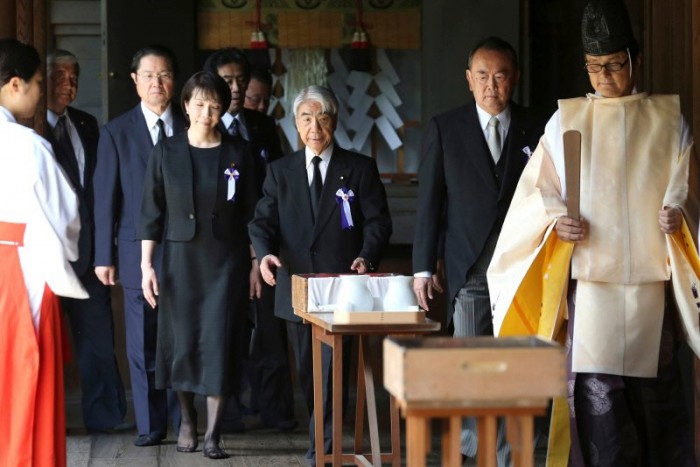 |
| Then-LDP Lower House lawmaker Takaichi Sanae, now Japan's prime minister, wears a ribbon as she walks with fellow lawmakers at Yasukuni Shrine in Tokyo on August 15, 2014. / AP-Yonhap |
Attention is turning to what historical stance Prime Minister Takaichi Sanae will strike on the 15th, marking 81 years since Japan's defeat, given that then-Prime Minister Ishiba Shigeru revived the word "reflection" in Japan's official August 15 memorial address last year — the first time it had appeared in 13 years. Japan's government will hold its National Memorial Ceremony for War Dead at Nippon Budokan in Tokyo on the 15th. Under a 1982 Cabinet decision, the government officially designated August 15 as a "day to mourn the war dead and pray for peace" each year, with the government tallying roughly 3.1 million war dead as the object of remembrance. The ceremony is attended by the prime minister, the Speaker of the House, the Chief Justice, and representatives of bereaved families, with a moment of silence observed at noon.
This year, the biggest question is how much of Ishiba's language Takaichi will carry forward. In his August 15 address last year, Ishiba said Japan must never again repeat the devastation of war and must never take the wrong path again, adding that the nation must deeply engrave in its heart the reflection on and lessons of that war. It marked the first time the word "reflection" had appeared in a prime minister's memorial address in 13 years. At a press conference immediately afterward, Ishiba explained the wording was deliberate, saying that reflection comes first, and lessons follow from it.
Takaichi's official remarks at war memorial events so far this year offer some clues. At a memorial ceremony for the Battle of Okinawa victims on June 23, she referenced the battle, which killed more than 200,000 people including civilians, saying Japan has walked the path of a nation that values peace, under a firm resolve never again to repeat the devastation of war. However, this remark alone isn't enough to determine whether the word "reflection" will appear in her August 15 address.
Another variable is Yasukuni Shrine. The Mainichi Shimbun reported on the 12th, citing multiple Japanese government and ruling party officials, that Takaichi has begun leaning toward not personally visiting Yasukuni Shrine on the 15th. The move is reportedly informed by considerations of maintaining good relations with South Korea and avoiding further diplomatic friction with China. However, sources close to the prime minister said no final decision has been made yet.
Before becoming prime minister, Takaichi visited Yasukuni Shrine on multiple occasions during her time as a Cabinet minister and LDP executive, including around August 15. She did not personally visit during last October's autumn festival, shortly before taking office as prime minister, or this April's spring festival. In April, she sent a ritual offering under the prime minister's name, which drew an official protest from the Chinese government.
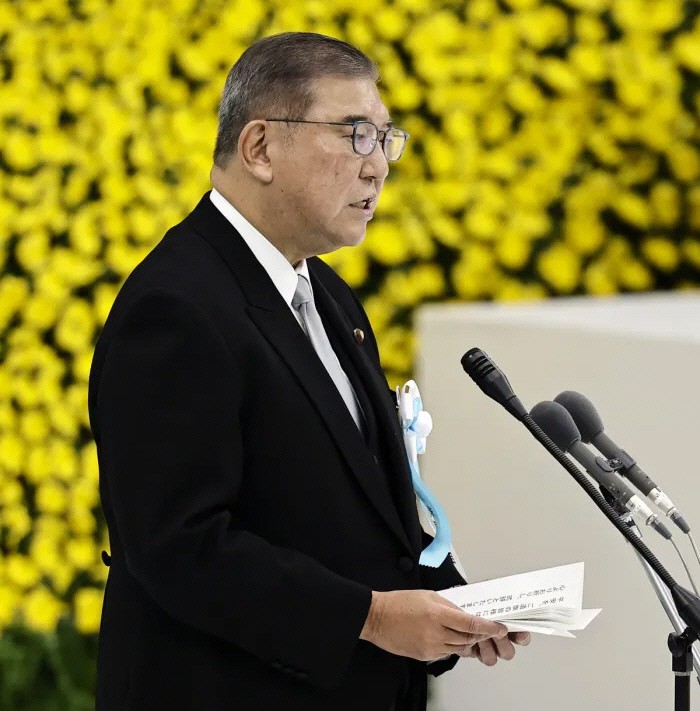 |
| Former Japanese Prime Minister Ishiba Shigeru delivers a memorial address at the National Memorial Ceremony for War Dead at Nippon Budokan in Tokyo on August 15, 2025. / Yonhap |
In Korea, the 15th marks the 81st anniversary of Liberation Day. In his March 1 Independence Movement Day address this year, President Lee Jae-myung said of relations with Japan that Korea would face the past directly, work together to resolve present-day issues, and move forward toward the future. At the same time, he also called on the Japanese government to respond based on genuine understanding and empathy.
China has taken a more direct approach to Japan's historical issues. China's Foreign Ministry protested Yasukuni-related developments in April, and in May, marking the 80th anniversary of the Tokyo Trials, it stressed the significance of the tribunal's finding that Japanese militarism had launched a war of aggression. Last August 15 as well, China described the day as marking Japan's unconditional surrender and called on Japan to squarely face and reflect on its history of aggression.
The U.S. and Russia mark the end of World War II on different dates than Japan altogether. Official U.S. Navy historical records treat September 2, 1945 — when Japanese government representatives signed the instrument of surrender aboard the USS Missouri in Tokyo Bay — as the moment of Japan's "formal surrender." Russia, since 2023, has designated September 3 as "Victory over Militarist Japan and the End of World War II Day."
August 15 thus carries distinct historical meanings across the region: Liberation Day in Korea, the 81st anniversary of defeat in Japan, memory of Japan's surrender and victory in the war of resistance against Japan in China, and separate September surrender/victory anniversaries in the U.S. and Russia. Amid this, the biggest point of interest is what language Prime Minister Takaichi actually chooses in her August 15 address, and whether she retains the word "reflection," which returned last year after a 13-year absence.
Choi Young-jae
Most Read
-
1
Trump shares map on social media labeling Strait o..

-
2
Kia Sportage outperforms Mazda CX-5 in German auto..

-
3
Houthis launch successive attacks on Saudi airport..

-
4
U.S. deploys carrier, 10,000 more troops to Middle..

-
5
Trump rejects Iran's offer to open Strait of Hormu..

-
6
N. Korea conducts first swarm attack drill with dr..

-
7
U.S.-China summit falls short on substance as Trum..

PEOPLE





HEADLINE NEWS
- Seoul dismisses Ukraine's claim of 'S. Korean support for Russia' as "inaccurate and inappropriate"
- S. Korea, Japan race to develop nuclear-powered submarines
- Henri Kagan, Kenso Soai win Nobel Prize in Chemistry for uncovering how mol..
- Vance says Alaska LNG cooperation will move forward with Seoul's current or..

-
Address : In-Young Bldg., 34, Uisadang-daero 1-gil, Yeongdeungpo-gu, Seoul
Copyright by ASIATODAY CO., LTD. All rights resereved