



WHO warns Congo's Ebola outbreak could surpass the worst on record
Aug 13, 2026, 01:03 pm


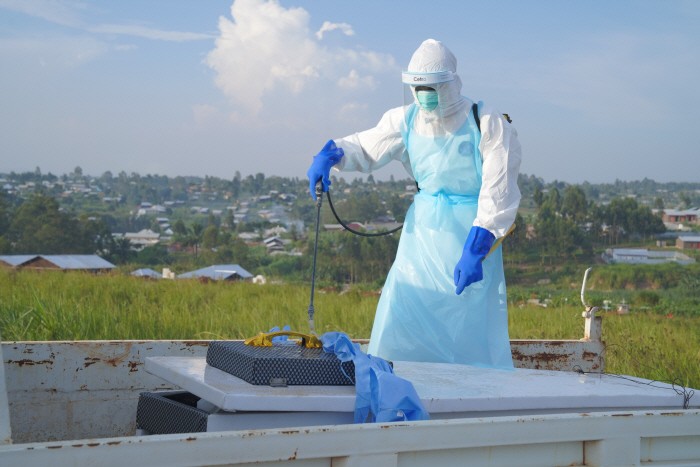 |
| A health worker sprays disinfectant on a coffin containing the remains of an Ebola victim in Bunia, Ituri Province, in eastern Democratic Republic of the Congo, on the 12th (local time). / AP-Yonhap |
AP reported on the 12th (local time) that the World Health Organization (WHO) has projected that the Ebola outbreak spreading through eastern Democratic Republic of the Congo could surpass the scale of the worst outbreak on record, in West Africa.
According to the WHO, the current outbreak has already recorded more than 4,300 cases and over 2,000 deaths, with the virus spreading rapidly.
WHO Director-General Tedros Adhanom Ghebreyesus warned that if the current pace of spread continues, the outbreak could exceed the 2014-2016 West Africa Ebola epidemic, which killed more than 11,000 people.
This outbreak involves the Bundibugyo strain of the virus, for which no approved vaccine or treatment currently exists, and it is spreading faster than the West Africa outbreak, which took eight months to reach 1,000 deaths.
Health authorities are struggling with tracking and containment efforts amid regional instability and poor conditions on the ground.
Eastern DRC, which borders South Sudan, Uganda, and Rwanda, is a remote region plagued by ongoing armed conflict and severely lacking in health infrastructure. Compounding the problem, local health workers have gone on strike over unpaid wages, while residents' wariness toward outsiders and the spread of false information have led many to avoid treatment, worsening the outbreak's toll.
DRC health authorities officially declared the Ebola outbreak on May 15, though genetic sequencing analysis later confirmed the virus had actually begun spreading as early as February this year.
Abdi Rahman Mahamud, the WHO's emergency response director, projected that the outbreak is expected to peak within six months, but could last up to 12 months depending on how the situation develops.
Efforts to develop vaccines and treatments are also accelerating. The first human clinical trials for two treatments and two vaccines specifically targeting the Bundibugyo virus have begun, centered in Ituri Province, the hardest-hit region. Verification of existing vaccines' preventive effectiveness is also underway.
According to a study recently published in the journal Nature Medicine, this outbreak's virus is genetically distinct from previously circulating strains. The outbreak has been confirmed not to be a resurgence of a past Ebola strain, but a new spillover from wildlife to humans.
Lee Jeong-eun
Most Read
-
1
Trump shares map on social media labeling Strait o..

-
2
Kia Sportage outperforms Mazda CX-5 in German auto..

-
3
Houthis launch successive attacks on Saudi airport..

-
4
U.S. deploys carrier, 10,000 more troops to Middle..

-
5
Trump rejects Iran's offer to open Strait of Hormu..

-
6
N. Korea conducts first swarm attack drill with dr..

-
7
U.S.-China summit falls short on substance as Trum..

PEOPLE






HEADLINE NEWS
- Seoul dismisses Ukraine's claim of 'S. Korean support for Russia' as "inaccurate and inappropriate"
- S. Korea, Japan race to develop nuclear-powered submarines
- Henri Kagan, Kenso Soai win Nobel Prize in Chemistry for uncovering how mol..
- Vance says Alaska LNG cooperation will move forward with Seoul's current or..

-
Address : In-Young Bldg., 34, Uisadang-daero 1-gil, Yeongdeungpo-gu, Seoul
Copyright by ASIATODAY CO., LTD. All rights resereved