



Taiwan hands down heavy sentence to Chinese-born spouse over election interference charges
Aug 13, 2026, 10:24 am


A Taiwanese court has sentenced a mainland Chinese-born spouse living in Taiwan to 7 years in prison at first instance, after being tried on charges of acting under Chinese direction to interfere in the 2022 local elections and 2024 presidential election, among others.
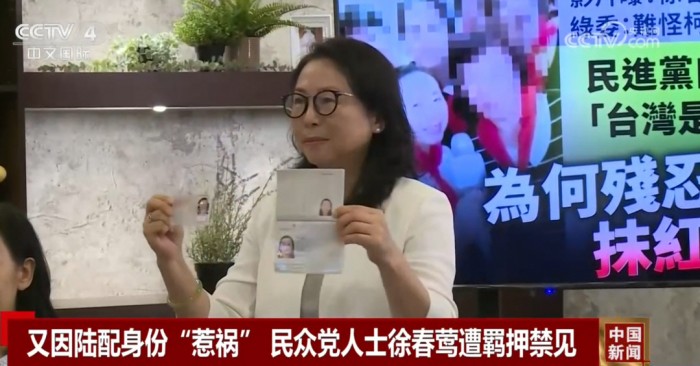 |
| A Chinese outlet's report claiming that Xu Chunying, honorary chairwoman of Taiwan's New Residents Development Association and chairwoman of the Cross-Strait Marriage Alliance, is facing persecution in Taiwan. / Jimu News |
According to Beijing sources familiar with cross-strait relations on the 12th, the Taiwanese district court for New Taipei City ruled the previous day on the case of Xu Chunying, honorary chairwoman of Taiwan's New Residents Development Association and chairwoman of the Cross-Strait Marriage Alliance, who had been indicted on four separate charges under the Anti-Infiltration Act, the Banking Act, the Criminal Code, and other laws.
According to the ruling, Xu, originally from Shanghai and married to a Taiwanese man in 1993, along with co-defendant Chung Chin-ming, chairman of the Cross-Strait Marriage Coordination Promotion Association, was recruited by China and stands accused of reporting on election-related developments involving the centrist opposition Taiwan People's Party from May 2021 to January 2024, acting on instructions from Yang Wentao, director of China's Ministry of Civil Affairs' Cross-Strait Marriage Center, and Sun Xian, deputy director of the Shanghai Municipal Committee's Committee for Promoting Peaceful Reunification of the Motherland.
She is also accused of working to support the Taiwan People's Party's presidential candidate Ko Wen-je, Taipei mayoral candidate Huang Shan-shan, and her own bid for a proportional-representation legislative seat. In addition, she is accused of falsifying documents related to Deputy Director Sun and submitting them to Taiwan's National Immigration Agency to help facilitate Sun's 10-day visit to Taiwan last October.
Xu is also accused of gathering and reporting information on the political participation of leaders of organizations representing Chinese spouses in Taiwan, while helping expand Chinese spouses' political influence and their entry into various public offices. Her alleged offenses don't end there — she is also accused of remitting more than 24.56 million New Taiwan dollars (about 1.08 billion won) to China through an illegal underground money-transfer network in Taiwan, under the guise of assisting Chinese spouses, while pocketing more than 210,000 New Taiwan dollars in commission fees along the way.
Prosecutors had earlier sought a sentence of 21 years and 6 months in prison, along with a fine of 23 million New Taiwan dollars, arguing that Xu had become a local collaborator for China in Taiwan — an extremely heavy sentence request. However, the first-instance court significantly reduced the sentence.
According to the sources, the Anti-Infiltration Act applied to Xu's case primarily prohibits those who receive funding, direction, or donations from "hostile external forces" from holding assemblies aimed at interfering in elections, lobbying public officials or legislators, or disrupting public order. Naturally, China and mainland-born residents in Taiwan have strongly pushed back against the law, calling it arbitrary and inconsistently applied.
Hong Soon-do
Most Read
-
1
Trump shares map on social media labeling Strait o..

-
2
Kia Sportage outperforms Mazda CX-5 in German auto..

-
3
Houthis launch successive attacks on Saudi airport..

-
4
U.S. deploys carrier, 10,000 more troops to Middle..

-
5
Trump rejects Iran's offer to open Strait of Hormu..

-
6
N. Korea conducts first swarm attack drill with dr..

-
7
U.S.-China summit falls short on substance as Trum..

PEOPLE






HEADLINE NEWS
- Seoul dismisses Ukraine's claim of 'S. Korean support for Russia' as "inaccurate and inappropriate"
- S. Korea, Japan race to develop nuclear-powered submarines
- Henri Kagan, Kenso Soai win Nobel Prize in Chemistry for uncovering how mol..
- Vance says Alaska LNG cooperation will move forward with Seoul's current or..

-
Address : In-Young Bldg., 34, Uisadang-daero 1-gil, Yeongdeungpo-gu, Seoul
Copyright by ASIATODAY CO., LTD. All rights resereved