



Trump expands U.S.-Mexico border wall construction
Aug 12, 2026, 02:23 pm


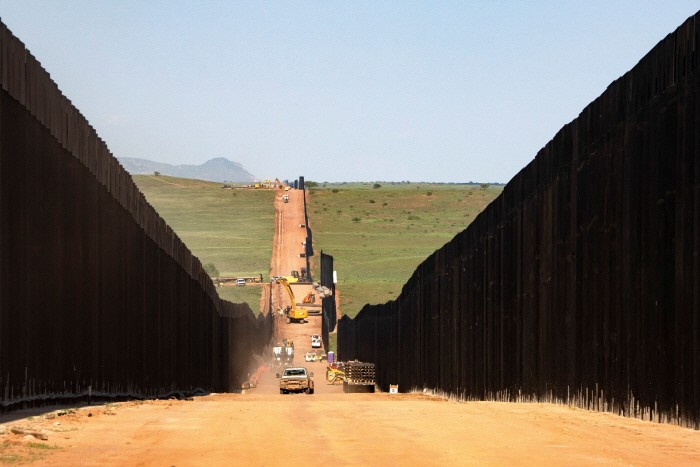 |
| Construction workers continue building the primary and secondary barriers along the U.S.-Mexico border in Rocky, Arizona, on the 8th (local time). / Reuters-Yonhap |
The Trump administration is significantly expanding U.S.-Mexico border wall construction, backed by a massive budget allocation.
According to the New York Times on the 11th (local time), the U.S. government plans to build at least 1,200 miles (about 1,930 km) of new primary and secondary border barriers along the southwestern border.
The project draws on roughly $47 billion (about 66.5 trillion won) in funding secured through the "One Big Beautiful Bill," enacted in July of last year — a sum exceeding the combined border wall budget of the past 20 years, with the funds available for use through September 2029. According to U.S. Customs and Border Protection (CBP), more than $33 billion (about 46.7 trillion won) in construction contracts have already been signed.
The core of the plan is roughly doubling the length of the existing "primary barrier" — steel fencing standing 5.5 to 9.1 meters tall. Construction is underway across all four states bordering Mexico: Texas, New Mexico, Arizona, and California. Plans also call for adding a "secondary barrier" set back from the border to reinforce the primary structure.
In rugged terrain and rural areas, vehicle barriers will be installed alongside advanced surveillance equipment such as smart cameras and detection sensors, along with new access roads, while large fixed buoys will be installed in the Rio Grande to block crossings by water.
CBP Commissioner Rodney Scott said the primary barrier is expected to be completed by the end of 2027, with the secondary barrier system finished by July 2028.
The expanded border wall project has also drawn criticism. Critics argue that with the number of illegal crossings having declined significantly in recent months, pouring massive funding into remote rural areas that previously had no barrier is of questionable value.
Legal and social conflicts over land ownership and environmental concerns have also continued throughout the construction process.
According to Time magazine, roughly 70% of the border zone consists of private, state-owned, or tribal land, complicating efforts to secure the necessary property. The Texas General Land Office sent a stop-work letter to a contractor over alleged disregard for state procedures and environmental damage, while the Tohono O'odham Nation has filed objections citing violations of tribal sovereignty. The federal government has said it will exercise eminent domain if land acquisition negotiations fail to reach agreement.
In New Mexico, allegations of unauthorized groundwater drilling for wall construction and concerns over depleted water resources for livestock have prompted CBP to temporarily halt drilling at some sites, with lawsuits from civil society groups continuing.
While the White House maintains that the project is an essential measure for securing the border and strengthening law enforcement, Native American tribes, local governments, and environmental groups continue to raise concerns over procedural legitimacy and environmental impact, suggesting the project is likely to face continued friction going forward.
Lee Jeong-eun
Most Read
-
1
Trump shares map on social media labeling Strait o..

-
2
Kia Sportage outperforms Mazda CX-5 in German auto..

-
3
Houthis launch successive attacks on Saudi airport..

-
4
U.S. deploys carrier, 10,000 more troops to Middle..

-
5
Trump rejects Iran's offer to open Strait of Hormu..

-
6
N. Korea conducts first swarm attack drill with dr..

-
7
U.S.-China summit falls short on substance as Trum..

PEOPLE






HEADLINE NEWS
- Seoul dismisses Ukraine's claim of 'S. Korean support for Russia' as "inaccurate and inappropriate"
- S. Korea, Japan race to develop nuclear-powered submarines
- Henri Kagan, Kenso Soai win Nobel Prize in Chemistry for uncovering how mol..
- Vance says Alaska LNG cooperation will move forward with Seoul's current or..

-
Address : In-Young Bldg., 34, Uisadang-daero 1-gil, Yeongdeungpo-gu, Seoul
Copyright by ASIATODAY CO., LTD. All rights resereved