



Taliban's 5 years in power: 2.4 million Afghan girls denied schooling
Aug 12, 2026, 10:15 am


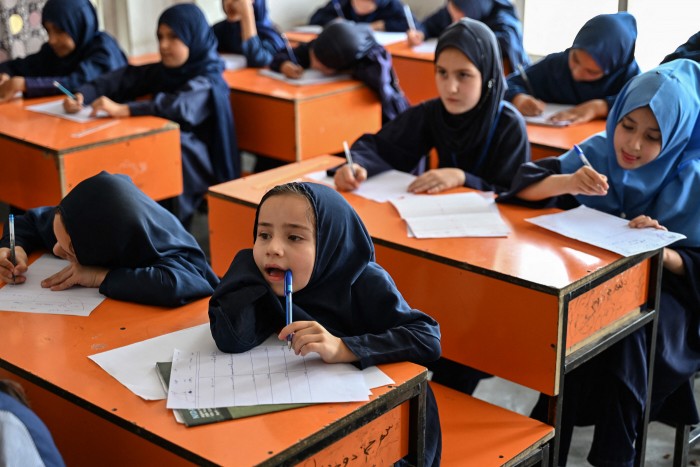 |
| Afghan girls take midterm exams at a primary school in Kabul, Afghanistan on the 21st of last month. / AFP-Yonhap |
Ahead of the fifth anniversary of the Taliban's return to power, UNESCO has said that roughly 2.4 million Afghan girls have now been shut out of secondary education.
According to Reuters on the 11th (local time), UNESCO said in a statement that day that Afghanistan remains the only country in the world to formally ban women's secondary and higher education, warning that the measure risks causing decades of lost potential, deepening poverty, and irreversible harm.
UNESCO estimated that the ban on women's education would push 600,000 Afghan women out of the labor market by 2066, with cumulative income losses reaching $9.6 billion (about 13.5 trillion won). It also projected a heightened risk of child marriage.
When the Taliban retook power in August 2021 alongside the U.S. withdrawal, it repeatedly pledged to the international community that it would guarantee women's right to education. However, in March 2022 it banned girls from attending secondary school, and by December of that year had also blocked women from attending university. The Taliban described both measures as temporary, but the bans remain in place to this day. The group maintains that it is respecting women's rights in accordance with its own interpretation of Islamic law and Afghan culture.
The fallout from the ban on women's education is also affecting boys. UNESCO estimated a shortage of more than 11,000 qualified female teachers by 2030. Hoda Zaberian, UNESCO's education-in-emergencies program coordinator, said many teachers have left the country, and even women who remained have been unable to continue teaching, adding that with women also barred from teaching boys, classes are increasingly being led by unqualified male teachers or going without a teacher altogether.
According to UNESCO, more than 90% of 10-year-old children in Afghanistan currently cannot read a simple text, and the national literacy rate stands at just 37%. Nearly half of schools lack basic water, sanitation, or heating facilities. Since 2021, natural disasters such as earthquakes and floods have forced 1,000 schools to close, and the shortage of schools has worsened further as 3 million people returned to Afghanistan in 2025 alone, through deportation or voluntary repatriation.
Jeong Ri-na
Most Read
-
1
Trump shares map on social media labeling Strait o..

-
2
Kia Sportage outperforms Mazda CX-5 in German auto..

-
3
Houthis launch successive attacks on Saudi airport..

-
4
U.S. deploys carrier, 10,000 more troops to Middle..

-
5
Trump rejects Iran's offer to open Strait of Hormu..

-
6
N. Korea conducts first swarm attack drill with dr..

-
7
U.S.-China summit falls short on substance as Trum..

PEOPLE





HEADLINE NEWS
- Seoul dismisses Ukraine's claim of 'S. Korean support for Russia' as "inaccurate and inappropriate"
- S. Korea, Japan race to develop nuclear-powered submarines
- Henri Kagan, Kenso Soai win Nobel Prize in Chemistry for uncovering how mol..
- Vance says Alaska LNG cooperation will move forward with Seoul's current or..

-
Address : In-Young Bldg., 34, Uisadang-daero 1-gil, Yeongdeungpo-gu, Seoul
Copyright by ASIATODAY CO., LTD. All rights resereved