



Philippines pushes bill to ban minors from social media after school shooting
Aug 11, 2026, 04:49 pm


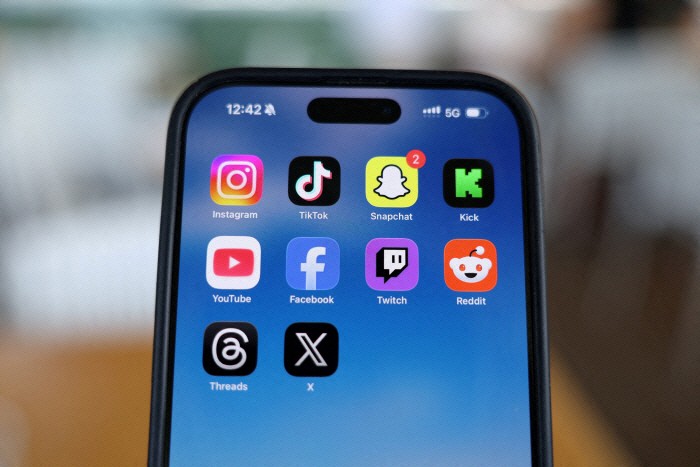 |
| Social media apps including Instagram, TikTok, Snapchat, YouTube, and Facebook are displayed on a phone screen. / Reuters-Yonhap |
The Philippine Congress has moved to draft legislation banning minors from using social media following a school shooting incident.
According to Channel News Asia (CNA) and local outlets on the 11th (local time), both the Philippine House of Representatives and Senate are recently pursuing bills to ban minors from using social media. The House bill would ban children under 13 from using social media, while the Senate bill extends the age restriction to under 16.
Both bills require online platforms to implement age and identity verification systems and to preemptively block accounts of users who don't meet the age requirement. Repeated violations could result in fines of up to 50 million pesos (about 1.2 billion won), and platforms could face permanent blocking within the Philippines.
The bills were directly prompted by a shooting at San Jose National High School in Tacloban City on June 22. Two students, aged 14 and 15, opened fire on campus, killing three students and injuring 20 — a rare school shooting that deeply shocked the Philippines.
Regarding the incident, Philippine Education Secretary Juan Edgardo Angara pointed to young people's exposure to harmful online content, grooming, and recruitment by terrorist organizations as one of the contributing factors.
Investigations found that one of the shooters had been recruited into an online extremist group called "764." Luis Angelo Talatala of cybersecurity civic group DeepWebConnect explained that members of the group take genuine pleasure in inciting violence and murder against others, calling it the organization's core ideology.
However, cybersecurity and mental health experts warn that an outright ban could backfire. They caution that minors pushed off mainstream platforms could migrate to hard-to-monitor underground sites instead. Psychologist PJ Bengwasan, a board member of the Psychological Association of the Philippines, criticized the approach, saying it effectively punishes the very people it's meant to protect. Experts recommend that working with platforms to detect and remove dangerous content and block recruitment attempts targeting children would be a more effective approach.
They also noted that online exposure alone cannot fully explain violent behavior. Many children who show violent tendencies are already struggling at home or at school, meaning social media restrictions alone have limits. Some are calling for expanded school counseling and stronger child mental health support. Bengwasan stressed that early signs of aggressive behavior at home should never be ignored, adding that setting boundaries is itself the beginning of a conversation.
Jeong Ri-na
Most Read
-
1
Trump shares map on social media labeling Strait o..

-
2
Kia Sportage outperforms Mazda CX-5 in German auto..

-
3
Houthis launch successive attacks on Saudi airport..

-
4
U.S. deploys carrier, 10,000 more troops to Middle..

-
5
Trump rejects Iran's offer to open Strait of Hormu..

-
6
N. Korea conducts first swarm attack drill with dr..

-
7
U.S.-China summit falls short on substance as Trum..

PEOPLE





HEADLINE NEWS
- Seoul dismisses Ukraine's claim of 'S. Korean support for Russia' as "inaccurate and inappropriate"
- S. Korea, Japan race to develop nuclear-powered submarines
- Henri Kagan, Kenso Soai win Nobel Prize in Chemistry for uncovering how mol..
- Vance says Alaska LNG cooperation will move forward with Seoul's current or..

-
Address : In-Young Bldg., 34, Uisadang-daero 1-gil, Yeongdeungpo-gu, Seoul
Copyright by ASIATODAY CO., LTD. All rights resereved