



Poland, Baltic states step up infrastructure security amid fears of Russian "false-flag" attacks
Aug 11, 2026, 01:06 pm


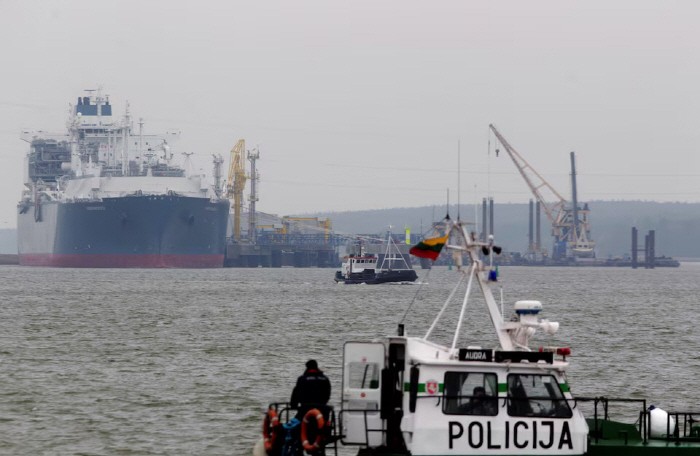 |
| The floating gas storage and regasification unit "Independence," one of Lithuania's key pieces of infrastructure. The military has increased security around the facility over fears of a possible false-flag attack by Russia. / Reuters-Yonhap |
Poland and the Baltic states (Lithuania, Latvia, Estonia) are significantly stepping up security around key infrastructure — dams, power plants, natural gas facilities — after intelligence agencies assessed that Russia could stage false-flag attacks using Ukrainian-made drones.
According to Reuters on the 10th (local time), Lithuania's government recently assessed that Moscow is considering carrying out false-flag attacks using Ukrainian drones. Poland, Latvia, and Estonia have also warned of the possibility of such operations, citing instances of Ukrainian-made drones found within their territory.
Lithuanian Defense Minister Robertas Kaunas told Reuters, "We are basing our readiness on intelligence," confirming stepped-up security at key infrastructure and cooperation with intelligence agencies. Lithuanian authorities have deployed military personnel to support security at LNG import terminals, oil terminals, power grid interconnectors, and pumped-storage hydroelectric plants.
Latvia has similarly increased security around the dam on the Daugava River near Riga and the Inčukalns underground gas storage facility. Latvian Prime Minister Andris Kulbergs said the level of hybrid threats has risen.
Regional intelligence officials said the core concern behind this warning may lie less in the immediate destruction of facilities and more in the political confusion that could unfold within the West and NATO over how to respond if such an attack occurs. Still, they have remained cautious about whether an actual attack will take place.
Polish energy company Orlen and gas infrastructure firm Gaz-System have begun exploring alternative routes and stepping up readiness in case import routes come under threat.
PEJ, the company developing Poland's first nuclear power plant, detected forged documents circulating under its name and has launched an investigation together with judicial authorities.
Sightings of drones of unclear origin have also been increasing across Europe. Recently, a drone carrying explosives was discovered at Leipzig-Halle Airport in Germany and is under investigation.
Russia's government has strongly pushed back against these claims, calling them nothing more than disinformation aimed at building justification for militarization. Kremlin spokesperson Dmitry Peskov criticized the Western warnings as merely an attempt to justify militarization against Russia, calling them one-sided claims based on Russophobia without concrete evidence.
Wojciech Konończuk, director of Poland's Centre for Eastern Studies, said the situation sends a message to Europe — a warning that instability will spread unless Moscow's demands are accepted — describing it as a dangerous gamble based on the calculation that the West's will to respond will be lacking.
Lee Jeong-eun
Most Read
-
1
Trump shares map on social media labeling Strait o..

-
2
Kia Sportage outperforms Mazda CX-5 in German auto..

-
3
Houthis launch successive attacks on Saudi airport..

-
4
U.S. deploys carrier, 10,000 more troops to Middle..

-
5
Trump rejects Iran's offer to open Strait of Hormu..

-
6
N. Korea conducts first swarm attack drill with dr..

-
7
U.S.-China summit falls short on substance as Trum..

PEOPLE






HEADLINE NEWS
- Seoul dismisses Ukraine's claim of 'S. Korean support for Russia' as "inaccurate and inappropriate"
- S. Korea, Japan race to develop nuclear-powered submarines
- Henri Kagan, Kenso Soai win Nobel Prize in Chemistry for uncovering how mol..
- Vance says Alaska LNG cooperation will move forward with Seoul's current or..

-
Address : In-Young Bldg., 34, Uisadang-daero 1-gil, Yeongdeungpo-gu, Seoul
Copyright by ASIATODAY CO., LTD. All rights resereved