



Takaichi hints at review of ban on bringing U.S. nuclear weapons into Japan
Aug 07, 2026, 01:15 pm


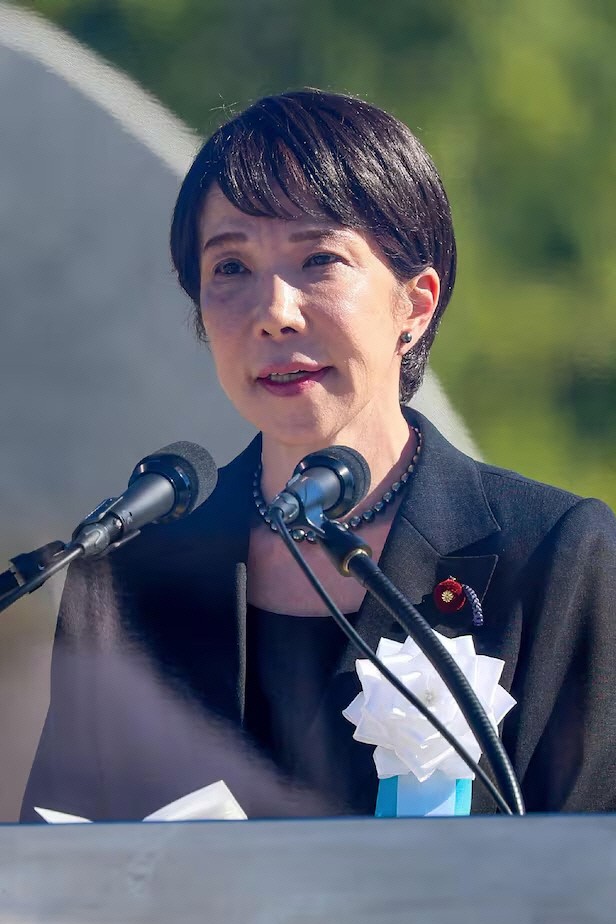 |
| Japan's Prime Minister Takaichi Sanae said on the 6th at the Hiroshima Peace Memorial Ceremony, "Japan is upholding the three non-nuclear principles, and we bear the mission of continuing our efforts to realize a world free of nuclear weapons." / Yonhap |
Japanese Prime Minister Takaichi Sanae, speaking in Hiroshima on the 81st anniversary of the atomic bombing, said Japan is "upholding" the three non-nuclear principles, but stopped short of pledging to continue doing so going forward. Analysts suggest this reflects Takaichi's long-standing view that the "no introduction" principle — which bars U.S. nuclear weapons and nuclear-powered submarines from entering Japan — constrains America's nuclear deterrent.
According to the Yomiuri Shimbun on the 7th, Takaichi said at the Hiroshima Peace Memorial Ceremony the previous day, "Japan is upholding the three non-nuclear principles, and we bear the mission of continuing our efforts to realize a world free of nuclear weapons." Unlike past prime ministers, who pledged to "continue upholding the three non-nuclear principles" going forward, Takaichi only described the current state of affairs. Sources close to the prime minister reportedly said the speech was still being revised up until the day before the ceremony — one reason observers see the wording as deliberate rather than a simple stylistic difference.
At a press conference after the ceremony, Takaichi repeated that the government maintains the three non-nuclear principles as policy. However, when asked whether the principles would continue to be explicitly stated in the three security-related documents — including the National Security Strategy — set to be revised by year-end, she declined to answer, saying she would refrain from prejudging the outcome.
The three non-nuclear principles state that Japan will not possess, manufacture, or permit the introduction of nuclear weapons into the country. Originating from a 1967 Diet response by then-Prime Minister Sato Eisaku, they have since been referred to as a national policy. The part Takaichi has taken issue with is the third principle — "no introduction." In a 2024 book published before she became prime minister, she argued that while the first two principles, not possessing or manufacturing nuclear weapons, should be maintained, the ban on introduction is "unrealistic," reasoning that if Japan doesn't even allow U.S. submarines carrying nuclear weapons to make port calls, the effectiveness of the nuclear umbrella the U.S. provides could be undermined.
Takaichi has also said she opposed including language affirming the three non-nuclear principles when the current set of three security documents was drawn up in 2022. There is speculation that, in the year-end revision process, rather than scrapping the three non-nuclear principles entirely, the "no introduction" clause specifically could be revised or removed from the documents.
Japan Innovation Party has also called for reviewing the no-introduction principle in light of new reality, citing new U.S. submarine-launched nuclear missiles set to be introduced in the 2030s. Party leader Yoshimura Hirofumi said the no-introduction principle is open to debate.
 |
| The nuclear-powered aircraft carrier USS Ronald Reagan, deployed at U.S. Fleet Activities Yokosuka in Kanagawa Prefecture, Japan. / Yonhap |
Also notable is that the Takaichi government is moving to strengthen the nuclear umbrella. In June, Japan and the U.S. held an Extended Deterrence Dialogue in Tokyo, reaffirming Washington's commitment to defend Japan with the full range of its defense capabilities, including nuclear weapons. The two sides also discussed modernizing U.S. nuclear forces and revising Japan's three security-related documents.
However, cautious views remain strong within the Japanese government. Under existing government interpretation, Japan can already grant an exception to allow port calls by U.S. vessels carrying nuclear weapons in a national emergency threatening the country's survival. Within the ruling Liberal Democratic Party (LDP), some argue Japan is effectively already operating under a "2.5 principles" arrangement in practice, and that there is little practical benefit in revising the formal principle if it means courting political controversy.
There are also concerns that, since the U.S. hasn't strongly pushed Japan to formally allow nuclear weapons in, revising the principle now could simply hand China and North Korea a pretext to criticize Japan's military buildup. The LDP has prioritized other issues such as increased defense spending and long-range missiles, and has not included a review of the three non-nuclear principles in its proposals for the security document revision.
Japan's shift also carries direct security implications for South Korea. Korea consults with the U.S. on nuclear force operations and extended deterrence strategy through the Nuclear Consultative Group (NCG). The two countries have reaffirmed that the U.S. will defend Korea with the full range of its capabilities, including nuclear weapons, and will strengthen cooperation through the NCG.
If Japan allows the temporary introduction of U.S. nuclear weapons or port calls by nuclear-armed vessels, it would expand the U.S.'s options for operating nuclear forces in Northeast Asia — bolstering deterrence against North Korea and China, but also potentially sparking debate over the role and balance between the separate nuclear umbrella arrangements the U.S. maintains with Korea and with Japan.
In particular, if Japan begins providing operational space for U.S. nuclear forces, calls within South Korea for redeploying tactical nuclear weapons, pursuing nuclear sharing, or developing an independent nuclear arsenal could grow louder once again. Still, a revision to Japan's three non-nuclear principles would not, by itself, mean U.S. nuclear weapons would be permanently stationed in either Japan or Korea.
Takaichi's apparent deliberate avoidance of future-tense language in Hiroshima is less a declaration of Japanese nuclear armament than a signal of intent to reduce constraints on how the U.S. nuclear umbrella can operate. Depending on what language ends up in the year-end security documents, both Japan's postwar nuclear policy and the broader Korea-U.S.-Japan extended deterrence framework look set to enter a new round of debate.
Choi Young-jae
Most Read
-
1
Celltrion’s Omlyclo gains ground in major European..

-
2
Trump demands rates fall below 1% as Fed hikes for..

-
3
Trump makes $1 trillion bet ahead of midterm elect..

-
4
Iran resumes ballistic missile production, assembl..

-
5
Samsung Electronics, Mistral AI to jointly develop..

-
6
Trump warns countries not helping U.S. must pay re..

-
7
Apple launches first foldable, 1 million won prici..

PEOPLE






HEADLINE NEWS
- Trump to roll out ‘unprecedented welcome’ for Xi with B-2 bombers, F-22 fighters
- S. Korea, U.S., and Japan form united front on Taiwan and economic coercion..
- Trump administration moves to impose sweeping sanctions on International Cr..
- Xi to make state visit to U.S. Sept. 23-25, dispelling rumors over his heal..

-
Address : In-Young Bldg., 34, Uisadang-daero 1-gil, Yeongdeungpo-gu, Seoul
Copyright by ASIATODAY CO., LTD. All rights resereved