



Trump imposes 15% tariff on Trump imposes 15% tariff on polysilicon, targets China's chip supply chain
Aug 07, 2026, 01:08 pm


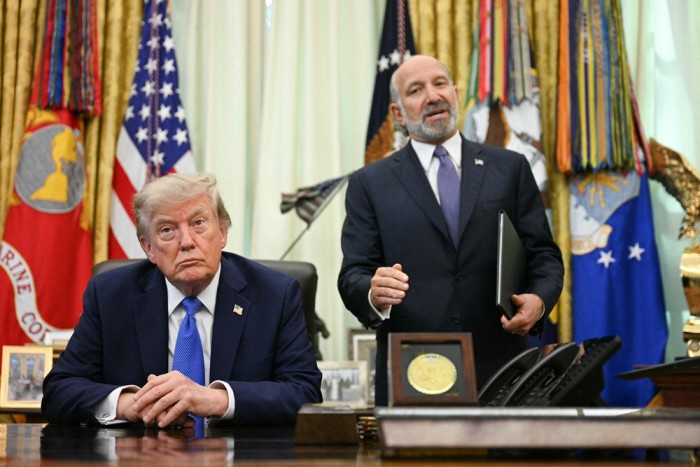 |
| U.S. President Donald Trump (left) listens to Commerce Secretary Howard Lutnick speak after signing an executive order on polysilicon imports at the Oval Office in Washington, D.C. on the 6th (local time). / AFP-Yonhap |
U.S. President Donald Trump announced on the 6th (local time) that he will impose a 15% tariff and set a price floor on polysilicon, a key material used in semiconductors and solar panels.
Trump signed a proclamation at the White House in Washington, D.C. that day imposing a 15% tariff on imports of solar energy-related materials and equipment, the Wall Street Journal and other outlets reported.
The measure will take effect on December 4, and companies that commit to building manufacturing facilities in the U.S. can apply for a tariff exemption.
The order also sets a price floor for solar components, banning the import of products priced below a certain threshold.
The minimum import prices are set at $21 per kg (about 30,000 won) for polysilicon, $100 per kg (about 140,000 won) for solar ingots and wafers, 22 cents per watt (about 300 won) for solar cells, and 38 cents per watt (about 500 won) for solar modules.
As a result, companies importing and reselling polysilicon and solar components must certify that resale prices do not fall below these minimums.
This measure is designed to prevent companies from declaring a higher price when filing import paperwork, then selling the product at a lower actual price to undermine the effect of the tariff.
At the signing ceremony, Commerce Secretary Howard Lutnick said the measure would bring supply chains back to the U.S., explaining that the tariff is meant to set pricing and encourage domestic production so that China can no longer dump cheap products on the market.
Semiconductors themselves are not included in this round of tariffs. The Commerce Department has already announced separate tariff measures on certain semiconductors under a Section 232 trade investigation.
The Commerce Department has been investigating since July of last year whether imports of polysilicon and related products pose a threat to national security, and what level of tariff could reduce that vulnerability.
U.S. solar and semiconductor manufacturers have argued that a flood of cheap Chinese products has hurt domestic factories, and have called for tariffs to address the issue.
Chinese products have reportedly been routed through third countries to avoid existing tariffs on China. Some U.S. companies welcomed the new tariff measure.
Kim Hyun-min
Most Read
-
1
Celltrion’s Omlyclo gains ground in major European..

-
2
Trump demands rates fall below 1% as Fed hikes for..

-
3
Trump makes $1 trillion bet ahead of midterm elect..

-
4
Iran resumes ballistic missile production, assembl..

-
5
Samsung Electronics, Mistral AI to jointly develop..

-
6
Trump warns countries not helping U.S. must pay re..

-
7
Apple launches first foldable, 1 million won prici..

PEOPLE






HEADLINE NEWS
- Trump to roll out ‘unprecedented welcome’ for Xi with B-2 bombers, F-22 fighters
- S. Korea, U.S., and Japan form united front on Taiwan and economic coercion..
- Trump administration moves to impose sweeping sanctions on International Cr..
- Xi to make state visit to U.S. Sept. 23-25, dispelling rumors over his heal..

-
Address : In-Young Bldg., 34, Uisadang-daero 1-gil, Yeongdeungpo-gu, Seoul
Copyright by ASIATODAY CO., LTD. All rights resereved