



Foreign reserves rise for 2nd straight month on FX bond issuance
Aug 05, 2026, 10:05 am


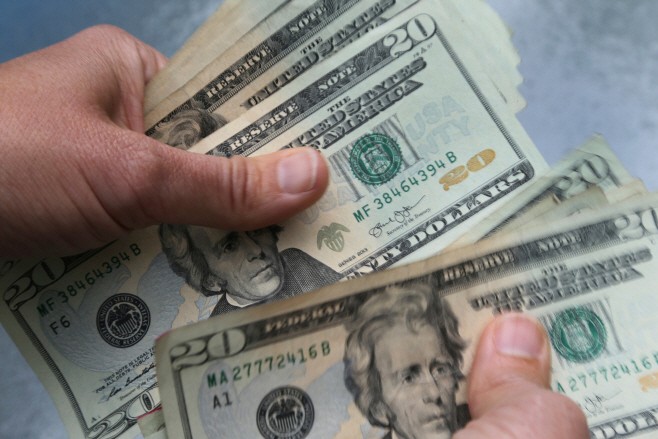 |
| U.S. dollar bills. (AP) |
Korea's foreign exchange reserves rose for a second straight month to $427.95 billion (about 612.18 trillion won). Despite a drag from the currency swap with the National Pension Service, this was offset by proceeds from newly issued foreign currency-denominated Foreign Exchange Equalization Fund Bonds, investment returns on foreign currency assets, and an increase in the dollar-converted value of assets held in other currencies amid a weaker dollar. As reserves declined in some countries, including Singapore and Italy, Korea's global ranking climbed three spots, from 13th to 10th, in a single month.
According to the Bank of Korea's "End-of-July Foreign Exchange Reserves" report released on the 5th, Korea's foreign exchange reserves stood at $427.95 billion at the end of last month, up $590 million from the previous month. This marks a second consecutive month of growth, following a $370 million increase in June.
The BOK explained that despite the currency swap with the National Pension Service, overall reserves grew due to proceeds from newly issued foreign currency-denominated Foreign Exchange Equalization Fund Bonds, investment income on foreign currency assets, and an increase in the dollar-converted value of assets denominated in other currencies. These bonds are issued by the government to stabilize the foreign exchange market and raise foreign currency funds; proceeds raised by issuing bonds in foreign currencies such as dollars or euros are added to foreign exchange reserves.
The dollar's weakness against major currencies last month also contributed to the increase in converted value. The dollar index, which tracks the dollar's value against six major currencies, fell 1.2%, from 101.11 at the end of June to 99.86 at the end of July. A reading above 100 indicates dollar strength, while a reading below 100 indicates weakness.
Over the same period, the euro appreciated 0.9% against the dollar, the British pound 1.5%, the Japanese yen 1.4%, and the Australian dollar 2.0% — meaning the dollar value of reserves held in currencies other than the dollar rose correspondingly.
By asset type, deposits led the overall increase, rising $860 million from the previous month to $23.13 billion. Special Drawing Rights (SDRs) from the International Monetary Fund and Korea's IMF reserve position rose $60 million and $10 million, respectively, to $15.7 billion and $4.32 billion. In contrast, securities such as government bonds, government agency bonds, and corporate bonds fell $340 million from the previous month to $380.01 billion. Gold holdings remained unchanged at $4.79 billion on a book-value basis.
By composition, securities accounted for the largest share of reserves at 88.8%, followed by deposits at 5.4%, SDRs at 3.7%, gold at 1.1%, and the IMF reserve position at 1.0%.
Korea's global ranking rose sharply. As of the end of May, Korea's foreign exchange reserves stood at $427 billion, ranking 13th in the world, but by the end of June, reserves rose to $427.4 billion, moving Korea up to 10th. This was largely driven by declines in reserves in France, Singapore, and Italy, all of which had ranked above Korea as of the end of May.
Singapore's reserves fell $3.9 billion from the previous month to $426.2 billion in June, dropping below Korea's total. Italy's reserves fell $39.6 billion to $412.6 billion, while France dropped out of the top 12 countries entirely by the end of June. This is attributed to a recent sharp drop in gold prices, with countries like Germany, Italy, and France seeing their reserves decline as they value gold holdings at current market prices rather than at the price paid at purchase.
As of the end of June, China held the world's largest foreign exchange reserves at $3.4163 trillion, followed by Japan at $1.2875 trillion and Switzerland at $1.0877 trillion. Russia, India, Taiwan, Germany, Saudi Arabia, and Hong Kong rounded out the fourth through ninth spots.
Han Sang-wook
Most Read
-
1
Celltrion’s Omlyclo gains ground in major European..

-
2
Trump demands rates fall below 1% as Fed hikes for..

-
3
Hyundai Motor Group breaks ground on integrated st..

-
4
U.S. strikes 3 Iranian oil tankers, Iran vows reta..

-
5
Trump makes $1 trillion bet ahead of midterm elect..

-
6
Iran resumes ballistic missile production, assembl..

-
7
Samsung Electronics, Mistral AI to jointly develop..

PEOPLE







-
Address : In-Young Bldg., 34, Uisadang-daero 1-gil, Yeongdeungpo-gu, Seoul
Copyright by ASIATODAY CO., LTD. All rights resereved