



Iran, Oman near agreement on joint management of Strait of Hormuz
Aug 04, 2026, 01:07 pm


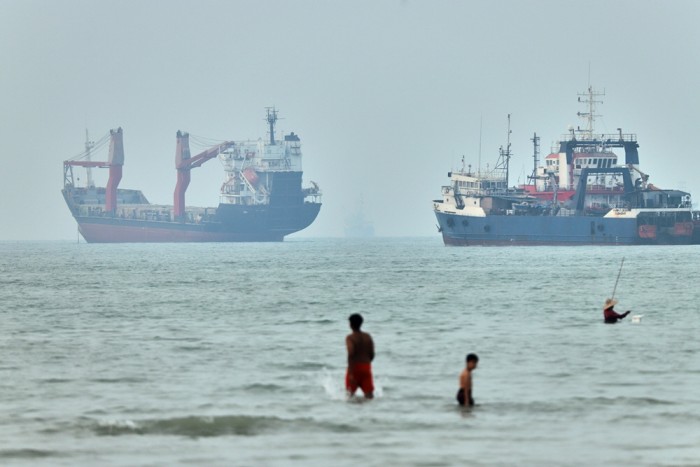 |
| Cargo ships anchor off Bandar Abbas, Iran, along the Strait of Hormuz, as residents spend their leisure time on the 30th of last month (local time). / AP-Yonhap |
Iran and Oman are approaching an agreement to jointly manage shipping routes through the Strait of Hormuz, the key maritime chokepoint in the Persian Gulf, the New York Times reported on the 3rd (local time), citing two Iranian officials.
Under the specifics of the proposed route management arrangement, vessels entering the Strait of Hormuz would follow waters controlled by Iran, while those exiting would follow waters controlled by Oman.
A service fee would be charged to vessels to cover environmental, security, and personnel costs, split evenly between the two countries.
Iran's Foreign Ministry spokesman Esmaeil Baghaei said that day that Iran and Oman have already exchanged route maps, describing this as a procedure to clarify vessel routes and saying it is focused on establishing a new corridor for vessels transiting the strait.
Baghaei added that the negotiations do not extend to broader issues, including relations with the U.S., saying there are currently no direct negotiations with the U.S., and that matters involving the U.S. would be addressed at a later stage.
The Strait of Hormuz has long operated under an internationally agreed Traffic Separation Scheme (TSS). To prevent ship collisions in the narrow waterway, one-way north-south lanes are designated, with most routes passing through Omani territorial waters.
However, as tensions in the Middle East have recently intensified, Iran has moved in earnest to restructure the existing navigation system.
The Strait of Hormuz is a passage for roughly 20% of the world's oil, so a new management system, if established, would be expected to have major ripple effects on international energy markets, the NYT noted.
Even if Iran and Oman reach an agreement, many obstacles remain in actually implementing such a system.
U.S. President Donald Trump has stressed that free navigation through the Strait of Hormuz is an international principle and has strongly opposed any plan to charge vessels fees or tolls.
Trump, who abruptly canceled a planned military strike on Iran over the weekend, explained the decision as one that took into account the possibility of reopening the strait and requests for restraint from regional allies such as Saudi Arabia.
Since the Strait of Hormuz is a critical route for international shipping and energy transport, growing expectations suggest that if the U.S. continues to oppose the plan, it will be difficult for an Iran-Oman agreement to actually become institutionalized within the international community.
Park Jin-sook
#Iran #Oman #Strait of Hormuz
Copyright by Asiatoday
Most Read
-
1
Celltrion’s Omlyclo gains ground in major European..

-
2
Trump demands rates fall below 1% as Fed hikes for..

-
3
Trump makes $1 trillion bet ahead of midterm elect..

-
4
Iran resumes ballistic missile production, assembl..

-
5
Samsung Electronics, Mistral AI to jointly develop..

-
6
Trump warns countries not helping U.S. must pay re..

-
7
Apple launches first foldable, 1 million won prici..

PEOPLE






HEADLINE NEWS
- Trump to roll out ‘unprecedented welcome’ for Xi with B-2 bombers, F-22 fighters
- S. Korea, U.S., and Japan form united front on Taiwan and economic coercion..
- Trump administration moves to impose sweeping sanctions on International Cr..
- Xi to make state visit to U.S. Sept. 23-25, dispelling rumors over his heal..

-
Address : In-Young Bldg., 34, Uisadang-daero 1-gil, Yeongdeungpo-gu, Seoul
Copyright by ASIATODAY CO., LTD. All rights resereved